. 2014 May 7;34(19):6573-82.
doi: 10.1523/JNEUROSCI.3507-13.2014.

Fear from the heart: sensitivity to fear stimuli depends on individual heartbeats

Affiliations

Fear from the heart: sensitivity to fear stimuli depends on individual heartbeats

Sarah N Garfinkel et al. J Neurosci. .

Abstract

Cognitions and emotions can be influenced by bodily physiology. Here, we investigated whether the processing of brief fear stimuli is selectively gated by their timing in relation to individual heartbeats. Emotional and neutral faces were presented to human volunteers at cardiac systole, when ejection of blood from the heart causes arterial baroreceptors to signal centrally the strength and timing of each heartbeat, and at diastole, the period between heartbeats when baroreceptors are quiescent. Participants performed behavioral and neuroimaging tasks to determine whether these interoceptive signals influence the detection of emotional stimuli at the threshold of conscious awareness and alter judgments of emotionality of fearful and neutral faces. Our results show that fearful faces were detected more easily and were rated as more intense at systole than at diastole. Correspondingly, amygdala responses were greater to fearful faces presented at systole relative to diastole. These novel findings highlight a major channel by which short-term interoceptive fluctuations enhance perceptual and evaluative processes specifically related to the processing of fear and threat and counter the view that baroreceptor afferent signaling is always inhibitory to sensory perception.

Keywords: amygdala; anxiety; attention; baroreceptor; emotion; fMRI.


Figures
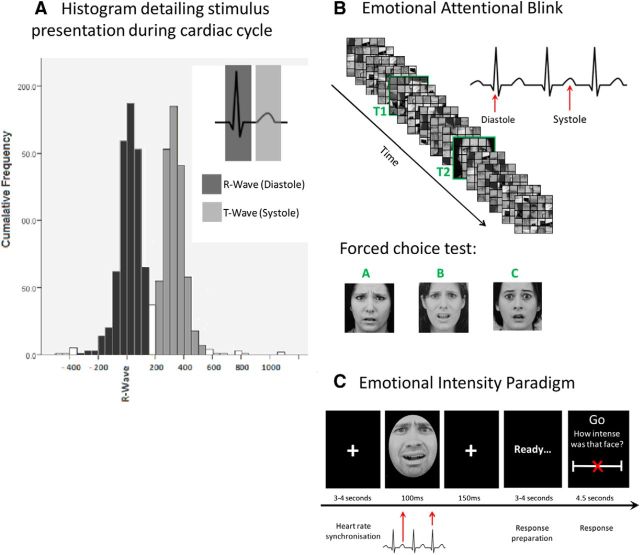
Figure 1.
Figure 1.
A, Histogram detailing fear and neutral face presentation in relation to cardiac cycle within the MRI scanner. For Experiments 1 and 2, stimulus presentation was time locked to coincide with distinct points of the cardiac cycle. B, For Experiment 1, participants were required to detect two targets (T1 and T2, outlined in green for illustrative purposes in this diagram only) embedded within an RSVP. T2 (face) detection served as the variable of interest, as determined by a subsequent forced-choice recognition test. C, For Experiment 2, face presentation (fear and neutral) were time locked to diastole and systole. Participants made subsequent trial-by-trial emotion intensity judgments using a VAS.
Figure 2.
Figure 2.
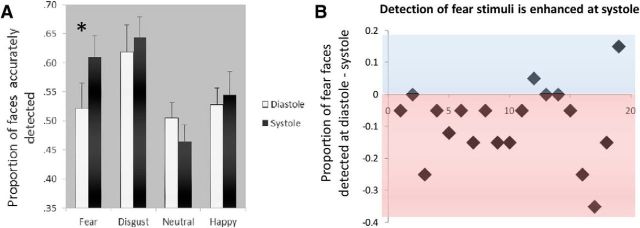
We tested the hypothesis that the cardiac cycle influences the processing of emotional stimuli using an RSVP task to present emotional and neutral stimuli periliminally (i.e., subceiling for detection). We extend the established findings that emotional stimuli are detected (i.e., “break through to awareness”) more than neutral stimuli by showing that, for fear faces only, this effect is modulated by the cardiac cycle, with enhanced detection of fear faces observed at systole relative to diastole. All other emotions (happy, neutral, disgust) were not significantly affected by cardiac cycle (A). Cardiac modulation of fear detection is documented at the subject level to illustrate individual shifts in fear face detection (each separate subject is represented as a diamond). The y-axis represents the percentage of fear faces detected at diastole − systole. The majority of participants were more likely to correctly identify fear faces at systole relative to diastole, as marked by a negative shift (B).
Figure 3.
Figure 3.
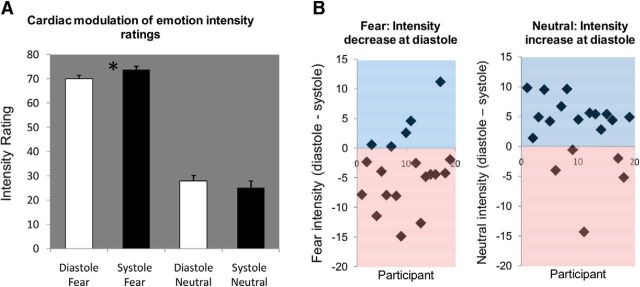
Graph depicting the interaction between cardiac timing and emotion intensity, with an increase in perceived subjective intensity of fear faces at systole and a (nonsignificant) tendency for neutral faces to be perceived as more intense at diastole (A). Cardiac modulation of fear intensity documented on the subject level to illustrate individual shifts in perceived fear intensity (each separate subject is represented as a diamond). The y-axis represents fear intensity ratings for faces at diastole − systole. The majority of participants were more likely to rate fear faces as more intense if seen at systole relative to diastole, as marked by a negative shift (B).
Figure 4.
Figure 4.
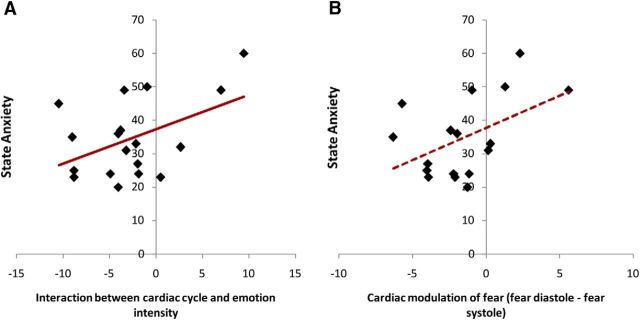
The interaction between cardiac cycle and emotion correlated significantly with state anxiety (A). This was largely driven by cardiac modulation of fear (diastole − systole), which displayed a trend relationship with state anxiety (B). Therefore, the relative inhibition of threat processing at diastole was aberrant with anxiety, suggesting a potential mechanism contributing to sustained overreactivity to fear signal and threat in anxiety.
Figure 5.
Figure 5.
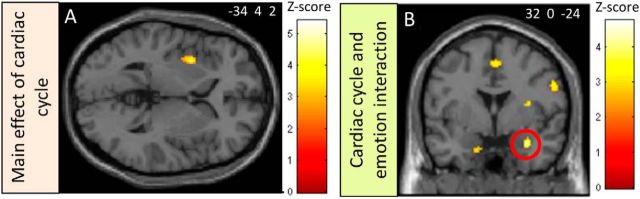
Main effect of cardiac cycle on emotion processing, documenting increased activity in left anterior insula (−34, 4, 2) for faces at systole > diastole (A). Brain activity illustrating the interaction of cardiac timing on emotion processing (fear systole > neutral systole vs fear diastole > neutral diastole). Notably, significant activation was observed in bilateral amygdala, with activity in right amygdala meeting FWE correction (circled). See Table 2 for a complete listing of activity during interaction (B).
Figure 6.
Figure 6.
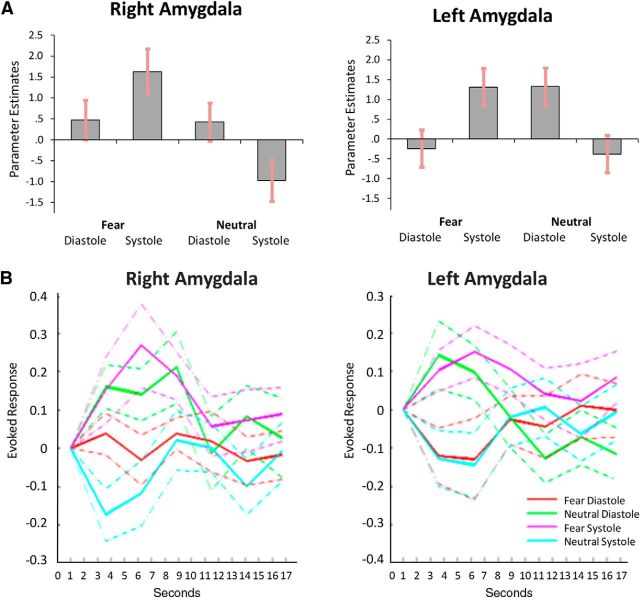
Patterns of bilateral amygdala activity correspond to emotion specific cardiac shifts in intensity, with increases for fear stimuli at systole and increases for neutral faces at diastole. Parameter estimates extracted from peak voxels in right (32, 0, −24) and left (−16, 0, −28) amygdala as defined by the interaction (fear systole > neutral systole vs fear diastole > neutral diastole; A). PSTH plots were computed using an anatomical ROI of bilateral amygdala to derive peak activity. Stimulus onset was set to time 0 and PSC over time was plotted in multiples of TR (2.62 s) separately for fear faces at diastole, neutral faces at diastole, fear faces at systole, and neutral faces at systole (B).

References

    1. Anderson AK, Phelps EA. Lesions of the human amygdala impair enhanced perception of emotionally salient events. Nature. 2001;411:305–309. doi: 10.1038/35077083. - DOI - PubMed
    1. Bechara A, Damasio H, Damasio AR. Emotion, decision making and the orbitofrontal cortex. Cereb Cortex. 2000;10:295–307. doi: 10.1093/cercor/10.3.295. - DOI - PubMed
    1. Bradley BP, Mogg K, Falla SJ, Hamilton LR. Attentional bias for threatening facial expressions in anxiety: manipulation of stimulus duration. Cognition and Emotion. 1998;12:737–753. doi: 10.1080/026999398379411. - DOI
    1. Cahill L, McGaugh JL. Mechanisms of emotional arousal and lasting declarative memory. Trends Neurosci. 1998;21:294–299. doi: 10.1016/S0166-2236(97)01214-9. - DOI - PubMed
    1. Critchley HD, Mathias CJ, Dolan RJ. Fear conditioning in humans: the influence of awareness and autonomic arousal on functional neuroanatomy. Neuron. 2002a;33:653–663. doi: 10.1016/S0896-6273(02)00588-3. - DOI - PubMed

Publication types

MeSH terms