. 2014 May 6;106(9):2037-48.
doi: 10.1016/j.bpj.2014.03.015.

Variable cell morphology approach for individual-based modeling of microbial communities

Affiliations

Variable cell morphology approach for individual-based modeling of microbial communities

Tomas Storck et al. Biophys J. .

Abstract

An individual-based, mass-spring modeling framework has been developed to investigate the effect of cell properties on the structure of biofilms and microbial aggregates through Lagrangian modeling. Key features that distinguish this model are variable cell morphology described by a collection of particles connected by springs and a mechanical representation of deformable intracellular, intercellular, and cell-substratum links. A first case study describes the colony formation of a rod-shaped species on a planar substratum. This case shows the importance of mechanical interactions in a community of growing and dividing rod-shaped cells (i.e., bacilli). Cell-substratum links promote formation of mounds as opposed to single-layer biofilms, whereas filial links affect the roundness of the biofilm. A second case study describes the formation of flocs and development of external filaments in a mixed-culture activated sludge community. It is shown by modeling that distinct cell-cell links, microbial morphology, and growth kinetics can lead to excessive filamentous proliferation and interfloc bridging, possible causes for detrimental sludge bulking. This methodology has been extended to more advanced microbial morphologies such as filament branching and proves to be a very powerful tool in determining how fundamental controlling mechanisms determine diverse microbial colony architectures.


Figures

Figure 1
Figure 1
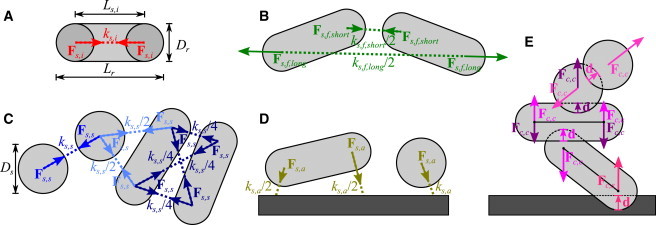
Forces acting on the mass particles. (A) Internal spring forces, Fs,i, in rod-shaped cells. (B) Short and long filial spring forces, Fs,f, in rod-shaped cells. (C) Sticking spring forces, Fs,s, using four springs between rod-shaped cells, two springs between a rod-shaped and a spherical cell, and one spring between spherical cells. (D) Anchoring forces, Fs,a. (E) Collision response forces between rod-shaped cells, spherical cells, and rod-shaped and spherical cells, Fc,c, and between cell and substratum, Fc,s. In addition to the forces shown in the figure, drag acts on all particles opposing the direction of movement. Force vectors are added to a resultant force vector for each mass particle. Spring constants (ks) are scaled for the number of springs in that link. To see this figure in color, go online.
Figure 2
Figure 2
Colony development for a pure culture of rod-shaped cells on a planar substratum (top and lateral views) after 4.67 h, with no anchoring and no filial links (A), with cell-substratum anchoring (B), and with filial links only (C). Colors denote the first four cell generations: red, yellow, blue, and green, respectively. Animations of these simulations are presented in Movies S1–S3 in the Supporting Material. To see this figure in color, go online.
Figure 3
Figure 3
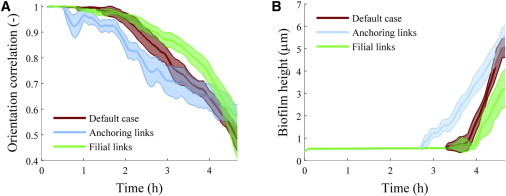
(A) Orientation correlation coefficient. (B) Biofilm thickness, for simulated colonies of rod-shaped cells growing on a planar substratum. The shaded regions represent the 95% confidence interval for the mean, based on 10 simulations (two-tailed t-test). To see this figure in color, go online.
Figure 4
Figure 4
Simulated activated sludge floc structures made of floc-former (gray) and filament-former (red) rod-shaped cells, showing the effect of different types of intercellular links. (A) Initial state for all simulated flocs. (B) The standard case (low O2 concentration (ls,f,shor t = 0.5, ls,f,long= 1.7), and ds,break = 1 μm). (C) Increased relative floc-former growth rate (high O2 concentration parameter set from Table 1). (D and E) Different filament stiffness is generated by changing (ls,f,short, ls,f,long) to (0.1, 2.1) for stiff filaments (D) and (0.9, 1.3) for flexible filaments. (E). (F and G) Sticking-link strength is adjusted by changing ds,break to 5 μm for strong sticking (F) and 0.2 μm for weak sticking (G). States A, B, and D–G are shown after 16.80 h (369 cells), and state C after 7.67 h (362 cells). Animations of aggregate development for all simulations can be seen in Movies S4–S9. To see this figure in color, go online.
Figure 5
Figure 5
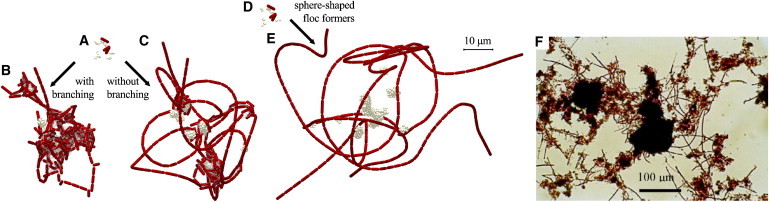
Simulated activated sludge floc structures showing the effects of filament branching and spherical floc formers. (A) Initial state for a rod-shaped floc former. (B and C) Rod-shaped floc former with 30% filament branching (B) and in a strictly straight (nonbranching) configuration. (D) Initial state for spherical floc former. (E) Spherical floc former. (F) Interfloc bridging observed in a Gram-stained visible light micrograph (from Xie et al. (57)). Simulation results are shown after 19.65 h. Animations of aggregate development resulting in structures B, C, and E can be viewed in Movies S10, S4, and S11, respectively. To see this figure in color, go online.

References

    1. Wanner O., Gujer W. A multispecies biofilm model. Biotechnol. Bioeng. 1986;28:314–328. - PubMed
    1. Alpkvist E., Klapper I. A multidimensional multispecies continuum model for heterogeneous biofilm development. Bull. Math. Biol. 2007;69:765–789. - PubMed
    1. Merkey B.V., Rittmann B.E., Chopp D.L. Modeling how soluble microbial products (SMP) support heterotrophic bacteria in autotroph-based biofilms. J. Theor. Biol. 2009;259:670–683. - PubMed
    1. Kreft J.-U., Picioreanu C., van Loosdrecht M.C.M. Individual-based modelling of biofilms. Microbiology. 2001;147:2897–2912. - PubMed
    1. Lardon L.A., Merkey B.V., Smets B.F. iDynoMiCS: next-generation individual-based modelling of biofilms. Environ. Microbiol. 2011;13:2416–2434. - PubMed

Publication types

LinkOut - more resources