


Validity and reliability of the robotic Objective Structured Assessment of Technical Skills
- PMID: 24807319
- PMCID: PMC4352540
- DOI: 10.1097/AOG.0000000000000288
Validity and reliability of the robotic Objective Structured Assessment of Technical Skills
Abstract
Objective: Objective Structured Assessments of Technical Skills have been developed to measure the skill of surgical trainees. Our aim was to develop an Objective Structured Assessments of Technical Skills specifically for trainees learning robotic surgery.
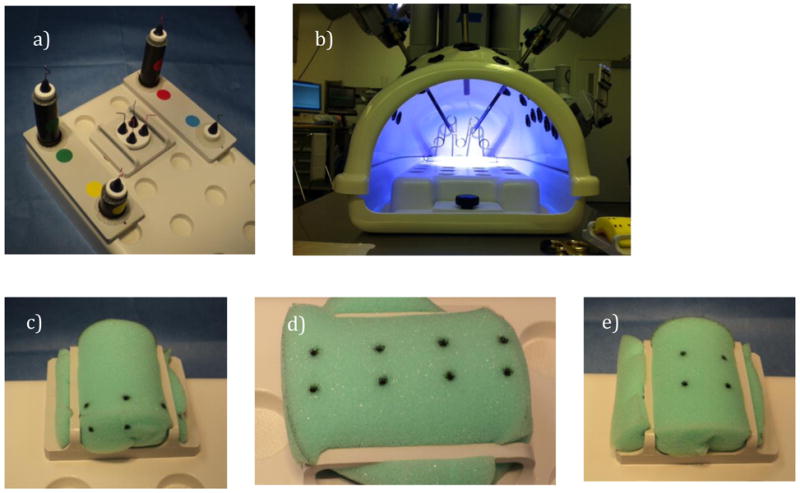
Methods: This is a multiinstitutional study conducted in eight academic training programs. We created an assessment form to evaluate robotic surgical skill through five inanimate exercises. Gynecology, general surgery, and urology residents, Fellows, and faculty completed five robotic exercises on a standard training model. Study sessions were recorded and randomly assigned to three blinded judges who scored performance using the assessment form. Construct validity was evaluated by comparing scores between participants with different levels of surgical experience; interrater and intrarater reliability were also assessed.
Results: We evaluated 83 residents, nine Fellows, and 13 faculty totaling 105 participants; 88 (84%) were from gynecology. Our assessment form demonstrated construct validity with faculty and Fellows performing significantly better than residents (mean scores 89±8 faculty, 74±17 Fellows, 59±22 residents; P<.01). In addition, participants with more robotic console experience scored significantly higher than those with fewer prior console surgeries (P<.01). Robotic Objective Structured Assessments of Technical Skills demonstrated good interrater reliability across all five drills (mean Cronbach's α 0.79±0.02). Intrarater reliability was also high (mean Spearman's correlation 0.91±0.11).
Conclusion: We developed a valid and reliable assessment form for robotic surgical skill. When paired with standardized robotic skill drills, this form may be useful to distinguish between levels of trainee performance.
Level of evidence: II.
Figures
Comment in
-
Validity and reliability of the robotic objective structured assessment of technical skills.Obstet Gynecol. 2014 Oct;124(4):839. doi: 10.1097/AOG.0000000000000499. Obstet Gynecol. 2014. PMID: 25244450 No abstract available.
-
In reply.Obstet Gynecol. 2014 Oct;124(4):839. doi: 10.1097/AOG.0000000000000488. Obstet Gynecol. 2014. PMID: 25244451 No abstract available.
References
-
- Lenihan JP, Jr, Kovanda C, Seshadri-Kreaden U. What is the learning curve for robotic assisted gynecologic surgery? Journal of minimally invasive gynecology. 2008 Sep-Oct;15(5):589–94. - PubMed
-
- Woelk JL, Casiano ER, Weaver AL, Gostout BS, Trabuco EC, Gebhart JB. The learning curve of robotic hysterectomy. Obstetrics and gynecology. 2013 Jan;121(1):87–95. - PubMed
-
- Martin JA, Regehr G, Reznick R, MacRae H, Murnaghan J, Hutchison C, et al. Objective structured assessment of technical skill (OSATS) for surgical residents. The British journal of surgery. 1997 Feb;84(2):273–8. - PubMed
-
- Reznick R, Regehr G, MacRae H, Martin J, McCulloch W. Testing technical skill via an innovative “bench station” examination. The American Journal of Surgery. 1997;173(3):226–30. - PubMed
-
- Buerkle B, Rueter K, Hefler LA, Tempfer-Bentz EK, Tempfer CB. Objective Structured Assessment of Technical Skills (OSATS) evaluation of theoretical versus hands-on training of vaginal breech delivery management: a randomized trial. European journal of obstetrics, gynecology, and reproductive biology. 2013 Sep 25; - PubMed
Publication types
MeSH terms
Grants and funding
LinkOut - more resources
Full Text Sources
Other Literature Sources
