. 2014 Apr 28:8:124.
doi: 10.3389/fnbeh.2014.00124. eCollection 2014.

Contingency-based emotional resilience: effort-based reward training and flexible coping lead to adaptive responses to uncertainty in male rats

Affiliations

Contingency-based emotional resilience: effort-based reward training and flexible coping lead to adaptive responses to uncertainty in male rats

Kelly G Lambert et al. Front Behav Neurosci. .

Abstract

Emotional resilience enhances an animal's ability to maintain physiological allostasis and adaptive responses in the midst of challenges ranging from cognitive uncertainty to chronic stress. In the current study, neurobiological factors related to strategic responses to uncertainty produced by prediction errors were investigated by initially profiling male rats as passive, active or flexible copers (n = 12 each group) and assigning to either a contingency-trained or non-contingency trained group. Animals were subsequently trained in a spatial learning task so that problem solving strategies in the final probe task, as well-various biomarkers of brain activation and plasticity in brain areas associated with cognition and emotional regulation, could be assessed. Additionally, fecal samples were collected to further determine markers of stress responsivity and emotional resilience. Results indicated that contingency-trained rats exhibited more adaptive responses in the probe trial (e.g., fewer interrupted grooming sequences and more targeted search strategies) than the noncontingent-trained rats; additionally, increased DHEA/CORT ratios were observed in the contingent-trained animals. Diminished activation of the habenula (i.e., fos-immunoreactivity) was correlated with resilience factors such as increased levels of DHEA metabolites during cognitive training. Of the three coping profiles, flexible copers exhibited enhanced neuroplasticity (i.e., increased dentate gyrus doublecortin-immunoreactivity) compared to the more consistently responding active and passive copers. Thus, in the current study, contingency training via effort-based reward (EBR) training, enhanced by a flexible coping style, provided neurobiological resilience and adaptive responses to prediction errors in the final probe trial. These findings have implications for psychiatric illnesses that are influenced by altered stress responses and decision-making abilities (e.g., depression).

Keywords: DHEA; contingency training; coping profiles; neuroplasticity markers; prediction errors; resilience; uncertainty.


Figures

Figure 1
Figure 1
Timeline for behavioral procedures utilized in the current study. Animals arrived in the laboratory at approximately 23 days of age then were exposed to the sequence of events in this timeline.
Figure 2
Figure 2
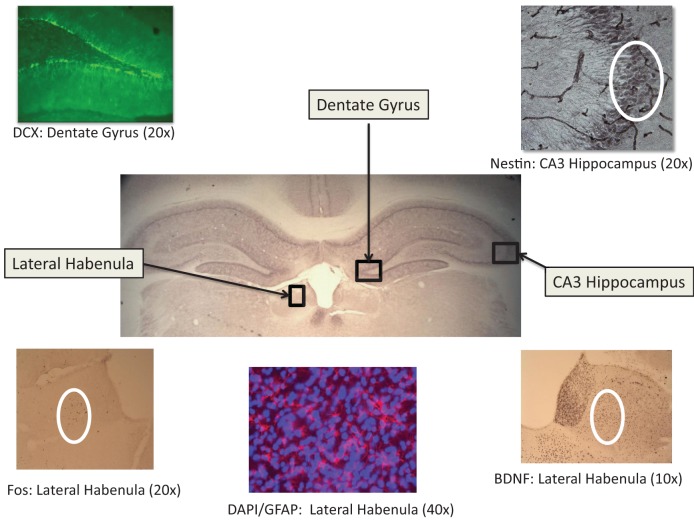
Representative photomicrographs of relevant immunoreactive tissue in the lateral habenula and hippocampus (dentate gyrus and CA3 area. See Results for statistical findings for each area.
Figure 3
Figure 3
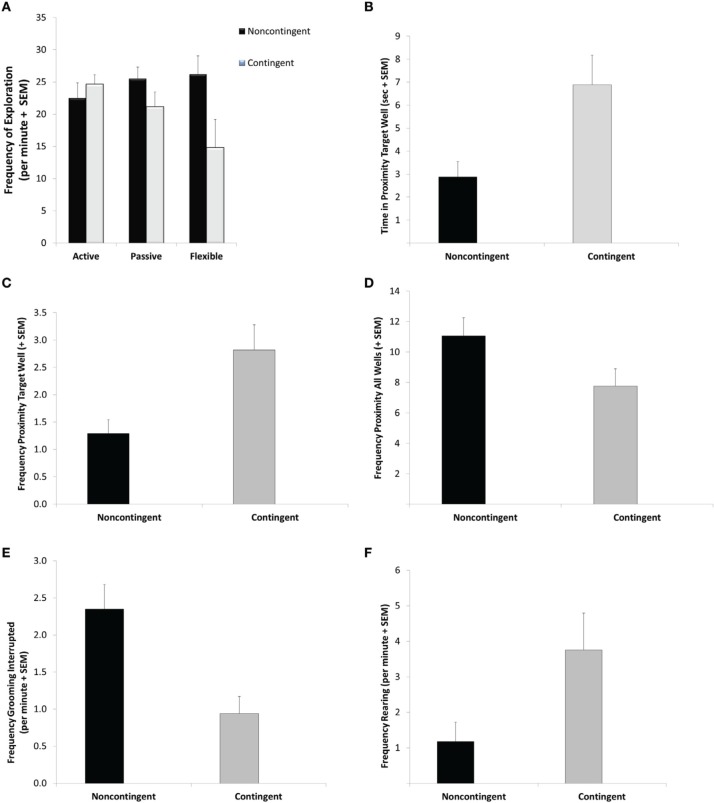
Probe trial behavior. During the 5-min probe trial flexible contingent animals engaged in less exploratory behavior (A) further contingent animals spent more time in proximity to the previously baited well (B) visited the previously baited well more frequently (C) visited the non-baited wells less frequently (D) exhibited fewer interrupted grooming sequences (E) and more rearing responses (F) than their noncontingent counterparts. See Results for specific statistical outcomes.
Figure 4
Figure 4
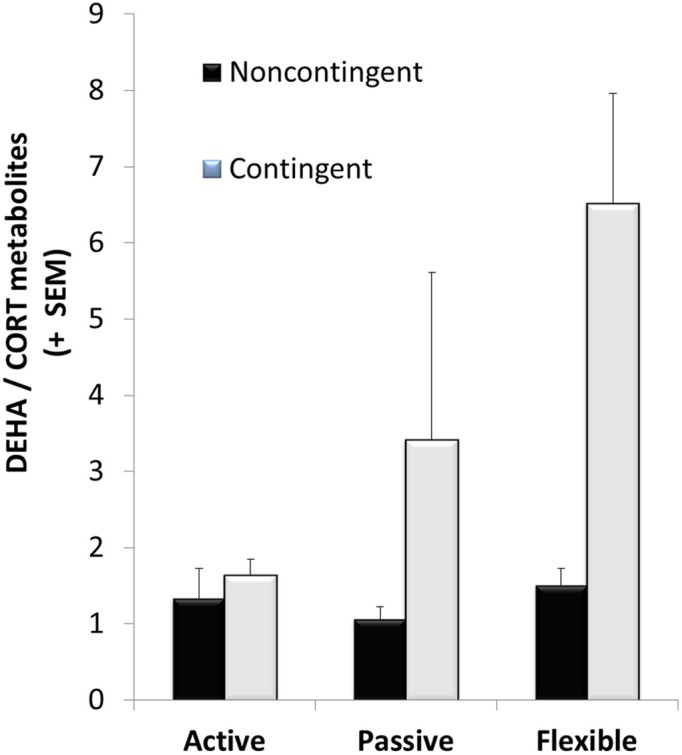
DHEA/CORT metabolite ratios were differentially affected after the acquisition trial in the dry land maze; although there was high variability in the varying coping groups, only a significant main effect for contingency training was observed (with mean values of 3.69 ± 1.11 and 1.29 ± 0.16 for the contingent and noncontingent groups, respectively). Although no significant interaction effect was observed, planned comparisons between contingent and noncontingent groups for each coping style revealed a significant training effect in the flexible coping group.
Figure 5
Figure 5
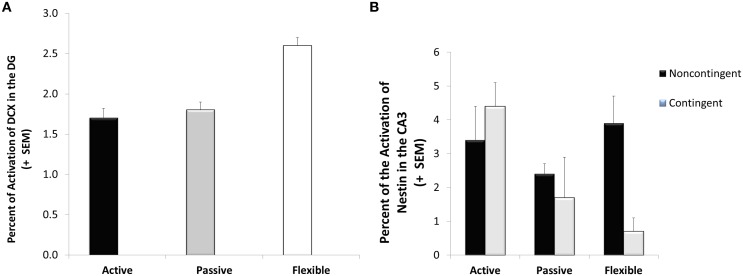
Neuroplasticity markers. Doublecortin-immunoreactive tissue was higher in the flexible coping animals than their active and passive counterparts (A) whereas a significant interaction was observed in the Nestin-immunoreactive tissue (B); specifically, lower levels were observed in the flexible contingent trained animals than in the flexible noncontingent animals, an effect not observed in the active and passive coping groups.
Figure 6
Figure 6
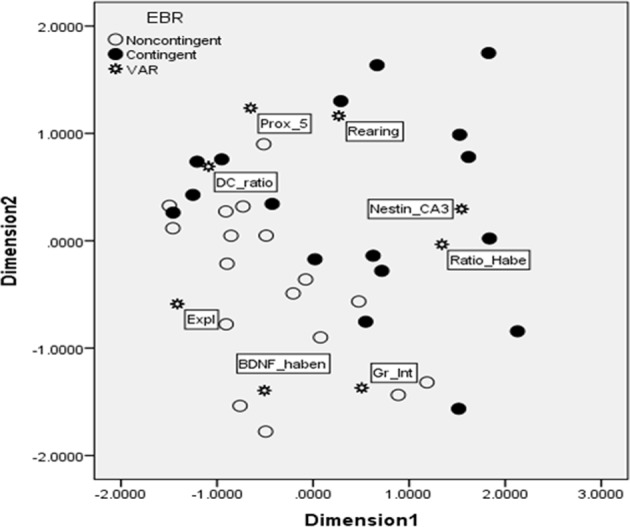
Multidimensional scaling map exhibiting proximity of key variables for the contingent and noncontingent animals during the DLM probe trial. As indicated in Results, the stress value for MDS was 0.101, and R2 = 0.956, thus indicating that the map was accurate and able to explain most of the variability. Two major clusters were clearly identified by the MDS, separated in the figure by a line. The lower quadrants represent noncontingent animals that displayed higher BDNF in the habenula (BDNF_haben), together with higher level of grooming interrupted (Gr_Int), and explorative behavior (Expl). The second group, in the upper quadrants, was characterized by contingent animals displaying higher neuron to glial cells ratio in the habenula (Ratio_Habe), lower nestin activation in the CA3 contingent flexible animals (Nestin_CA3), a higher DHEA/CORT ratio (DC_ratio), more time spent in proximity of the previously baited well #5 (Prox_5), and rearing (Rearing).

References

    1. Abramson L. Y., Seligman M. E. P., Teasdale J. D. (1978). Learned helplessness in humans: critique and reformation. J. Abnorm. Psychol. 87, 49–74 10.1037/0021-843X.87.1.49 - DOI - PubMed
    1. Alexander W. H., Brown J. W. (2011). Medial prefrontal cortex as an action-outcome predictor. Nat. Neurosci. 14, 1338–1344 10.1038/nn.2921 - DOI - PMC - PubMed
    1. Bardi M., Franssen C. L., Hampton J. E., Shea E. A., Fanean A. P., Lambert K. G. (2011). Paternal experience and stress responses in the California mouse (Peromyscus californicus). Comp. Med. 60, 20–23 - PMC - PubMed
    1. Bardi M., Rhone A. P., Franssen C. L., Hampton J. E., Shea E. A., Hyer M. M., et al. (2012). Behavioral training and predisposed coping strategies interact to influence resilience inmale Long-Evans rats: implications for depression. Stress 15, 306–317 - PubMed
    1. Bardi M., True M., Franssen C. L., Kaufman C., Rzucidlo A., Lambert K. G. (2013). Effort-based reward (EBR) training enhances neurobiological efficiency in a problem-solving task: insights for depression therapies. Brain Res. 1490, 101–110 10.1016/j.brainres.2012.10.027 - DOI - PubMed

LinkOut - more resources