. 2014 May 8;10(5):e1004363.
doi: 10.1371/journal.pgen.1004363. eCollection 2014 May.

Predicting the minimal translation apparatus: lessons from the reductive evolution of mollicutes

Affiliations

Predicting the minimal translation apparatus: lessons from the reductive evolution of mollicutes

Henri Grosjean et al. PLoS Genet. .

Abstract

Mollicutes is a class of parasitic bacteria that have evolved from a common Firmicutes ancestor mostly by massive genome reduction. With genomes under 1 Mbp in size, most Mollicutes species retain the capacity to replicate and grow autonomously. The major goal of this work was to identify the minimal set of proteins that can sustain ribosome biogenesis and translation of the genetic code in these bacteria. Using the experimentally validated genes from the model bacteria Escherichia coli and Bacillus subtilis as input, genes encoding proteins of the core translation machinery were predicted in 39 distinct Mollicutes species, 33 of which are culturable. The set of 260 input genes encodes proteins involved in ribosome biogenesis, tRNA maturation and aminoacylation, as well as proteins cofactors required for mRNA translation and RNA decay. A core set of 104 of these proteins is found in all species analyzed. Genes encoding proteins involved in post-translational modifications of ribosomal proteins and translation cofactors, post-transcriptional modifications of t+rRNA, in ribosome assembly and RNA degradation are the most frequently lost. As expected, genes coding for aminoacyl-tRNA synthetases, ribosomal proteins and initiation, elongation and termination factors are the most persistent (i.e. conserved in a majority of genomes). Enzymes introducing nucleotides modifications in the anticodon loop of tRNA, in helix 44 of 16S rRNA and in helices 69 and 80 of 23S rRNA, all essential for decoding and facilitating peptidyl transfer, are maintained in all species. Reconstruction of genome evolution in Mollicutes revealed that, beside many gene losses, occasional gains by horizontal gene transfer also occurred. This analysis not only showed that slightly different solutions for preserving a functional, albeit minimal, protein synthetizing machinery have emerged in these successive rounds of reductive evolution but also has broad implications in guiding the reconstruction of a minimal cell by synthetic biology approaches.


Conflict of interest statement

The authors have declared that no competing interests exist.

Figures
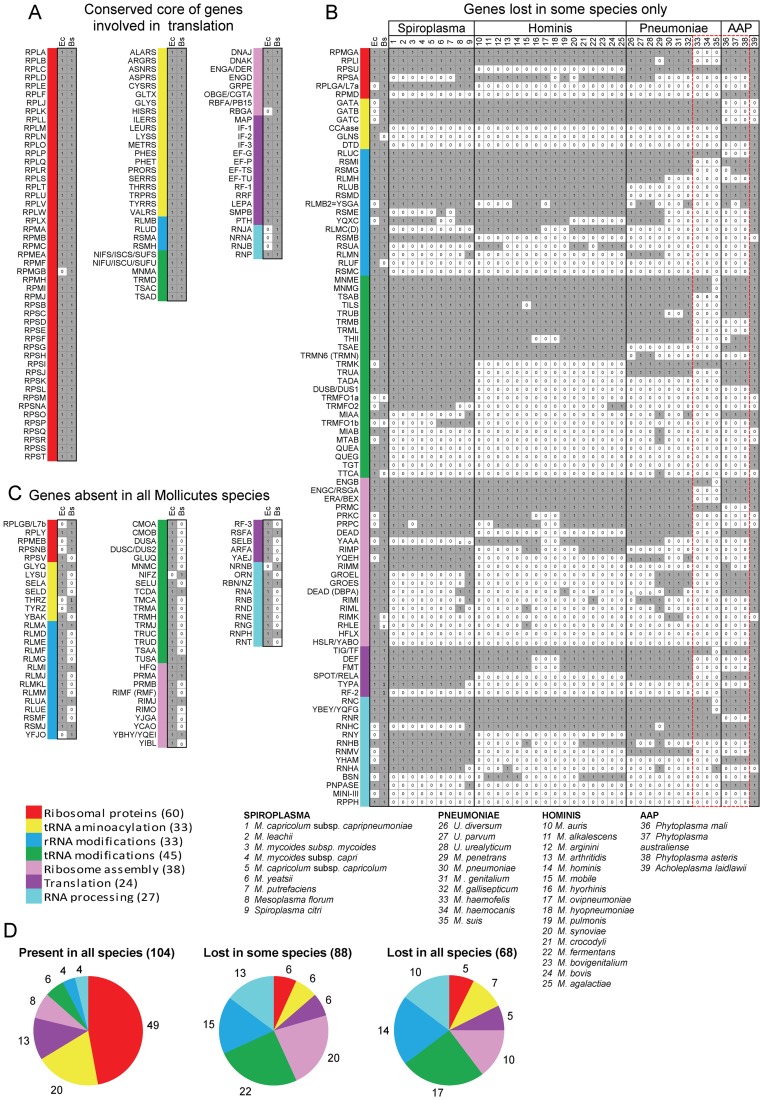
Figure 1
Figure 1. Genes coding for proteins implicated in translation in Mollicutes.
Using queries from E. coli (Ec) and from B. subtilis (Bs), the presence of homologous proteins was searched in 39 Mollicutes genomes (see list of selected species below part B of the figure). This figure corresponds to the raw data given in Table S3. The results were grouped into three panels: conserved core of genes involved in translation (A), genes lost in some species only (B) and genes absent in all Mollicutes species (C). In panels A and C, only data concerning Ec and Bs are shown. In part B, the selected species clustered according to the 4 phylogenetic groups; Spiroplasma, Hominis, Pneumoniae and AAP . The queries, of which names of corresponding acronyms are given in Table S2, are ordered from top to bottom, first according to the highest number of occurences and second according to the 7 protein categories following this sequence: ribosomal proteins, tRNA aminoacylation, rRNA modifications, tRNA modifications, ribosome assembly, translation and RNA processing. The different categories are color coded as shown in Table 1 and below part C of the figure. The presence or absence of a given gene in a Mollicutes species is indicated by “1” in a grey background or by “0” in a white background, respectively. The 17 genes missing in some of the non-cultivated Mollicutes are indicated within a dashed-red box. The total number of genes in each category is indicated in panel D.
Figure 2
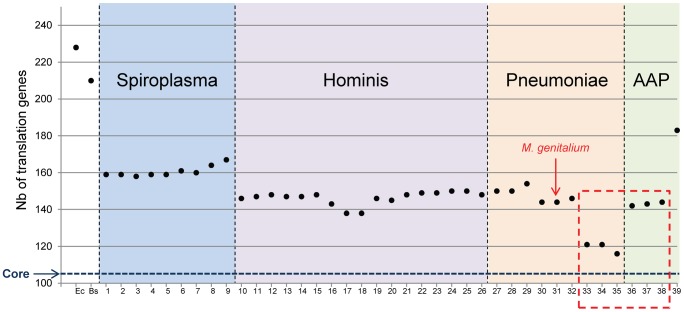
Figure 2. Total number of proteins involved in translation for each Mollicutes species.
The number of proteins involved in translation for each Mollicutes species was tabulated in reference to the number found for the two model bacteria E. coli (Ec) and B. subtilis (Bs). The numbering of species is the same as in Figure 1. The data corresponding to non-cultivated Mollicutes are framed with a red dashed line as in Figure 1. The horizontal blue dashed line indicates 104, which correspond to the core of translation proteins shared by all Mollicutes.
Figure 3
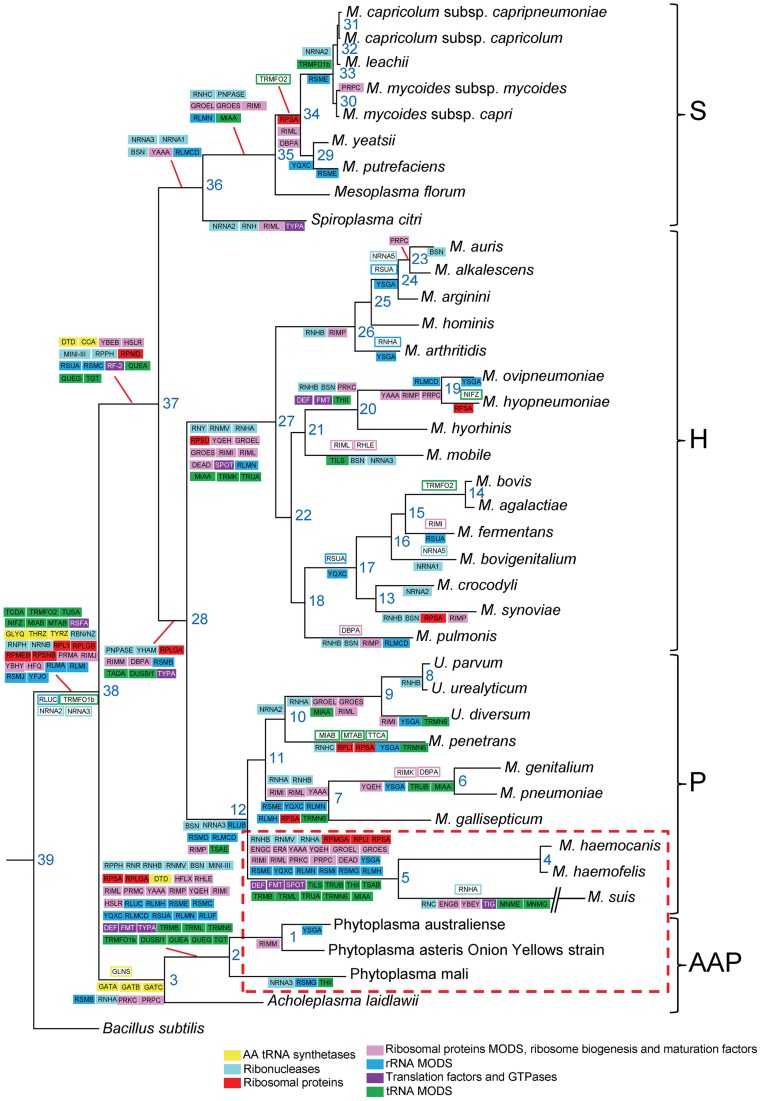
Figure 3. Reconstruction of the evolution of translation-related gene set in mollicutes.
Ancestral gene content at each node of the phylogenetic tree was inferred using the posterior probabilities calculated from the birth-and death model implemented in the COUNT program. Genes gained and lost are framed and highlighted with colors corresponding to gene categories, respectively. Very similar results were obtained using Wagner parsimony method with a gain penalty of 4. The phylogenetic tree was inferred using the maximum likelihood method from the concatenated multiple alignments of 79 proteins encoded by genes present at one copy in each genome. The phylogenetic groups are indicated: S for Spiroplasma, H for Hominis, P for Pneumoniae and AAP. The non-cultivated Mollicutes are framed by a red dashed line.
Figure 4
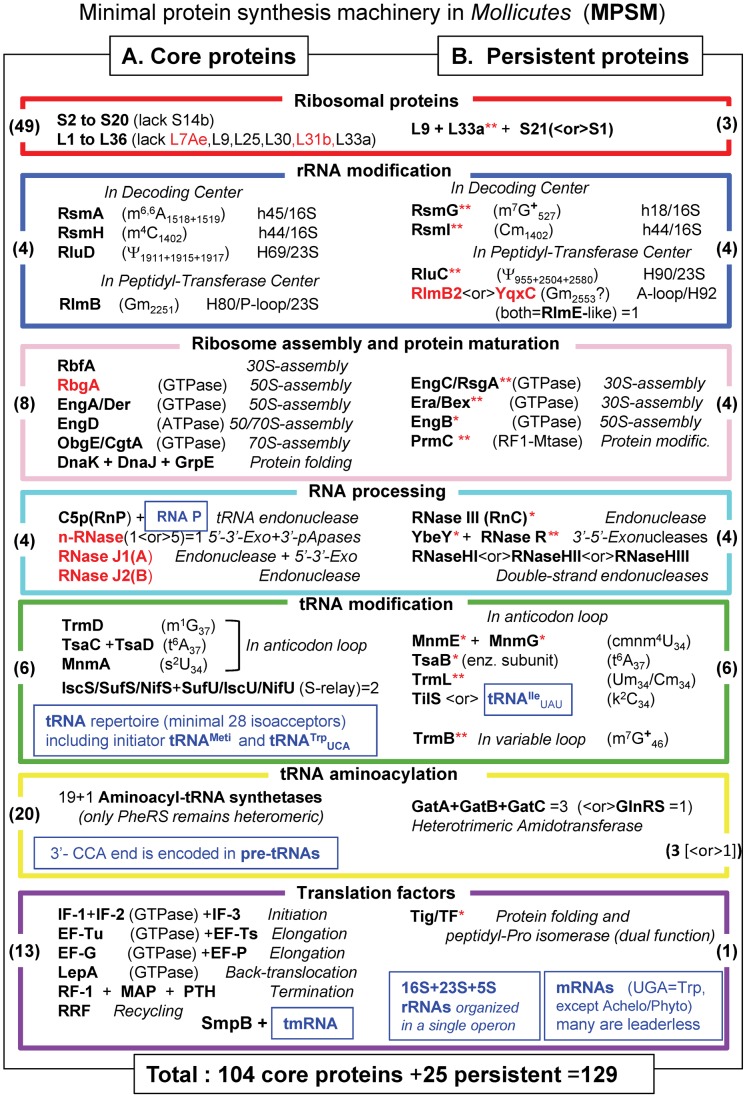
Figure 4. The minimal set of proteins for a functional translation apparatus in the 39 Mollicutes species.
The acronyms of the 129 selected translation proteins in Mollicutes are divided in 2 parts: in A (left part), the 104 core proteins present in all Mollicutes analyzed are listed, while in B (right part) 25 additional proteins supposed to complement the 104 core protein are indicated. The acronyms and corresponding color code for the boxes are as in Figures 1 and 3 and the corresponding names are given in Table S2). When the acronym in bold black letters is followed by one red asterisk, the proteins are absent in the non culturable M. suis and when followed by two red stars proteins are absent in the 3 hemoplasmas and/or the phytoplasmas (all these are present in panel B only). All numbers in brackets within boxes correspond to those indicated in part D of Figure 1. Acronyms indicated in red correspond to proteins that are found in B. subtilis and not in E. coli. The various types of translation-associated RNAs are indicated in small blue boxes. In the cases of tRNA and rRNA modification enzymes, the type of nucleotide modification and their positions in RNA as identified in E. coli are also given. Modified nucleotides m7G and m1A carries a positive charge at neutral pH (indicated by a +). X<or>Y means that either protein X or protein Y is found in mollicutes. However because of their overlapping functions or analogous specificities, the common essential function is preserved in all the 39 Mollicutes analyzed. The indication ‘n-RNases (1<or>5)’ means that one ancestral gene has been duplicated several times independently and each mollicute contain 1 to up 4 exemplars (they were however counted for one enzyme in our statistic). The average G+C % content in genome of the 39 Mollicutes analyzed is 27.6 varying from 21.4 in Ca. Phytoplasma mali to up to 40.0 in M. pneumoniae (Table S1).
Figure 5
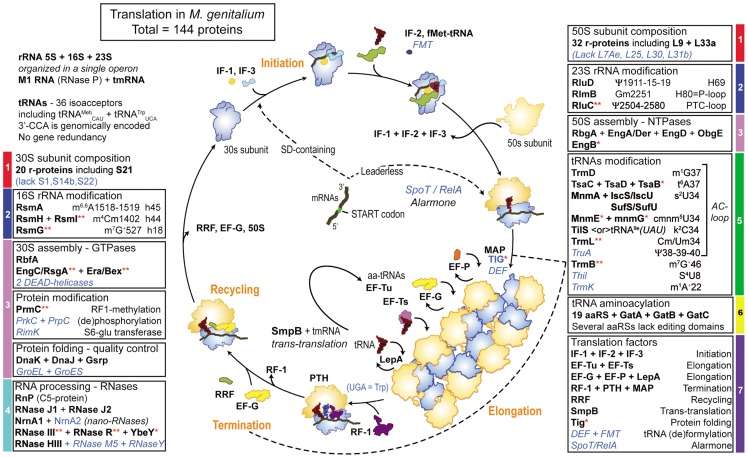
Figure 5. Schematic view of ribosome assembly and translation cycle in M. genitalium.
In each box are indicated the acronyms of proteins encoded in the genome of M. genitalium (Table S3). The acronyms in black bold letters correspond to proteins listed in Figure 4 (A+B) of the minimal protein synthesis machinery (MPSM), only RlmB2<or>YqxC is missing (see text). When the acronym is followed by a red asterisk, the protein is absent in the non-culturable M. suis and when followed by double asterisks, proteins are absent in the 3 hemoplasmas and/or the phytoplasmas. The acronyms in italic blue letters correspond to proteins that are absent in many mollicutes, but present in M. genitalium and M. pneumoniae. The color codes for each box are the same as in Table 1. Steps of translation are indicated in orange. Elongation (ribosomes assembled on mRNA forming polysomes) and termination are indicated by a circle dashed line. The step corresponding to the action of RF-1 has been isolated from the rest of the polysome, for better visualization. Depending on whether an mRNA harbors a 5′-leader sequence with SD-sequence or is leaderless, initiation occurs either on 30S subunit or 70S ribosome respectively. This figure allows a direct comparison with the similar one for translation cycle in Bacteria versus Eukaryotes published by Melnikov et al from M. Yusupov's laboratory in Strasbourg, France .

References

    1. Weisburg WG, Tully JG, Rose DL, Petzel JP, Oyaizu H, et al. (1989) A phylogenetic analysis of mycoplasmas: basis for their classification. J Bacteriol 171: 6455–6467. - PMC - PubMed
    1. Razin S, Yogev D, Naot Y (1998) Molecular biology and pathogenicity of mycoplasmas. Microbiol Mol Biol Rev 62: 1094–1156. - PMC - PubMed
    1. Yus E, Maier T, Michalodimitrakis K, van Noort V, Yamada T, et al. (2009) Impact of genome reduction on bacterial metabolism and its regulation. Science 326: 1263–1268. - PubMed
    1. Guell M, van Noort V, Yus E, Chen WH, Leigh-Bell J, et al. (2009) Transcriptome complexity in a genome-reduced bacterium. Science 326: 1268–1271. - PubMed
    1. Catrein I, Herrmann R (2011) The proteome of Mycoplasma pneumoniae, a supposedly “simple” cell. Proteomics 11: 3614–3632. - PubMed

Publication types

LinkOut - more resources