


Comment
doi: 10.1182/blood-2014-04-565515.
Abnl(17p) in AML: who will guard the guardian?
Affiliations
- PMID: 24810623
- PMCID: PMC4014835
- DOI: 10.1182/blood-2014-04-565515
Item in Clipboard
Comment
Abnl(17p) in AML: who will guard the guardian?
Blood.
.
Abstract
In this issue of Blood, Middeke and colleagues highlight the poor outcome of the abnormal (17p) [abnl(17p)] subgroup of cytogenetically adverse-risk acute myeloid leukemia (AML) even after allogeneic hematopoietic stem cell transplantation (HSCT).
Conflict of interest statement
Conflict-of-interest disclosure: The author declares no competing financial interests.
Figures
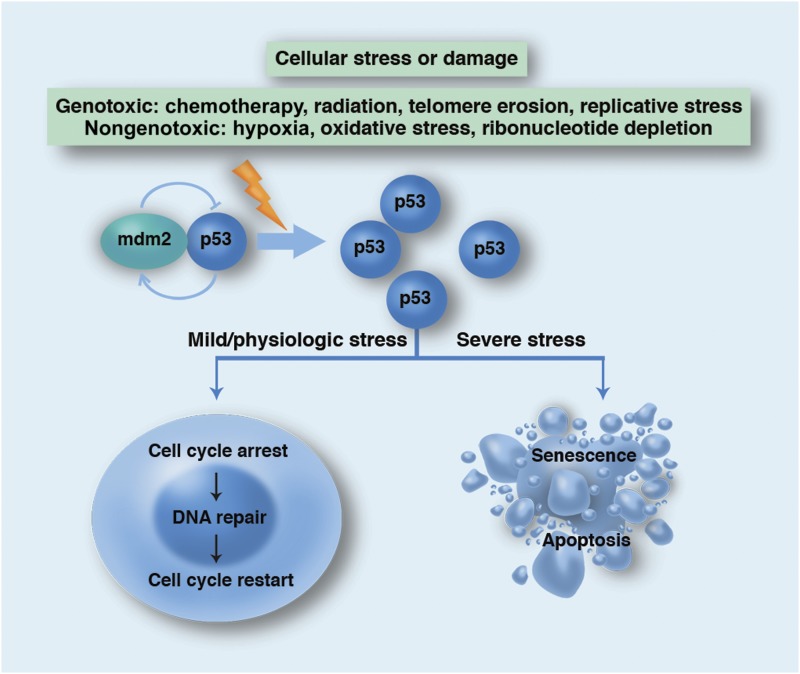
Schema for the physiological role of the p53 network in promoting genetic stability. WT p53 is normally targeted for proteasomal degradation by mdm2 but accumulates in states of cellular stress or damage. p53 transcriptionally regulates numerous target genes (including p21) as well as interacts directly with other proteins to either quarantine the cell for repair or condemn it to die. Professional illustration by Marie Dauenheimer.
Comment on
-
Outcome of patients with abnl(17p) acute myeloid leukemia after allogeneic hematopoietic stem cell transplantation.Blood. 2014 May 8;123(19):2960-7. doi: 10.1182/blood-2013-12-544957. Epub 2014 Mar 20. Blood. 2014. PMID: 24652988
References
-
- Middeke JM, Fang M, Cornelissen JJ, et al. Outcome of patients with abnl(17p) acute myeloid leukemia after allogeneic hematopoietic stem cell transplantation. Blood. 2014;123(19):2960–2967. - PubMed
-
- Wong TN, Ramsingh G, Young A, et al. The role of early TP53 mutations on the evolution of therapy-related AML [abstract]. Blood. 2013;122(21) Abstract 5.
-
- Grossmann V, Schnittger S, Kohlmann A, et al. A novel hierarchical prognostic model of AML solely based on molecular mutations. Blood. 2012;120(15):2963–2972. - PubMed
-
- Bowen D, Groves MJ, Burnett AK, et al. TP53 gene mutation is frequent in patients with acute myeloid leukemia and complex karyotype, and is associated with very poor prognosis. Leukemia. 2009;23(1):203–206. - PubMed
Publication types
MeSH terms
LinkOut - more resources
Full Text Sources
Other Literature Sources
