


Performance-optimized hierarchical models predict neural responses in higher visual cortex
- PMID: 24812127
- PMCID: PMC4060707
- DOI: 10.1073/pnas.1403112111
Performance-optimized hierarchical models predict neural responses in higher visual cortex
Abstract
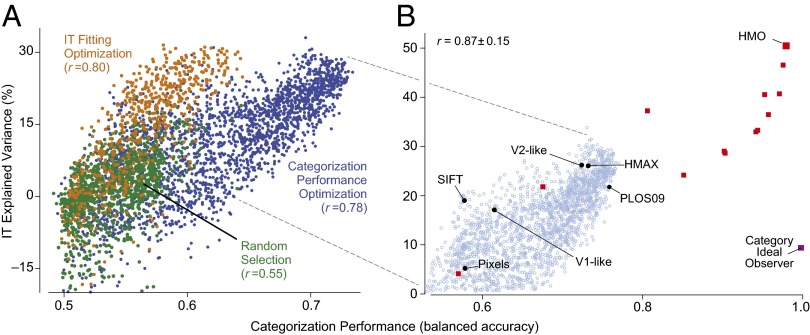
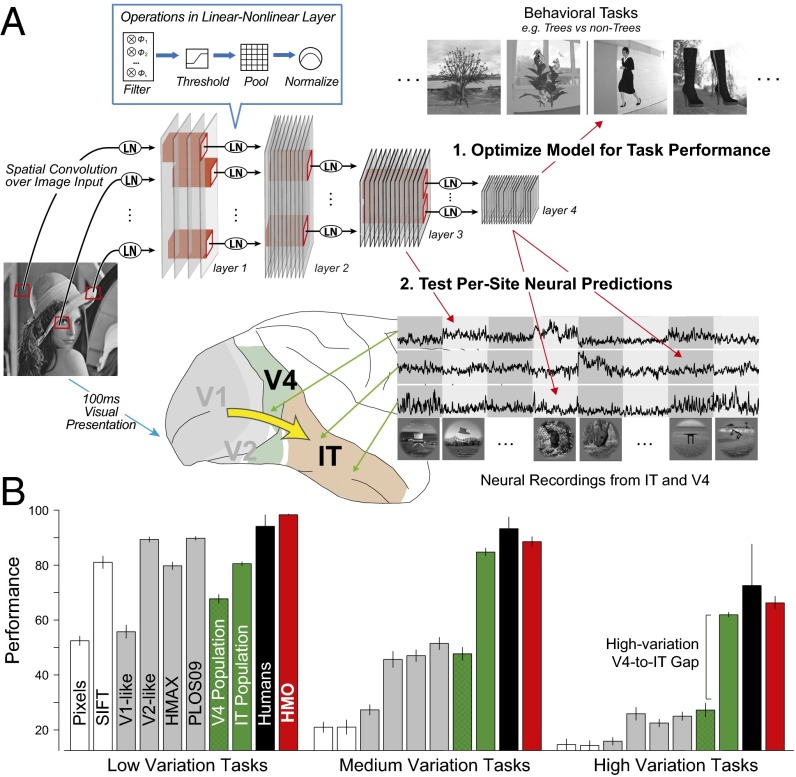
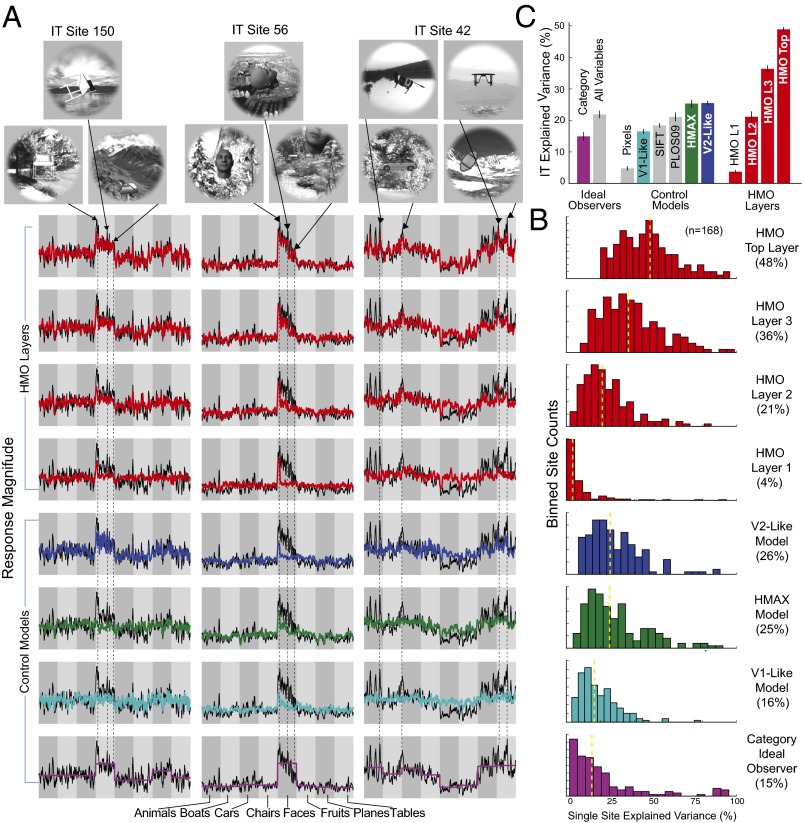
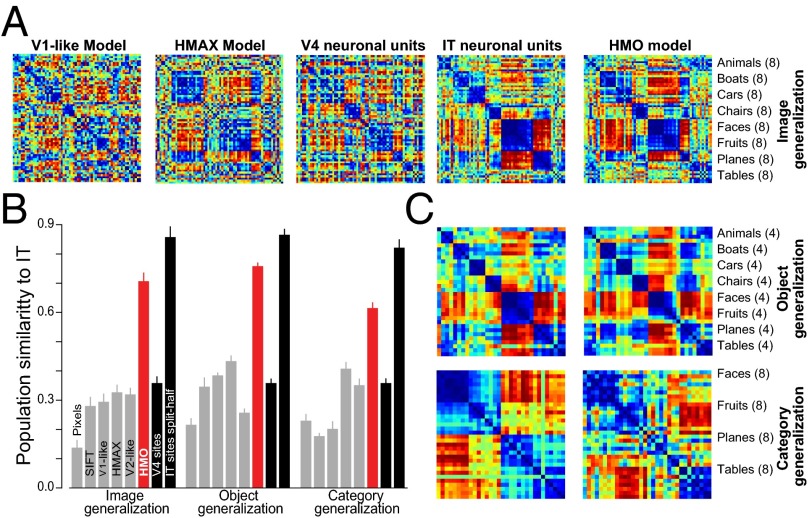
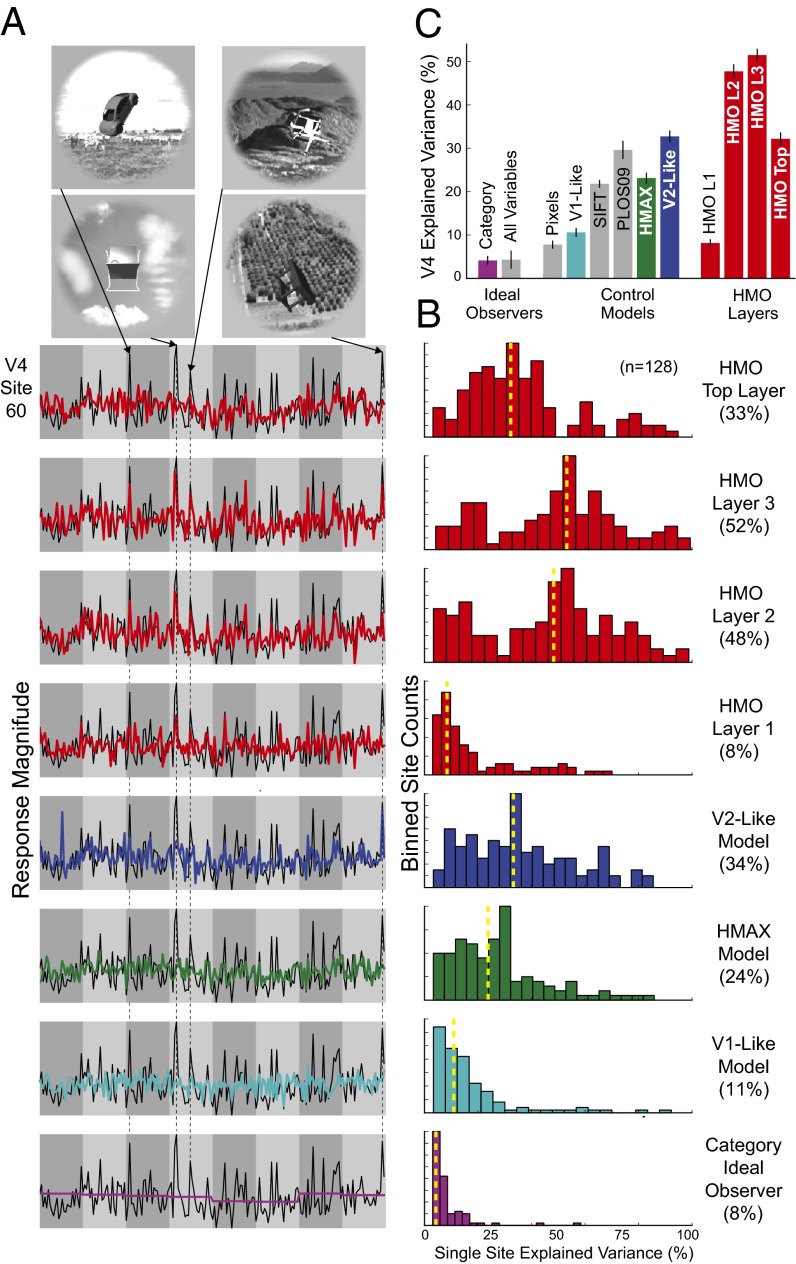
The ventral visual stream underlies key human visual object recognition abilities. However, neural encoding in the higher areas of the ventral stream remains poorly understood. Here, we describe a modeling approach that yields a quantitatively accurate model of inferior temporal (IT) cortex, the highest ventral cortical area. Using high-throughput computational techniques, we discovered that, within a class of biologically plausible hierarchical neural network models, there is a strong correlation between a model's categorization performance and its ability to predict individual IT neural unit response data. To pursue this idea, we then identified a high-performing neural network that matches human performance on a range of recognition tasks. Critically, even though we did not constrain this model to match neural data, its top output layer turns out to be highly predictive of IT spiking responses to complex naturalistic images at both the single site and population levels. Moreover, the model's intermediate layers are highly predictive of neural responses in the V4 cortex, a midlevel visual area that provides the dominant cortical input to IT. These results show that performance optimization--applied in a biologically appropriate model class--can be used to build quantitative predictive models of neural processing.
Keywords: array electrophysiology; computational neuroscience; computer vision.
Conflict of interest statement
The authors declare no conflict of interest.
Figures
Comment in
-
Function determines structure in complex neural networks.Proc Natl Acad Sci U S A. 2014 Jun 10;111(23):8327-8. doi: 10.1073/pnas.1407198111. Epub 2014 May 29. Proc Natl Acad Sci U S A. 2014. PMID: 24876274 Free PMC article. No abstract available.
-
How AI and neuroscience drive each other forwards.Nature. 2019 Jul;571(7766):S15-S17. doi: 10.1038/d41586-019-02212-4. Nature. 2019. PMID: 31341311 No abstract available.
References
-
- DiCarlo JJ, Cox DD. Untangling invariant object recognition. Trends Cogn Sci. 2007;11(8):333–341. - PubMed
-
- Grill-Spector K, Kourtzi Z, Kanwisher N. The lateral occipital complex and its role in object recognition. Vision Res. 2001;41(10-11):1409–1422. - PubMed
-
- Malach R, Levy I, Hasson U. The topography of high-order human object areas. Trends Cogn Sci. 2002;6(4):176–184. - PubMed
-
- Tanaka K. Inferotemporal cortex and object vision. Annu Rev Neurosci. 1996;19:109–139. - PubMed
Publication types
MeSH terms
Grants and funding
LinkOut - more resources
Full Text Sources
Other Literature Sources
