


Children under the age of two are more likely to watch inappropriate background media than older children
- PMID: 24812713
- PMCID: PMC4067319
- DOI: 10.1111/apa.12588
Children under the age of two are more likely to watch inappropriate background media than older children
Abstract
Aim: To establish whether young children watched foreground electronic media or background media that was not aimed at them or was inappropriate for their age.
Methods: We performed a longitudinal analysis of mother-infant dyads participating in a larger parenting study. The primary dependent variable was maternal reports of watching habits from media diaries at 6, 14, 24 and 36 months. Independent variables were child age, programme content and whether the programme was turned on specifically for the child.
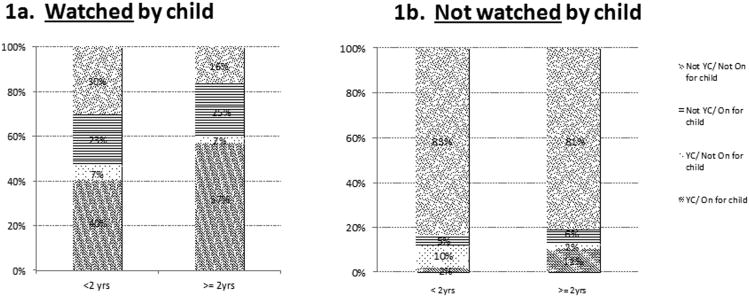
Results: We analysed 3570 programme exposures in 527 children, mostly from television. Children were significantly more likely to actually watch programmes if they were older, if the content was coded as 'educational young child' or if the parent tuned on the programme specifically so the child could watch it. Children under the age of two were more likely than older children to watch background media that featured age-inappropriate content or had not been turned on for them to watch [30% versus 16% of programmes; AOR = 2.19 (95%CI 1.82-2.65)].
Conclusion: Young children under the age of two frequently watch background media that has age-inappropriate content or has not been turned on for them to watch.
Conflict of interest statement
Figures
References
-
- Anderson DR, Evans MK. Zero To Three. Babies, Toddlers & Media: Peril and Potential of Media for Infants and Toddlers. 2001;22:10–16.
-
- Christakis DA, Zimmerman FJ, DiGiuseppe DL, McCarty CA. Early television exposure and subsequent attentional problems in children. Pediatrics. 2004;113:708–713. - PubMed
-
- Zimmerman FJ, Christakis DA, Meltzoff AN. Associations between media viewing and language development in children under age 2 years. J Pediatr. 2007;151:364–368. - PubMed
-
- Zimmerman FJ, Christakis DA. Children's television viewing and cognitive outcomes: a longitudinal analysis of national data. Arch Pediatr Adolesc Med. 2005;159:619–625. - PubMed
Publication types
MeSH terms
Grants and funding
LinkOut - more resources
Full Text Sources
Other Literature Sources
Medical
