. 2014 Dec 1;76(11):895-901.
doi: 10.1016/j.biopsych.2014.03.027. Epub 2014 Apr 3.

An unconditioned stimulus retrieval extinction procedure to prevent the return of fear memory

Affiliations

An unconditioned stimulus retrieval extinction procedure to prevent the return of fear memory

Jianfeng Liu et al. Biol Psychiatry. .

Abstract

Background: Conditioned fear memories can be updated by extinction during reconsolidation, and this effect is specific to the reactivated conditioned stimulus (CS). However, a traumatic event can be associated with several cues, and each cue can potentially trigger recollection of the event. We introduced a technique to target all diverse cues associated with an aversive event that causes fear.

Methods: In human experiments, 161 subjects underwent modified fear conditioning, in which they were exposed to an unconditioned stimulus (US) or unreinforced CS to reactivate the memory and then underwent extinction, spontaneous recovery, and reinstatement. In animal experiments, 343 rats underwent contextual fear conditioning under a similar protocol as that used in the human experiments. We also explored the molecular alterations after US reactivation in rats.

Results: Presentation of a lower intensity US before extinction disrupted the associations between the different CS and reactivated US in both humans and rats. This effect persisted for at least 6 months in humans and was selective to the reactivated US. This procedure was also effective for remote memories in both humans and rats. Compared with the CS, the US induced stronger endocytosis of alpha-amino-3-hydroxy-5-methyl-4-isoxazole propionic acid glutamate receptors 1 and 2 and stronger activation of protein kinase A, p70S6 kinase, and cyclic adenosine monophosphate response element binding protein in the dorsal hippocampus in rats.

Conclusions: These findings demonstrate that a modified US retrieval extinction strategy may have a potential impact on therapeutic approaches to prevent the return of fear.

Keywords: Extinction; fear memory; hippocampus; reconsolidation; retrieval; unconditioned stimulus.


Figures

Figure 1
Figure 1
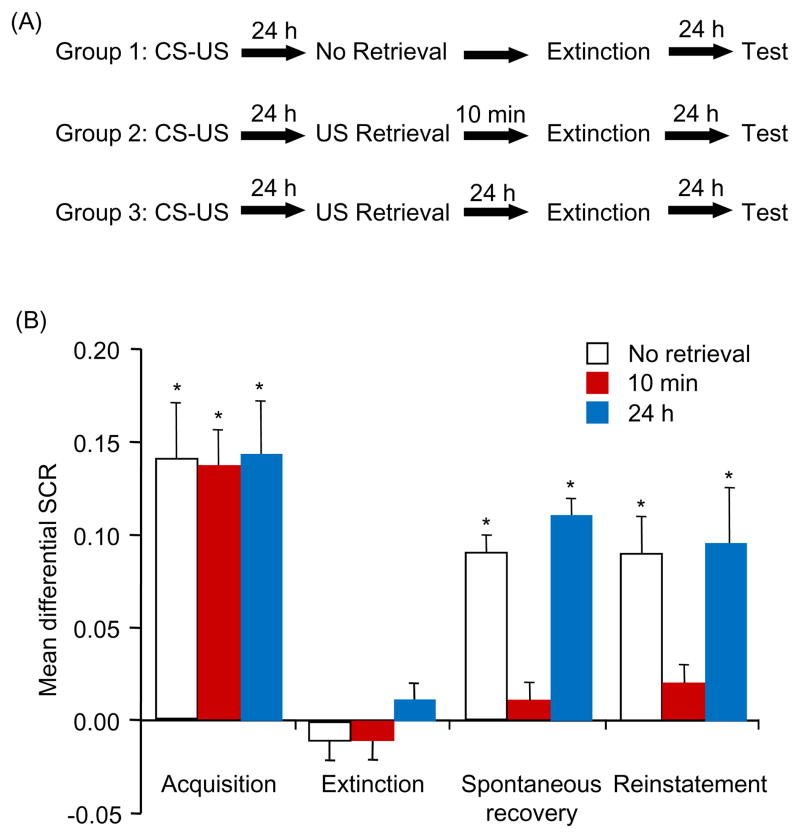
Extinction 10 min after US exposure prevented spontaneous recovery and reinstatement of extinguished fear in humans. (A) Experimental design and timeline. (B) Mean differential SCR (CS+ minus CS−) during acquisition (late phase), extinction (last trial), test for spontaneous recovery (first trial), and reinstatement (first trial) for each of the experimental groups (10 min, 24 h and no retrieval). Spontaneous recovery (first trial of this test vs. last trial of extinction) and reinstatement (first trial of reinstatement vs. last trial of spontaneous recovery) were found in the 24 h and no-retrieval groups. No spontaneous recovery or reinstatement was found in the 10 min group. *p < .05, comparisons between acquisition and extinction, between extinction and the first trial of spontaneous recovery, and between last trial of spontaneous recovery and reinstatement (all within-group). The data are expressed as mean ± SEM (n = 16–19 per group). CS, conditioned stimulus; US, unconditioned stimulus; SCR, skin conductance response.
Figure 2
Figure 2
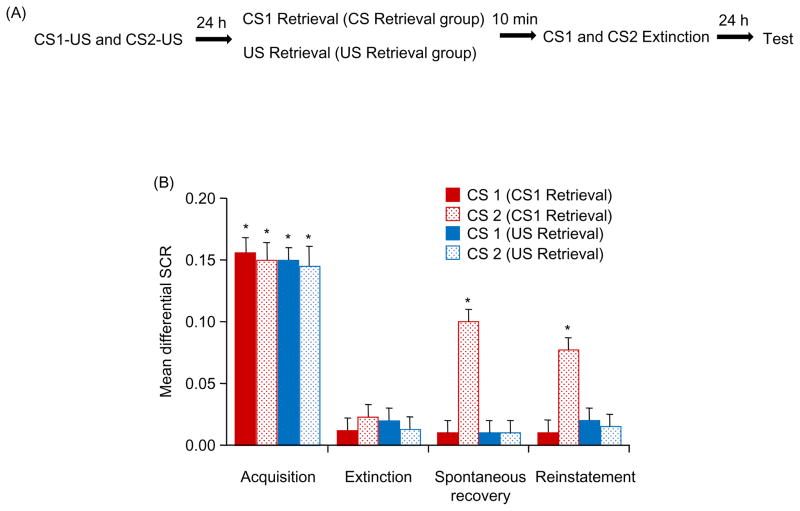
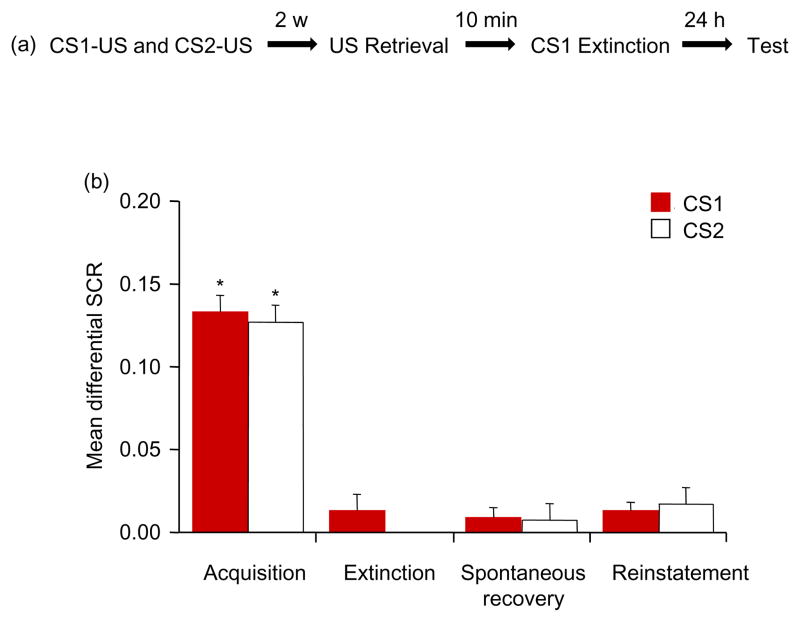
Extinction after exposure to the US alone disrupted the reconsolidation of fear conditioning in response to both the CS1 and CS2 in humans. (A) Experimental design and timeline. (B) Mean differential SCR (CS1+ minus CS− or CS2+ minus CS−) during acquisition (late phase), extinction (last trial), spontaneous recovery test (first trial), and reinstatement (first trial). *p < .05, comparisons between acquisition and extinction, between extinction and the first trial of the spontaneous recovery test, and between the last trial of the spontaneous recovery test and reinstatement (all within-group). The data are expressed as mean ± SEM (n = 18 per group).
Figure 3
Figure 3
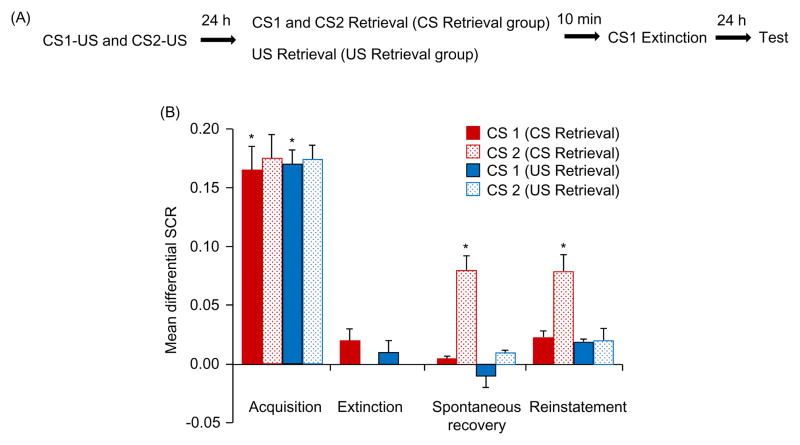
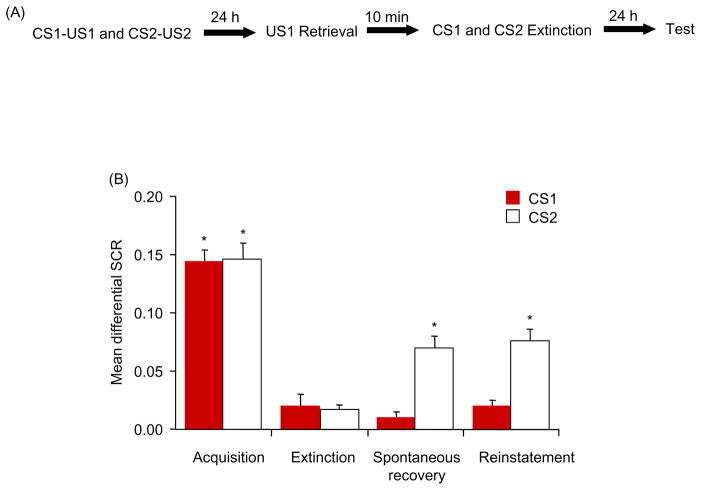
Either CS1 or CS2 extinction following exposure to the US alone disrupted the reconsolidation of fear conditioning in response to both the CS1 and CS2 in humans. (A) Experimental design and timeline. (B) Mean differential SCR (CS1+ minus CS− or CS2+ minus CS−) during acquisition (late phase), extinction (last trial), spontaneous recovery test (first trial), and reinstatement (first trial). *p < .05, comparisons between acquisition and extinction, between the last trial of extinction (CS1+) and first trial of spontaneous recovery (CS1+ and CS2+), and between the last trial of spontaneous recovery and reinstatement (all within-group). The data are expressed as mean ± SEM (n = 18–19 per group).
Figure 4
Figure 4
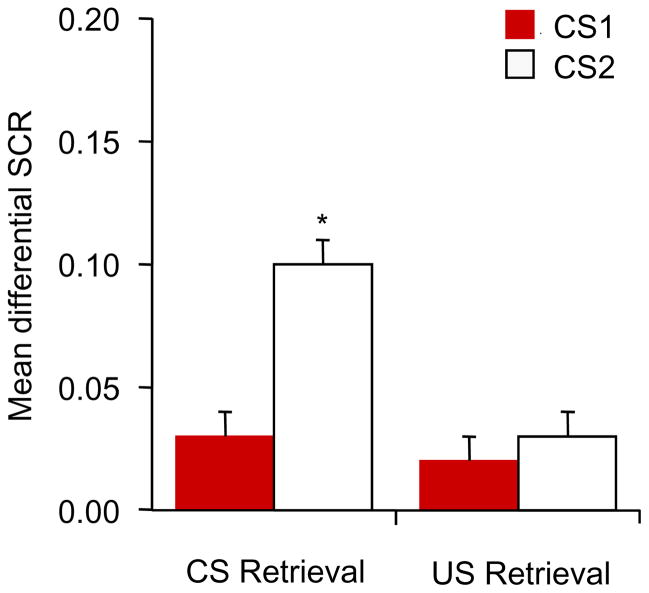
Persistence of blockade of fear conditioning in response to both the CS1 and CS2 by either CS1 or CS2 extinction following exposure to the US alone in humans. The reinstatement index is the mean differential SCR (CS1+ minus CS− or CS2+ minus CS−) during reinstatement (first trial) after re-extinction 6 months later. Significant reinstatement of conditioned fear was found for the CS2+ but not CS1+ in the CS retrieval group. No reinstatement was found in the US retrieval group. *p < .05. The data are expressed as mean ± SEM (n = 11–13 per group).
Figure 5
Figure 5
The US retrieval-extinction procedure disrupted remote fear memory in humans. (A) Experimental design and timeline. (B) Mean differential SCR (CS+ minus CS−) during acquisition (late phase), extinction (last trial), test for spontaneous recovery (first trial), and reinstatement (first trial). No spontaneous recovery or reinstatement was found. *p < .05, comparison between acquisition and extinction (within-group). The data are expressed as mean ± SEM (n = 15).
Figure 6
Figure 6
Reconsolidation is specific to the reactivated US. (A) Experimental design and timeline. (B) Mean differential SCR (CS1+ minus CS− or CS2+ minus CS−) during acquisition (late phase), extinction (last trial), spontaneous recovery test (first trial), and reinstatement (first trial). *p < .05, comparisons between acquisition and extinction, between extinction and the first trial of spontaneous recovery, and between the last trial of the spontaneous recovery test and reinstatement (all within-group). The data are expressed as mean ± SEM (n = 19).

Comment in

  • A lighter shade of trauma.
    Schiller D. Schiller D. Biol Psychiatry. 2014 Dec 1;76(11):838-9. doi: 10.1016/j.biopsych.2014.09.016. Epub 2014 Nov 4. Biol Psychiatry. 2014. PMID: 25439999 No abstract available.

References

    1. Gerardi M, Cukor J, Difede J, Rizzo A, Rothbaum BO. Virtual reality exposure therapy for post-traumatic stress disorder and other anxiety disorders. Curr Psychiatry Rep. 2010;12:298–305. - PubMed
    1. McLean CP, Foa EB. Prolonged exposure therapy for post-traumatic stress disorder: a review of evidence and dissemination. Expert Rev Neurother. 2011;11:1151–1163. - PubMed
    1. Eysenck HJ. Behavior therapy and the conditioning model of neurosis. International Journal of Psychology. 1981;16:343–370.
    1. Herry C, Ferraguti F, Singewald N, Letzkus JJ, Ehrlich I, Luthi A. Neuronal circuits of fear extinction. Eur J Neurosci. 2010;31:599–612. - PubMed
    1. Bouton ME. Context, ambiguity, and unlearning: sources of relapse after behavioral extinction. Biol Psychiatry. 2002;52:976–986. - PubMed

Publication types

LinkOut - more resources