. 2014 Jul;105(7):755-62.
doi: 10.1111/cas.12436. Epub 2014 Jul 3.

Busulfan inhibits growth of human osteosarcoma through miR-200 family microRNAs in vitro and in vivo

Affiliations

Busulfan inhibits growth of human osteosarcoma through miR-200 family microRNAs in vitro and in vivo

Qiang Mei et al. Cancer Sci. 2014 Jul.

Abstract

Osteosarcoma typically arises in tissues of mesenchymal origin, and is the most malignant bone tumor characterized by high local aggressiveness, with poor therapeutic outcome. Busulfan has been widely used to treat CML. So far, there are no reports on the therapeutic effect of busulfan on osteosarcoma. Here, we showed that busulfan dose-dependently reduced the cell viability and proliferation, and induced cell apoptosis, senescence, and reactive oxygen species levels in two osteosarcoma cell lines. Moreover, a series of loss-of-function and gain-of-function experiments further indicated that busulfan may have its anti-osteosarcoma effect by upregulating the microRNA-200 (miR-200) family which subsequently downregulated its target genes ZEB1 and ZEB2. Furthermore, treatment with busulfan potentially inhibited the growth of implanted osteosarcoma in nude mice. Taken together, our data suggest that busulfan may have an anti-osteosarcoma effect through downregulating ZEB1 and ZEB2 through activating the miR-200 family, highlighting a possibility of using busulfan as a novel therapy for osteosarcoma.

Keywords: Busulfan; ZEB1; ZEB2; microRNAs; osteosarcoma.


Figures

Figure 1
Figure 1
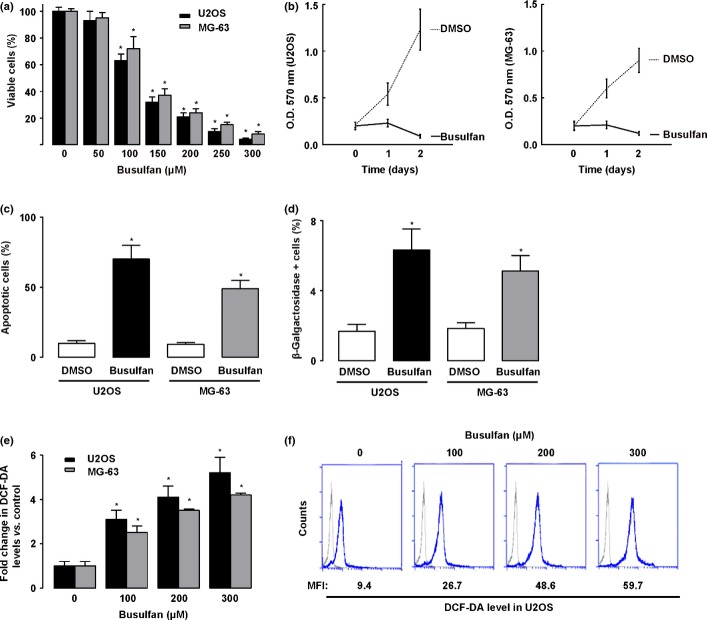
Measurements of cell viability, proliferation, apoptosis, senescence, and reactive oxygen species (ROS) levels in busulfan-treated osteosarcoma cells. (a) Percentage of viable cells (U2OS and MG-63) 24 h after different doses of busulfan. (b) Busulfan (100 μM) significantly inhibited the proliferation of U2OS and MG-63 cells. (c) Busulfan increased the apoptosis of U2OS and MG-63 cells. (d) Quantification of β-Gal positive cells in busulfan-treated U2OS and MG-63 cells. (e,f) 2'-7'-Dichlorodihydrofluorescein diacetate (DCF-DA) levels in U2OS after the different doses of busulfan treatment by representative cytometry histogram (e) and by quantification (f). MFI, mean fluorescence intensity. *P < 0.05.
Figure 2
Figure 2
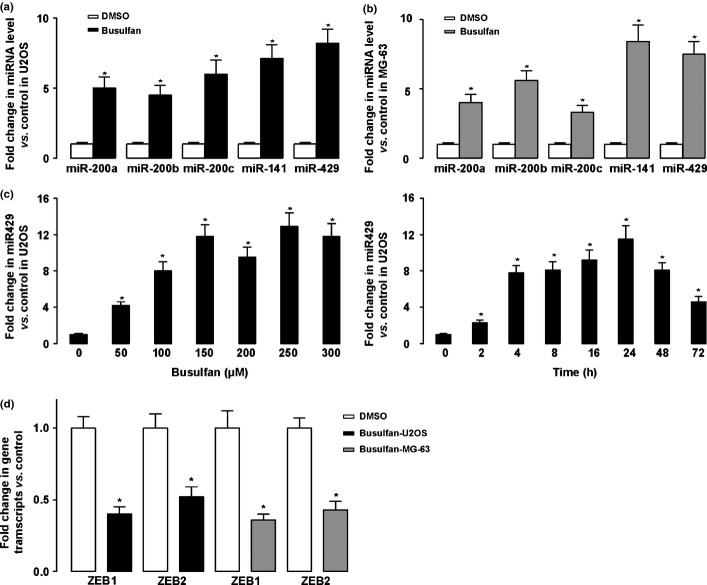
Busulfan upregulated the microRNA-200 (miR-200) family and modulated its target genes in osteosarcoma. (a,b) Messenger RNA from the miR-200 family (miR-200a, miR-200b, miR-200c, miR-141, and miR-429) was assayed by quantitative RT-PCR and normalized to control, showing that all were upregulated after busulfan treatment in U2OS (a) and MG-63 cells (b). (c) Dose-dependent and time-dependent effect of busulfan on the activation of miR-429. Busulfan (150 μM) seemed to be efficient for activation of miR-429. Moreover, efficient induction of miR-429 was detected 24 h after busulfan treatment. (d) Changes in mRNA of ZEB1 and ZEB2 in both lines were assayed by quantitative RT-PCR and normalized to control. *P < 0.05
Figure 3
Figure 3
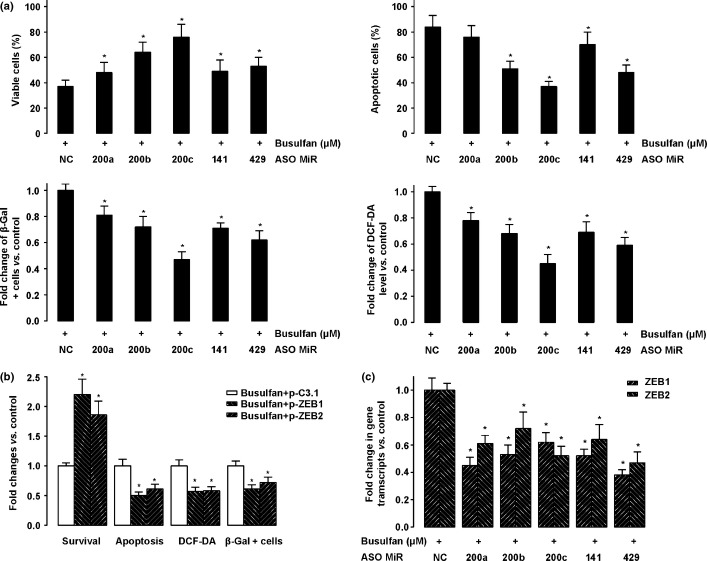
Downregulating the microRNA-200 (miR-200) family or upregulating ZEB1 and ZEB2 reversed the anti-osteosarcoma effect of busulfan. (a) U2OS cells were transfected with antisense oligonucleotides (ASO) of miR-200a, miR-200b, miR-200b, miR-141, and miR-429 to downregulate the expression of miRNAs. The percentage of viable cells, apoptosis, β-gal-positive cells and 2'-7'-Dichlorodihydrofluorescein diacetate (DCF-DA) levels were assayed after 24 h. All data were normalized to negative control (NC). (b) MG-63 cells were transfected with pcDNA3.1-ZEB1 or pcDNA3.1-ZEB2, two overexpressing plasmids. The percentage of viable cells, apoptosis, β-gal-positive cells and DCF-DA levels were assayed after 24 h. (c) Downregulation of all five members in the miR-200 family by ASO resulted in upregulation of ZEB1 and ZEB2. *P < 0.05.
Figure 4
Figure 4
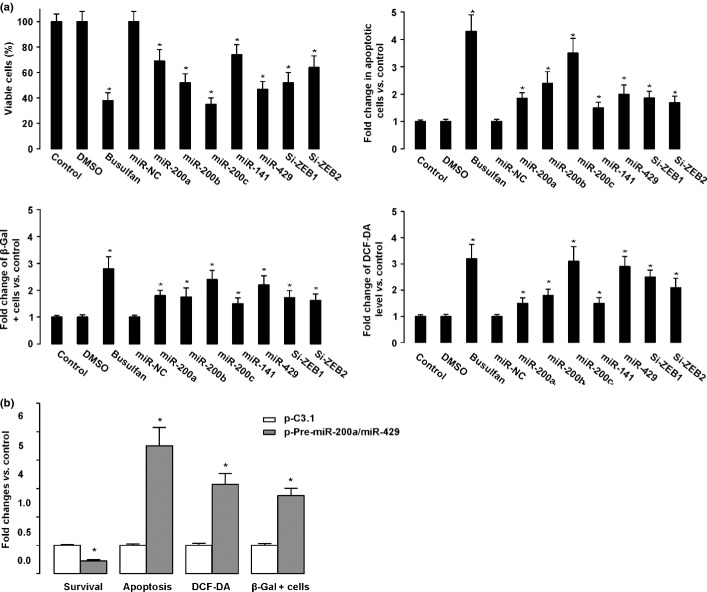
Upregulating the microRNA-200 (miR-200) family, or inhibiting ZEB1 and ZEB2, partly mimicked the effect of busulfan in osteosarcoma cell lines. (a) U2OS cells were transfected with mimics of miR-200a, miR-200b, miR-200b, miR-141, and miR-429 to upregulate miRNAs. The percentage of viable cells, apoptosis, β-gal-positive cells, and 2'-7'-Dichlorodihydrofluorescein diacetate (DCF-DA) levels were assayed after 24 h. All data were normalized to negative control. (b) MG-63 cells were transfected with siRNA for ZEB1 and ZEB2 to downregulate the expression of ZEB1 and ZEB2. The percentage of viable cells, apoptosis, β-gal-positive cells, and DCF-DA levels were assayed after 24 h. All data were normalized to negative control (NC). *P < 0.05.
Figure 5
Figure 5
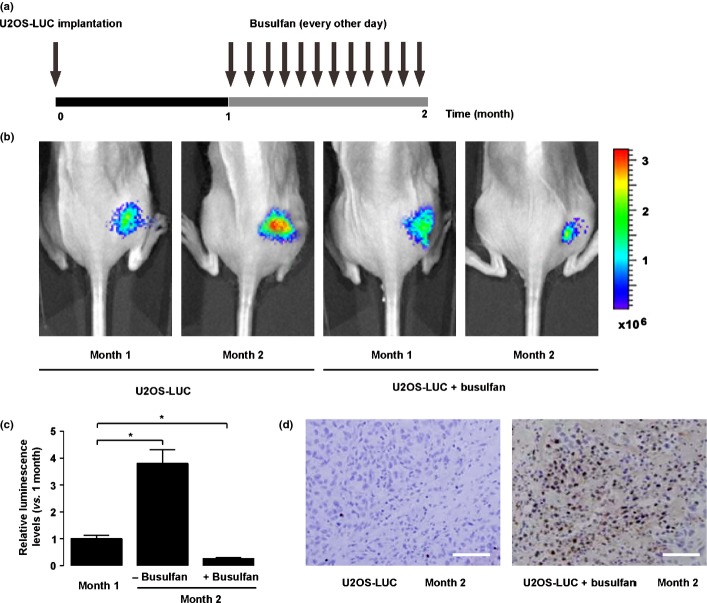
Busulfan inhibited osteosarcoma growth in vivo in a mouse model. (a) In order to evaluate the therapeutic effect of busulfan on osteosarcoma in vivo, we generated a mouse model by orthotopically injecting luciferase-transfected U2OS (U2OS-LUC) into the tibia of nude mice. One month later, busulfan was i.v. injected into the mice every other day for another month. (b,c) Tumor growth was monitored by bioluminescence imaging. We found a continuous growth of the implanted tumor in the control mice, but the tumor growth was significantly inhibited in the mice that received busulfan, shown by representative images (b), and by quantification (c). (d) TUNEL assay further confirmed that busulfan induced significant apoptosis of osteosarcoma cells in vivo. Scale bar = 40 μm.

References

    1. Yang J, Zhang W. New molecular insights into osteosarcoma targeted therapy. Curr Opin Oncol. 2013;25:398–406. - PubMed
    1. Tsuchiya H, Tomita K, Mori Y, et al. Caffeine-assisted chemotherapy and minimized tumor excision for nonmetastatic osteosarcoma. Anticancer Res. 1998;18(1B):657–66. - PubMed
    1. Ponten J, Saksela E. Two established in vitro cell lines from human mesenchymal tumours. Int J Cancer. 1967;2:434–47. - PubMed
    1. Billiau A, Edy VG, Heremans H, et al. Human interferon: mass production in a newly established cell line, MG-63. Antimicrob Agents Chemother. 1977;12(1):11–5. - PMC - PubMed
    1. Kim VN, Han J, Siomi MC. Biogenesis of small RNAs in animals. Nat Rev Mol Cell Biol. 2009;10:126–39. - PubMed

Publication types

MeSH terms