Participant-perceived quality of life in a long-term, open-label trial of lisdexamfetamine dimesylate in adolescents with attention-deficit/hyperactivity disorder
- PMID: 24815910
- PMCID: PMC4026374
- DOI: 10.1089/cap.2013.0077
Participant-perceived quality of life in a long-term, open-label trial of lisdexamfetamine dimesylate in adolescents with attention-deficit/hyperactivity disorder
Abstract
Objectives: The purpose of this study was to assess long-term improvement in quality of life (QOL) in adolescents with attention-deficit/hyperactivity disorder (ADHD) treated with lisdexamfetamine dimesylate (LDX).
Methods: Adolescents with ADHD treated for ≥3 weeks in a 4 week, placebo-controlled study entered a 1 year, open-label study. After the 4 week dose optimization (30, 50, and 70 mg/day LDX) period, treatment was maintained for 48 additional weeks. Change from baseline (of prior study) to week 52/early termination (ET) (of open-label study) in ADHD Rating Scale IV (ADHD-RS-IV) assessed effectiveness, and the Youth QOL-Research Version (YQOL-R) assessed participant-perceived QOL. Post-hoc analyses described effectiveness and QOL for participants with self-perceived poor QOL at baseline (≥1 SD below the mean) versus all others, and for study completers versus study noncompleters.
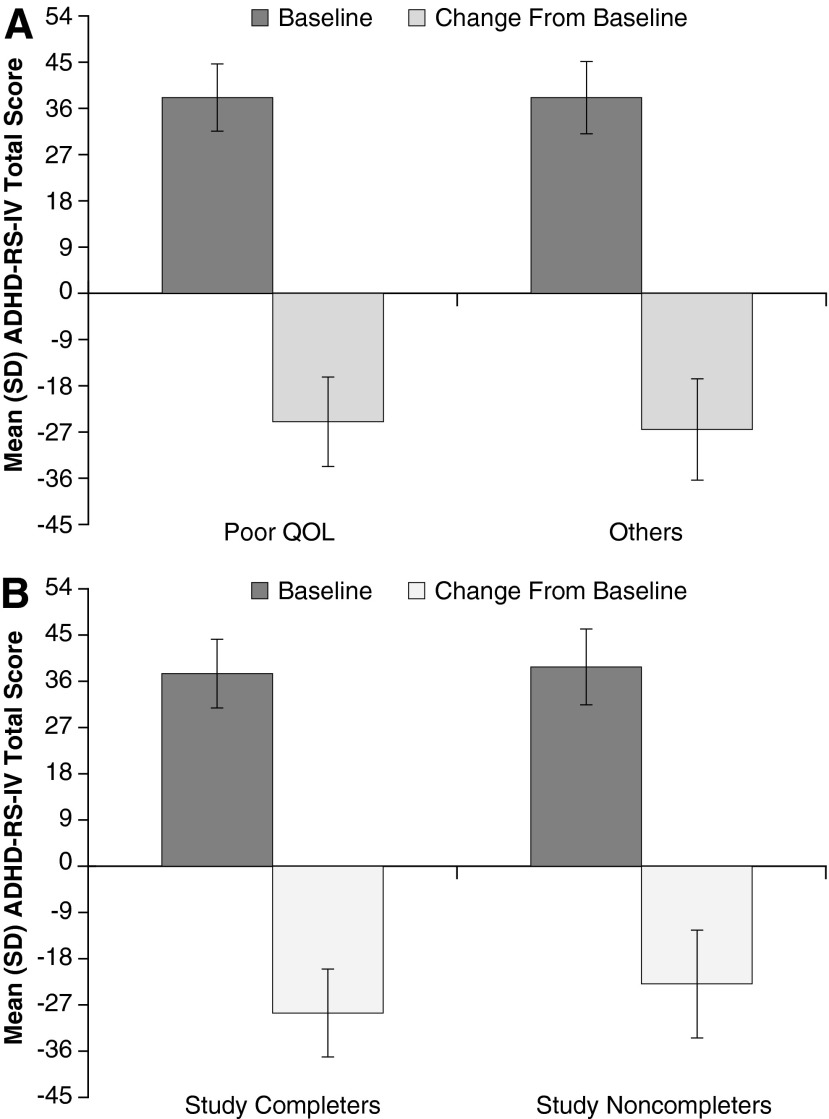
Results: These post-hoc analyses included 265 participants. Participants with baseline self-perceived poor QOL (n=32) versus all others (n=232) exhibited robust YQOL-R perceptual score changes (improvement) with LDX, emerging by week 28 and maintained to week 52/ET. Week 52/ET mean change score ranged from +9.8 to +17.6 for participants with baseline self-perceived poor QOL and +0.4 to +5.1 for all others; week 52/ET improvements in ADHD-RS-IV total scores were similar, regardless of baseline YQOL-R total score. At week 52/ET, study completers had greater YQOL-R improvements than did noncompleters; ADHD-RS-IV total score changes were also numerically larger at week 52/ET for completers than for noncompleters.
Conclusion: Participant-perceived QOL and ADHD symptoms improved from baseline with LDX in adolescents with ADHD; greatest improvements occurred among participants with baseline self-perceived poor QOL.
Figures
References
-
- Barkley RA, Fischer M, Smallish L, Fletcher K: The persistence of attention-deficit/hyperactivity disorder into young adulthood as a function of reporting source and definition of disorder. J Abnorm Psychol 111:279–289, 2002 - PubMed
-
- Berek M, Kordon A, Hargarter L, Mattejat F, Slawik L, Rettig K, Schauble B: Improved functionality, health related quality of life and decreased burden of disease in patients with ADHD treated with OROS® MPH: Is treatment response different between children and adolescents? Child Adolesc Psychiatry Ment Health 5: 26, 2011 - PMC - PubMed
-
- Brams M, Giblin J, Gasior M, Gao J, Wigal T: Effects of open-label lisdexamfetamine dimesylate on self-reported quality of life in adults with ADHD. Postgrad Med 123:99–108, 2011 - PubMed
-
- Brown TE, Landgraf JM: Improvements in executive function correlate with enhanced performance and functioning and health-related quality of life: Evidence from 2 large, double-blind, randomized, placebo-controlled trials in ADHD. Postgrad Med 122: 42–51, 2010 - PubMed
-
- Buitelaar JK, Casas M, Philipsen A, Kooij JJ, Ramos–Quiroga JA, Dejonckheere J, van Oene JC, Schauble B: Functional improvement and correlations with symptomatic improvement in adults with attention deficit hyperactivity disorder receiving long-acting methylphenidate. Psychol Med 42:195–204, 2012 - PMC - PubMed
Publication types
MeSH terms
Substances
LinkOut - more resources
Full Text Sources
Other Literature Sources
Medical