


Perineural but not systemic low-dose dexamethasone prolongs the duration of interscalene block with ropivacaine: a prospective randomized trial
- PMID: 24817819
- PMCID: PMC4012348
- DOI: 10.2147/LRA.S59158
Perineural but not systemic low-dose dexamethasone prolongs the duration of interscalene block with ropivacaine: a prospective randomized trial
Abstract
Purpose: To determine the effects of intravenous and perineural dexamethasone on the duration of interscalene brachial plexus block (ISB) with ropivacaine in patients undergoing arthroscopic shoulder surgery.
Patients and methods: In this prospective, randomized, placebo-controlled trial, patients presenting for arthroscopic shoulder surgery with an ISB were randomized to receive ropivacaine 0.75% (group C), ropivacaine 0.75% plus perineural dexamethasone 4 mg (group Dperi), or ropivacaine 0.75% plus intravenous dexamethasone 4 mg (group Div). The primary outcome was the duration of analgesia, defined as the time between performance of the block and the first request for analgesic.
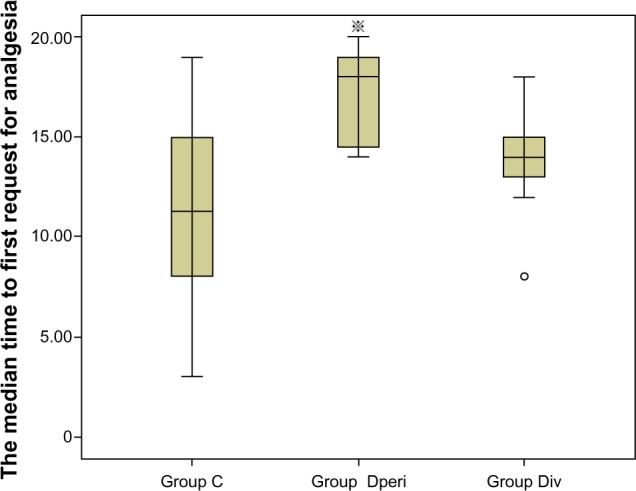
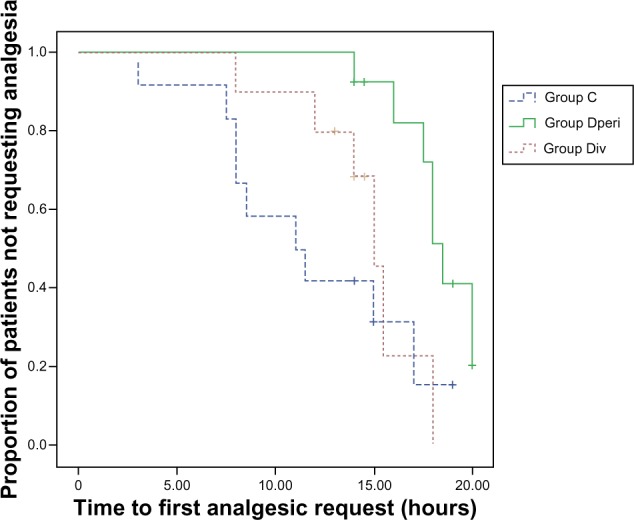
Results: Thirty-nine patients were randomized. The median times of sensory block in groups C, Dperi, and Div were 11.2 hours (interquartile range [IQR] 8.0-15.0 hours), 18.0 hours (IQR 14.5-19.0 hours), and 14.0 hours (IQR 12.7-15.1 hours), respectively. Significant differences were observed between groups Dperi and C (P=0.001). Kaplan-Meier analysis for the first analgesic request showed significant differences between groups Dperi and C (P=0.005) and between groups Dperi and Div (P=0.008), but not between groups C and Div.
Conclusion: Perineural but not intravenous administration of 4 mg of dexamethasone significantly prolongs the duration of effective postoperative analgesia resulting from a single-shot ISB with ropivacaine 0.75%.
Keywords: dexamethasone; interscalene nerve block; perineural; postoperative pain; ropivacaine.
Figures
Comment in
-
Perineural or intravenous dexamethasone: do we still need catheters?Anaesthesia. 2016 Aug;71(8):983-4. doi: 10.1111/anae.13596. Anaesthesia. 2016. PMID: 27396259 No abstract available.
-
Dexamethasone for nerve blocks: Design matters!J Clin Anesth. 2017 Jun;39:152-153. doi: 10.1016/j.jclinane.2017.03.043. Epub 2017 Apr 10. J Clin Anesth. 2017. PMID: 28494894 No abstract available.
References
-
- Fredrickson MJ, Krishnan S, Chen CY. Postoperative analgesia for shoulder surgery: a critical appraisal and review of current techniques. Anaesthesia. 2010;65:608–624. - PubMed
-
- Brown DL, Ransom DM, Hall JA, Leicht CH, Schroeder DR, Offord KP. Regional anesthesia and local anesthetic-induced systemic toxicity: seizure frequency and accompanying cardiovascular changes. Anesth Analg. 1995;8:321–328. - PubMed
-
- Grossi P, Allegri M. Continuous peripheral nerve blocks: state of the art. Curr Opin Anesthesiol. 2005;18:522–526. - PubMed
-
- Litz RJ, Vicent O, Wiessner D, Heller AR. Misplacement of a psoas compartment catheter in the subarachnoid space. Reg Anesth Pain Med. 2004;29:60–64. - PubMed
-
- Hong JY, Han SW, Kim WO, Kim EJ, Kil HK. Effect of dexamethasone in combination with caudal analgesia on postoperative pain control in day-case paediatric orchiopexy. Br J Anaesth. 2010;105:506–510. - PubMed
LinkOut - more resources
Full Text Sources
Other Literature Sources
Medical
