


Functional connectivity of neural motor networks is disrupted in children with developmental coordination disorder and attention-deficit/hyperactivity disorder
- PMID: 24818082
- PMCID: PMC3984446
- DOI: 10.1016/j.nicl.2014.03.010
Functional connectivity of neural motor networks is disrupted in children with developmental coordination disorder and attention-deficit/hyperactivity disorder
Abstract
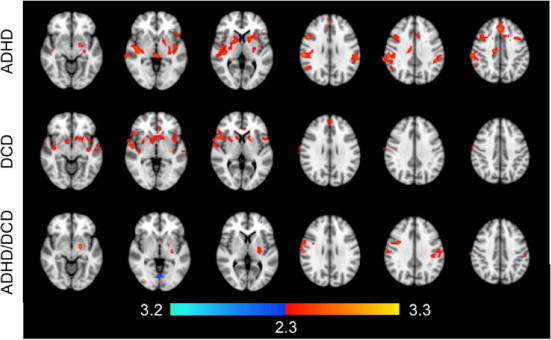
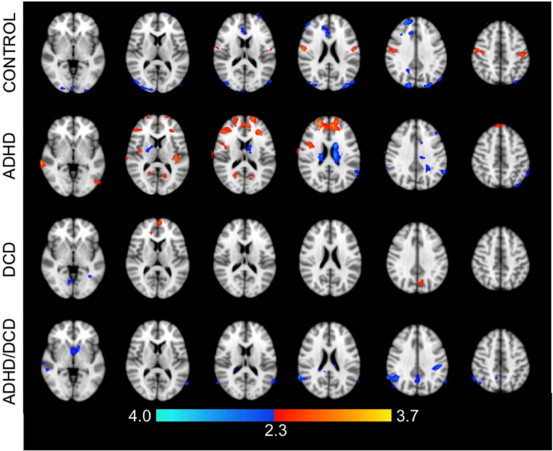
Developmental coordination disorder (DCD) and attention deficit/hyperactivity disorder (ADHD) are prevalent childhood disorders that frequently co-occur. Evidence from neuroimaging research suggests that children with these disorders exhibit disruptions in motor circuitry, which could account for the high rate of co-occurrence. The primary objective of this study was to investigate the functional connections of the motor network in children with DCD and/or ADHD compared to typically developing controls, with the aim of identifying common neurophysiological substrates. Resting-state fMRI was performed on seven children with DCD, 21 with ADHD, 18 with DCD + ADHD and 23 controls. Resting-state connectivity of the primary motor cortex was compared between each group and controls, using age as a co-factor. Relative to controls, children with DCD and/or ADHD exhibited similar reductions in functional connectivity between the primary motor cortex and the bilateral inferior frontal gyri, right supramarginal gyrus, angular gyri, insular cortices, amygdala, putamen, and pallidum. In addition, children with DCD and/or ADHD exhibited different age-related patterns of connectivity, compared to controls. These findings suggest that children with DCD and/or ADHD exhibit disruptions in motor circuitry, which may contribute to problems with motor functioning and attention. Our results support the existence of common neurophysiological substrates underlying both motor and attention problems.
Keywords: ADHD, attention deficit/hyperactivity disorder; Attention-deficit/hyperactivity disorder; DCD, developmental coordination disorder; DSM-IV, Diagnostic and Statistical Manual of Mental Disorders (4th edition); DTI, diffusion tensor imaging; Developmental coordination disorder; FC, functional connectivity; Functional connectivity; GLM general, linear model; ICA, independent component analysis; M1, primary motor cortex; PFC, prefrontal cortex; Resting state fMRI, Motor networks; fMRI, functional magnetic resonance imaging; rs-fMRI, resting-state fMRI.
Figures
References
-
- American Psychiatric Association . Diagnostic and Statistical Manual of Mental Disorders. fourth edition, Text Revision. American Psychiatric Association; Washington, D.C.: 2000.
-
- Booth J.R., Burman D.D., Meyer J.R., Lei Z., Trommer B.L., Davenport N.D., Li W., Parrish T.B., Gitelman D.R., Mesulam M.M. Larger deficits in brain networks for response inhibition than for visual selective attention in attention deficit hyperactivity disorder (ADHD) Journal of Child Psychology and Psychiatry, and Allied Disciplines. 2005;46:94–111. doi: 10.1111/j.1469-7610.2004.00337.x. 15660647 - DOI - PubMed
MeSH terms
LinkOut - more resources
Full Text Sources
Other Literature Sources
Medical
Miscellaneous
