Review
. 2014 Jun;11(6):317-23.
doi: 10.1038/nrurol.2014.91. Epub 2014 May 13.

Prostate cancer in young men: an important clinical entity

Affiliations
Review

Prostate cancer in young men: an important clinical entity

Claudia A Salinas et al. Nat Rev Urol. 2014 Jun.

Abstract

Prostate cancer is considered a disease of older men (aged >65 years), but today over 10% of new diagnoses in the USA occur in young men aged ≤55 years. Early-onset prostate cancer, that is prostate cancer diagnosed at age ≤55 years, differs from prostate cancer diagnosed at an older age in several ways. Firstly, among men with high-grade and advanced-stage prostate cancer, those diagnosed at a young age have a higher cause-specific mortality than men diagnosed at an older age, except those over age 80 years. This finding suggests that important biological differences exist between early-onset prostate cancer and late-onset disease. Secondly, early-onset prostate cancer has a strong genetic component, which indicates that young men with prostate cancer could benefit from evaluation of genetic risk. Furthermore, although the majority of men with early-onset prostate cancer are diagnosed with low-risk disease, the extended life expectancy of these patients exposes them to long-term effects of treatment-related morbidities and to long-term risk of disease progression leading to death from prostate cancer. For these reasons, patients with early-onset prostate cancer pose unique challenges, as well as opportunities, for both research and clinical communities. Current data suggest that early-onset prostate cancer is a distinct phenotype-from both an aetiological and clinical perspective-that deserves further attention.


Figures
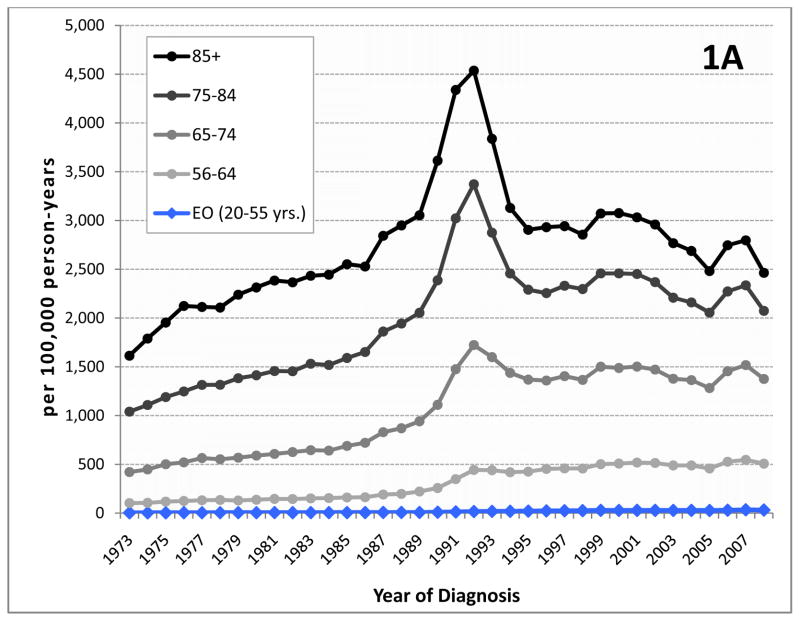
Figure 1
Figure 1
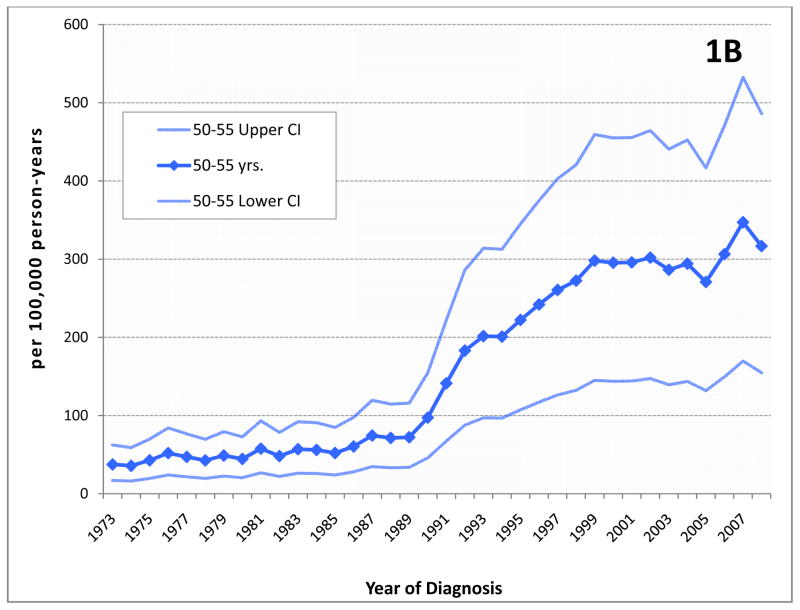
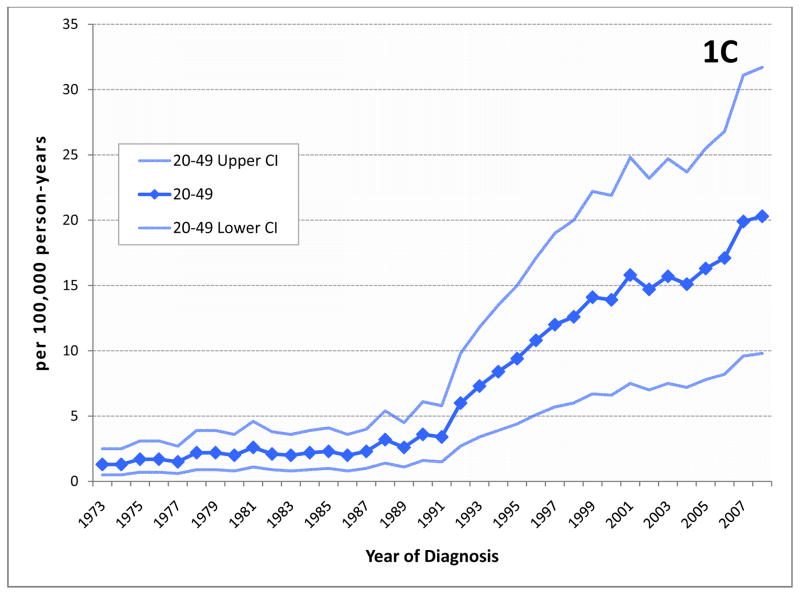
Incidence of prostate cancer by age group.(A) The age-adjusted incidence of prostate cancer increased dramatically during the late 1980’s and early 1990’s as a result of screening with serum PSA. Since then, incidence has decreased or stabilized among most age groups. Although prostate cancer in men aged ≤55 (early onset prostate cancer or EO) represents only a portion of all men diagnosed with this disease, incidence in this group continues to rise. (B) Incidence in men 50–55 years at diagnosis, among whom screening was commonly recommended by most medical organizations until recently, may have stabilized to some extent, however, (C) among younger men who are not expected to have been screened with PSA, incidence rates continue to rise. (Note the different scale for each chart.)
Figure 1
Figure 1
Incidence of prostate cancer by age group.(A) The age-adjusted incidence of prostate cancer increased dramatically during the late 1980’s and early 1990’s as a result of screening with serum PSA. Since then, incidence has decreased or stabilized among most age groups. Although prostate cancer in men aged ≤55 (early onset prostate cancer or EO) represents only a portion of all men diagnosed with this disease, incidence in this group continues to rise. (B) Incidence in men 50–55 years at diagnosis, among whom screening was commonly recommended by most medical organizations until recently, may have stabilized to some extent, however, (C) among younger men who are not expected to have been screened with PSA, incidence rates continue to rise. (Note the different scale for each chart.)
Figure 1
Figure 1
Incidence of prostate cancer by age group.(A) The age-adjusted incidence of prostate cancer increased dramatically during the late 1980’s and early 1990’s as a result of screening with serum PSA. Since then, incidence has decreased or stabilized among most age groups. Although prostate cancer in men aged ≤55 (early onset prostate cancer or EO) represents only a portion of all men diagnosed with this disease, incidence in this group continues to rise. (B) Incidence in men 50–55 years at diagnosis, among whom screening was commonly recommended by most medical organizations until recently, may have stabilized to some extent, however, (C) among younger men who are not expected to have been screened with PSA, incidence rates continue to rise. (Note the different scale for each chart.)
Figure 2
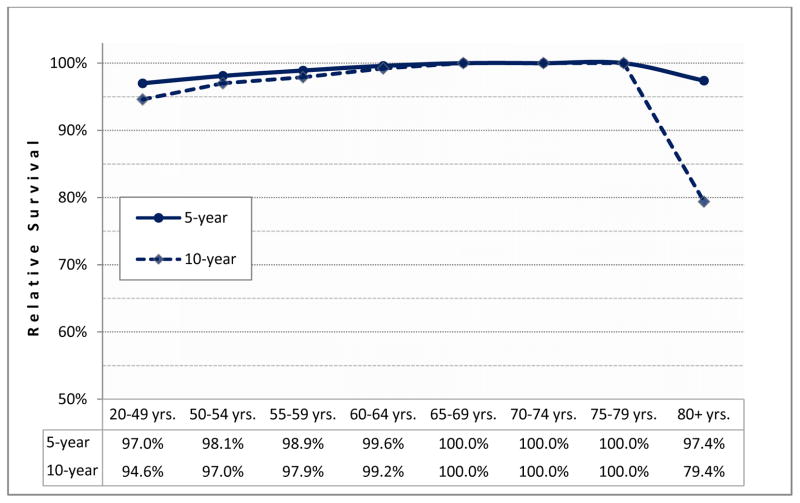
Figure 2. Relative survival of prostate cancer cases by age at diagnosis (1994–2008)
The survival of men diagnosed with prostate cancer is compared to the survival of men with similar demographic characteristics from the US population using SEER data. A reduction in relative survival from 100% demonstrates the impact of death due to prostate cancer. Among men diagnosed between 1994–2008, those diagnosed with prostate cancer before age 55 have worse 5- and 10-year survival than all other men except the elderly (80+ years at diagnosis).
Figure 3
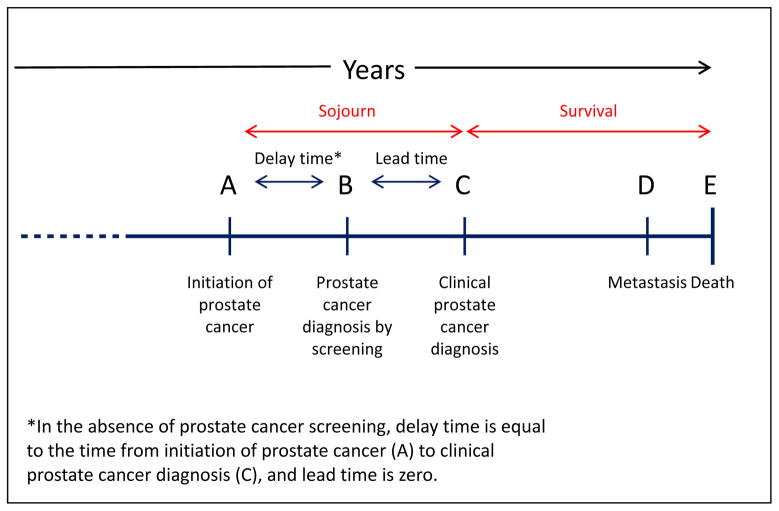
Figure 3. Natural history of prostate cancer
This figure illustrates the course of prostate cancer from initiation (A), to diagnosis by screening, (B), to diagnosis based upon clincial symptoms (C), to clinically detectable metastatic disease (D), and finally to death from prostate cancer (E). The “sojourn” time is the time between cancer initiation (A) and clinical detection (C). Survival is the time between cancer diagnosis (C) and death form the disease (E).
Figure 4
Figure 4
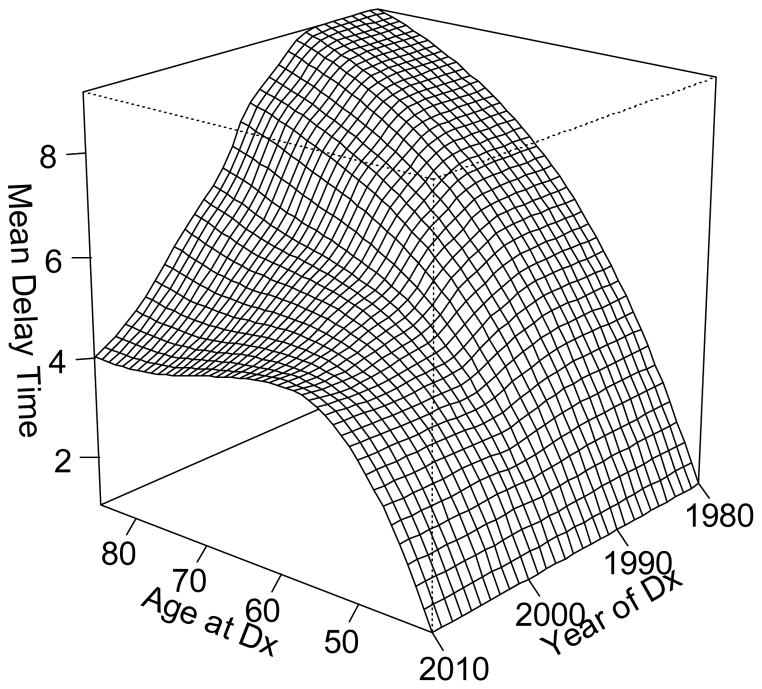
Mean delay time (years) in prostate cancer detection in the US population by age and calendar time of diagnosis (Dx).

References

    1. Siegel R, Naishadham D, Jemal A. Cancer statistics, 2012. CA: a cancer journal for clinicians. 2012;62:10–29. - PubMed
    1. Howlader NNA, Krapcho M, Neyman N, Aminou R, Altekruse SF, Kosary CL, Ruhl J, Tatalovich Z, Cho H, Mariotto A, Eisner MP, Lewis DR, Chen HS, Feuer EJ, Cronin KA, editors. SEER Cancer Statistics Review, 1975–2009. 2012 (Vintage 2009 Populations), . based on November 2011 SEER data submission, posted to the SEER web site, April 2012. [serial online] Available from URL: http://seer.cancer.gov/csr/1975_2009_pops09/</csr/1975_2009_pops09/
    1. Jemal A, Siegel R, Xu J, Ward E. Cancer statistics, 2010. CA Cancer J Clin. 2010;60:277–300. - PubMed
    1. SEER17 Surveillance, Epidemiology, and End Results (SEER) Program SEER*Stat Database: Incidence - SEER 17 Regs Reserach Data + Hurricane Impacted Louisiana Cases 2010.

    1. Droz JP, Balducci L, Bolla M, et al. Management of prostate cancer in older men: recommendations of a working group of the International Society of Geriatric Oncology. BJU Int. 2010;106:462–469. - PMC - PubMed

Publication types

MeSH terms

Substances