


Determinants of noninvasive ventilation success or failure in morbidly obese patients in acute respiratory failure
- PMID: 24819141
- PMCID: PMC4018299
- DOI: 10.1371/journal.pone.0097563
Determinants of noninvasive ventilation success or failure in morbidly obese patients in acute respiratory failure
Abstract
Purpose: Acute respiratory failure (ARF) is a common life-threatening complication in morbidly obese patients with obesity hypoventilation syndrome (OHS). We aimed to identify the determinants of noninvasive ventilation (NIV) success or failure for this indication.
Methods: We prospectively included 76 consecutive patients with BMI>40 kg/m2 diagnosed with OHS and treated by NIV for ARF in a 15-bed ICU of a tertiary hospital.
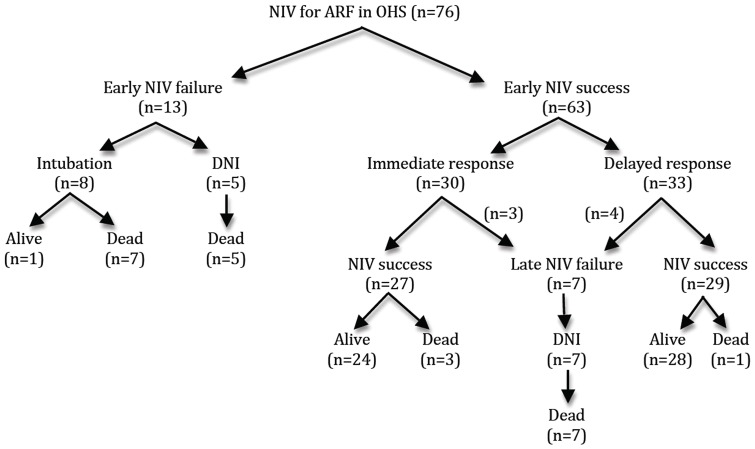
Results: NIV failed to reverse ARF in only 13 patients. Factors associated with NIV failure included pneumonia (n = 12/13, 92% vs n = 9/63, 14%; p<0.0001), high SOFA (10 vs 5; p<0.0001) and SAPS2 score (63 vs 39; p<0.0001) at admission. These patients often experienced poor outcome despite early resort to endotracheal intubation (in-hospital mortality, 92.3% vs 17.5%; p<0.001). The only factor significantly associated with successful response to NIV was idiopathic decompensation of OHS (n = 30, 48% vs n = 0, 0%; p = 0.001). In the NIV success group (n = 63), 33 patients (53%) experienced a delayed response to NIV (with persistent hypercapnic acidosis during the first 6 hours).
Conclusions: Multiple organ failure and pneumonia were the main factors associated with NIV failure and death in morbidly obese patients in hypoxemic ARF. On the opposite, NIV was constantly successful and could be safely pushed further in case of severe hypercapnic acute respiratory decompensation of OHS.
Conflict of interest statement
Figures

References
-
- Finucane MM, Stevens GA, Cowan MJ, Danaei G, Lin JK, et al. (2011) National, regional, and global trends in body-mass index since 1980: systematic analysis of health examination surveys and epidemiological studies with 960 country-years and 9·1 million participants. Lancet. 377: 557–567. - PMC - PubMed
-
- Nowbar S, Burkart KM, Gonzales R, Fedorowicz A, Gozansky WS, et al. (2004) Obesity-associated hypoventilation in hospitalized patients: prevalence, effects, and outcome. Am J Med. 116: 1–7. - PubMed
-
- Mokhlesi B (2010) Obesity hypoventilation syndrome: a state-of-the-art review. Resp Care. 55: 1347–1362. - PubMed
-
- Piper AJ, Grunstein RR (2011) Obesity hypoventilation syndrome, mechanisms and management. Am J Respir Crit Care Med. 183: 292–298. - PubMed
-
- Marik PE (2012) The malignant obesity hypoventilation syndrome (MOHS). Obesity Reviews. 13: 902–9. - PubMed
Publication types
MeSH terms
LinkOut - more resources
Full Text Sources
Other Literature Sources
Medical
