A comprehensive evaluation of human papillomavirus positive status and p16INK4a overexpression as a prognostic biomarker in head and neck squamous cell carcinoma
- PMID: 24820457
- PMCID: PMC4079160
- DOI: 10.3892/ijo.2014.2440
A comprehensive evaluation of human papillomavirus positive status and p16INK4a overexpression as a prognostic biomarker in head and neck squamous cell carcinoma
Abstract
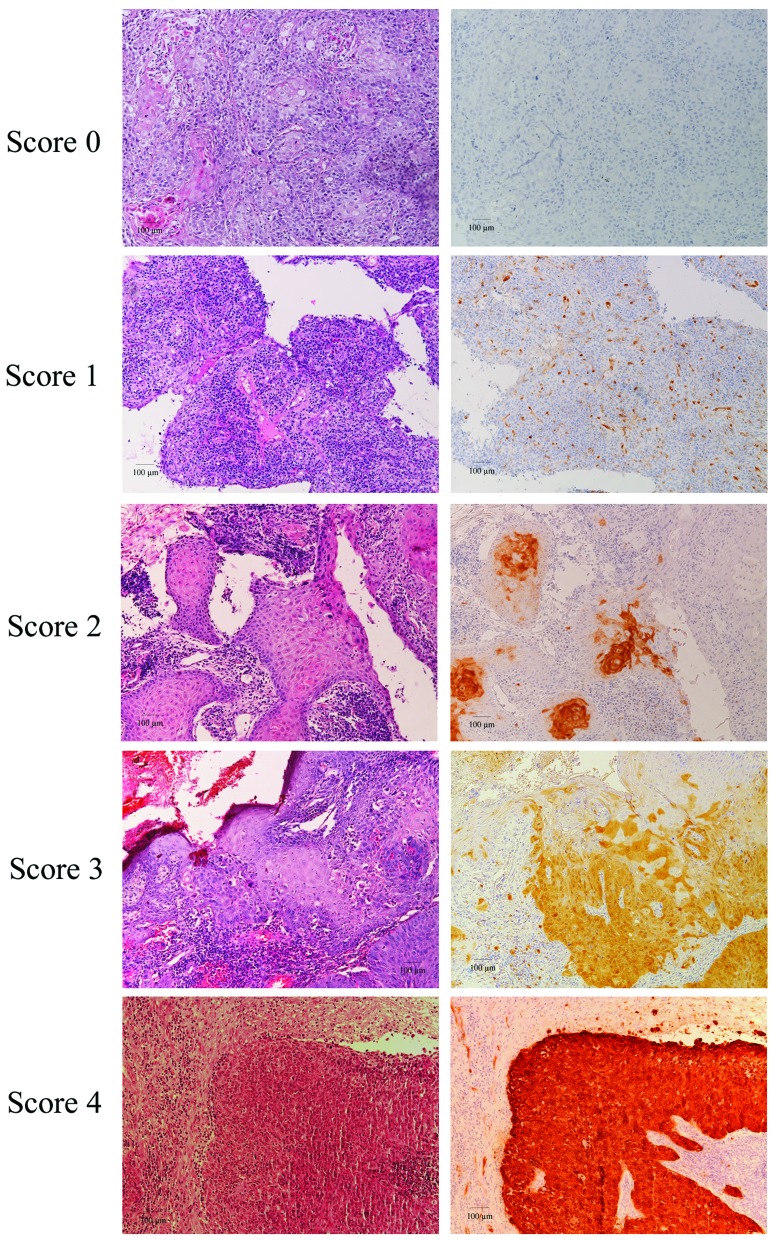
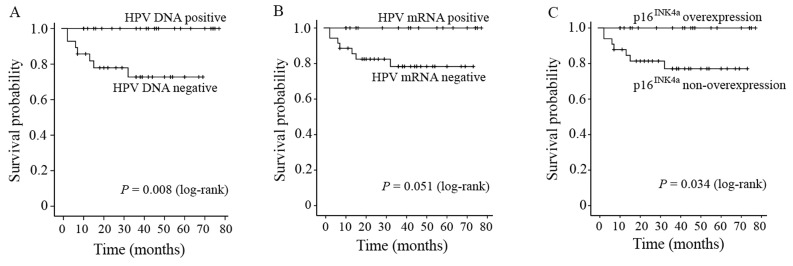
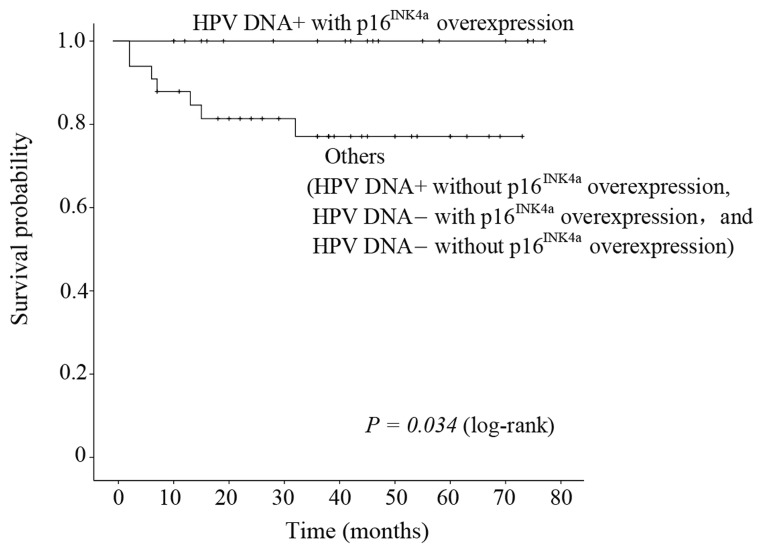
Head and neck squamous cell carcinoma (HNSCC) patients with human papillomavirus (HPV) infection have better prognosis than those without HPV infection. Although p16(INK4a) expression is used as a surrogate marker for HPV infection, there is controversy as to whether p16(INK4a) reliably indicates HPV infection. Here, to evaluate the accuracy of p16(INK4a) expression for determining HPV infection and the prognostic value of HPV infection and p16(INK4a) expression for HNSCC survival, especially oropharyngeal squamous cell carcinoma (OPSCC) survival, 150 fresh-frozen HNSCC samples were analyzed for HPV DNA, E6/E7 mRNA and p16(INK4a) expression by polymerase chain reaction and immunohistochemistry. p16(INK4a) expression was scored from 0 to 4 according to the percentage of p16(INK4a)-positive cells, with overexpression defined as >40% positive cells. Of the 150 tumor samples tested, 10 tumors were nasopharyngeal, 53 oropharyngeal, 39 hypopharyngeal, 24 laryngeal and 24 were located in the oral cavity. HPV DNA was detected in 47 (31.3%) samples, but only 21 also exhibited HPV mRNA expression. Inter-rater agreement was low between p16(INK4a) expression and HPV DNA presence and between p16(INK4a) expression and HPV mRNA expression, but was good between the combination of HPV DNA status and p16(INK4a) overexpression and HPV mRNA expression. Three-year recurrence-free survival was significantly higher for OPSCC patients who were HPV DNA-positive than for OPSCC patients who were HPV DNA-negative (P=0.008) and for OPSCC patients overexpressing p16(INK4a) than for without overexpressing p16(INK4a) (P=0.034). Multivariate analysis revealed that T1-3 stage and the combination of HPV DNA positivity and p16(INK4a) overexpression predicted significantly better recurrence-free survival. This combination is a more accurate marker for active HPV infection in HNSCC than HPV DNA status or general p16(INK4a)-positive status alone and offers a useful and reliable method for detecting and determining the prognosis of HPV-related HNSCC.
Figures
References
-
- Jemal A, Bray F, Center MM, Ferlay J, Ward E, Forman D. Global cancer statistics. CA Cancer J Clin. 2011;61:69–90. - PubMed
-
- Hashibe M, Brennan P, Chuang SC, Boccia S, Castellsague X, Chen C, Curado MP, Dal Maso L, Daudt AW, Fabianova E, Fernandez L, Wunsch-Filho V, Franceschi S, Hayes RB, Herrero R, Kelsey K, Koifman S, La Vecchia C, Lazarus P, Levi F, Lence JJ, Mates D, Matos E, Menezes A, McClean MD, Muscat J, Eluf-Neto J, Olshan AF, Purdue M, Rudnai P, Schwartz SM, Smith E, Sturgis EM, Szeszenia-Dabrowska N, Talamini R, Wei Q, Winn DM, Shangina O, Pilarska A, Zhang ZF, Ferro G, Berthiller J, Boffetta P. Interaction between tobacco and alcohol use and the risk of head and neck cancer: pooled analysis in the international head and neck cancer epidemiology consortium. Cancer Epidemiol Biomarkers Prev. 2009;18:541–550. - PMC - PubMed
-
- Gillison ML, Koch WM, Capone RB, Spafford M, Westra WH, Wu L, Zahurak ML, Daniel RW, Viglione M, Symer DE, Shah KV, Sidransky D. Evidence for a causal association between human papillomavirus and a subset of head and neck cancers. J Natl Cancer Inst. 2000;92:709–720. - PubMed
-
- Näsman A, Attner P, Hammarstedt L, Du J, Eriksson M, Giraud G, Ahrlund-Richter S, Marklund L, Romanitan M, Lindquist D, Ramqvist T, Lindholm J, Sparén P, Ye W, Dahlstrand H, Munck-Wikland E, Dalianis T. Incidence of human papillomavirus (HPV) positive tonsillar carcinoma in Stockholm, Sweden: an epidemic of viral-induced carcinoma? Int J Cancer. 2009;125:362–366. - PubMed
-
- Deng Z, Hasegawa M, Matayoshi S, Kiyuna A, Yamashita Y, Maeda H, Suzuki M. Prevalence and clinical features of human papillomavirus in head and neck squamous cell carcinoma in Okinawa, southern Japan. Eur Arch Otorhinolaryngol. 2011;268:1625–1631. - PubMed
Publication types
MeSH terms
Substances
LinkOut - more resources
Full Text Sources
Other Literature Sources
Medical