. 2015 Oct;62(4):1040-1047.e2.
doi: 10.1016/j.jvs.2014.04.033. Epub 2014 May 10.

Hypercholesterolemia inhibits re-endothelialization of arterial injuries by TRPC channel activation

Affiliations

Hypercholesterolemia inhibits re-endothelialization of arterial injuries by TRPC channel activation

Michael A Rosenbaum et al. J Vasc Surg. 2015 Oct.

Abstract

Objective: After arterial injury, endothelial cell (EC) migration is essential for healing, but lipid oxidation products activate TRPC6 and TRPC5 ion channels, leading to increased intracellular calcium and inhibition of EC migration in vitro. The objective of this study was to further evaluate the role of TRPC channels in EC migration in vitro and to validate in vitro findings in an in vivo model.

Methods: Mouse aortic ECs were cultured, and the effect of lysophosphatidylcholine, the major lysophospholipid in oxidized low-density lipoprotein, on migration was assessed in a razor-scrape assay. EC healing after a carotid injury with electrocautery was evaluated in wild-type (WT), TRPC6(-/-), and TRPC5(-/-) mice receiving either a chow or high-cholesterol (HC) diet.

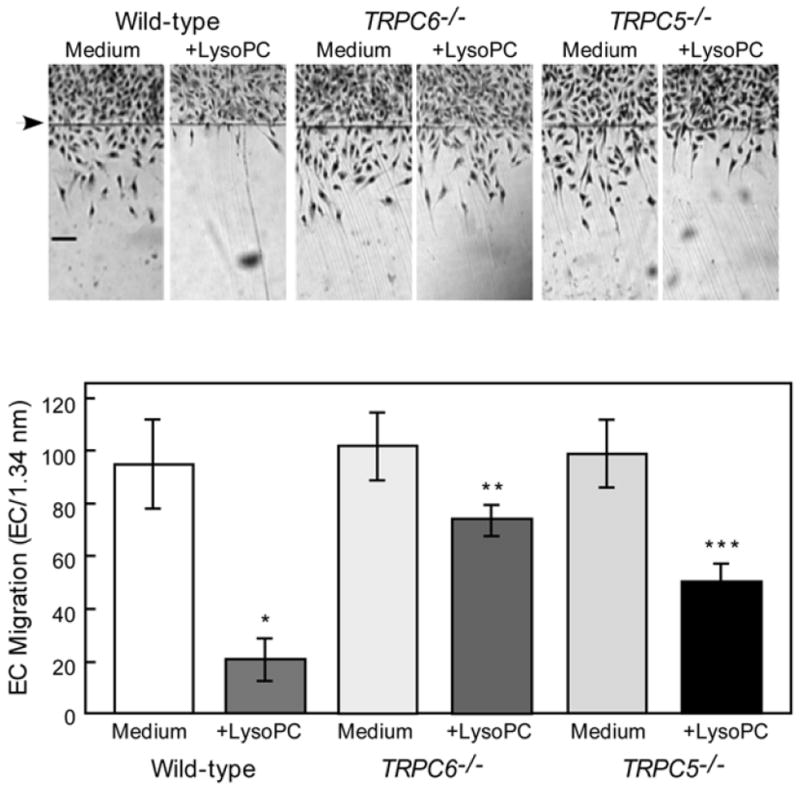
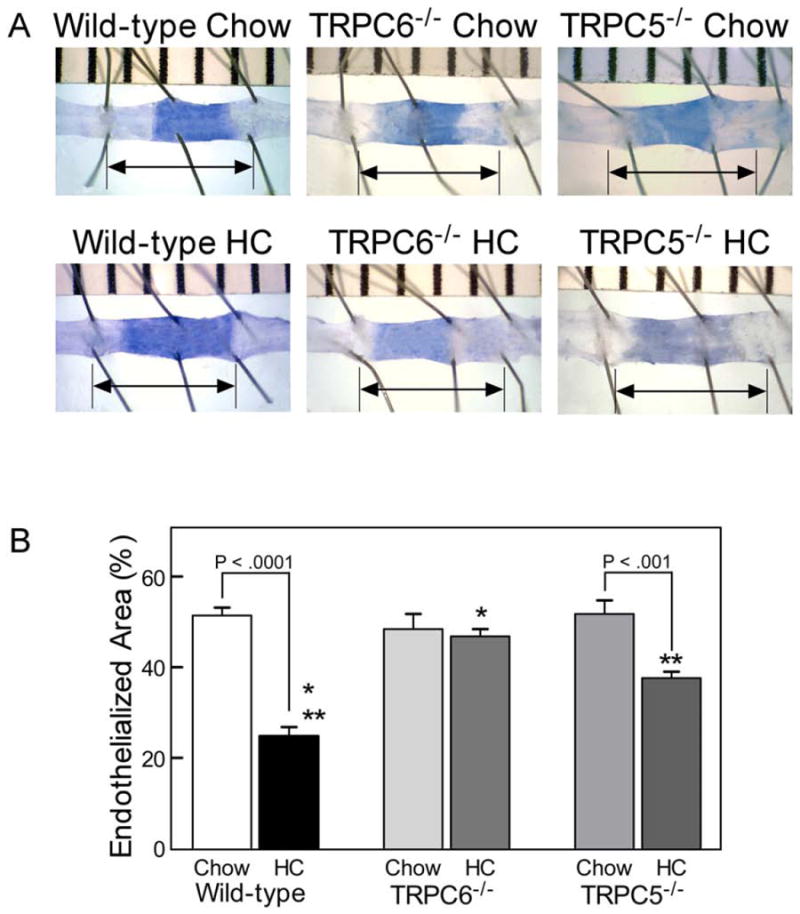
Results: Lysophosphatidylcholine inhibited EC migration of WT ECs to 22% of baseline and of TRPC5(-/-) ECs to 53% of baseline but had minimal effect on TRPC6(-/-) EC migration. Hypercholesterolemia severely impaired EC healing in vivo, with 51.4% ± 1.8% and 24.9% ± 2.0% of the injury resurfaced with ECs at 5 days in chow-fed and HC-fed WT mice, respectively (P < .001). Hypercholesterolemia did not impair healing in TRPC6(-/-) mice, with coverage of 48.4% ± 3.4% and 46.8% ± 1.6% in chow-fed and HC-fed TRPC6(-/-) mice, respectively. Hypercholesterolemia had a reduced inhibitory effect in TRPC5(-/-) mice, with EC coverage of 51.7% ± 3.0% and 37.% ± 1.4% in chow-fed and HC-fed TRPC5(-/-) mice, respectively.

Conclusions: Results suggest that activation of TRPC6 and TRPC5 channels is the key contributor to impaired endothelial healing of arterial injuries in hypercholesterolemic mice.


Conflict of interest statement

DISCLOSURE

The authors have no conflicts of interest to disclose.

Figures
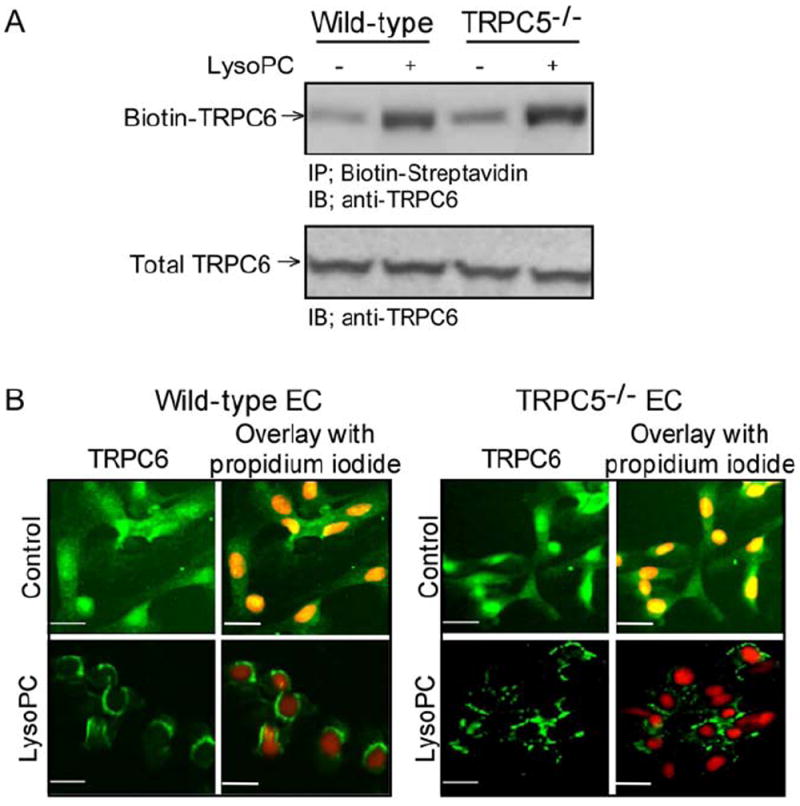
Fig 1
Fig 1. Lysophosphatidylcholine (lysoPC) induces externalization of canonical transient receptor potential (TRPC) 6 protein in TRPC5-/- endothelial cells (ECs)
(A) Wild-type and TRPC5-/- ECs were incubated with or without lysoPC for 1 hour. Cell surface proteins were biotinylated and immunoblot analysis was performed for biotinylated TRPC6 (top panel). Prior to incubation with streptavidin-agarose beads, an aliquot of cell lysate was removed for immunoblot analysis to determine total TRPC6 protein level (bottom panel). (B) WT or TRPC5-/- ECs were incubated with or without lysoPC for 15 minutes, and then exposed to anti-TRPC6 antibody followed by Alexa 488 conjugated secondary antibody. TRPC6 location was assessed by fluorescence microscopy. Nuclei were detected by counterstaining with propidium iodide. Original magnification, x40. Bar, 40 μm.
Fig 2
Fig 2. The anti-migratory effect of lysophosphatidylcholine (lysoPC) is attenuated in canonical transient receptor potential (TRPC) 5-deficient (TRPC5-/-) ECs
Migration assay was initiated in quiescent WT, TRPC6-/- (previously reported, but included for comparison), and TRPC5-/- ECs, lysoPC (10 μM) added, and migration quantitated at 24 hours. Arrow indicates starting line of migration. Original magnification, x40. Bar, 100 μm. The bottom panel represents migration results by mean ± SD (n = 3, * P < .001 compared with WT control ECs, ** P < .001 compared with TRPC6-/- control (previously reported, but included for comparison) and *** P < .001 compared with TRPC5-/- control).
Fig 3
Fig 3. Endothelial healing after carotid artery injury
(A) Representative images 120 hours after carotid electrocautery. The area without an intact endothelial monolayer stained with Evans Blue. The arrow identifies the length of the original injury. (B) Reendothelialization results shown as the percent of reendothelialized area relative to the total injured area. Results are expressed as the mean ± standard error for each group: wild-type chow diet (n = 10), wild-type high cholesterol (HC) diet (n = 10), TRPC6-/- chow diet (n = 8), TRPC6-/- HC diet (n = 8, * P < .0001 compared with wild-type HC), TRPC5-/- chow diet (n = 8), and TRPC5-/- HC diet (n = 8, ** P = .0001 compared with wild-type HC).

References

    1. Rosenbaum MA, Miyazaki K, Graham LM. Hypercholesterolemia and oxidative stress inhibit endothelial cell healing after arterial injury. J Vasc Surg. 2012 Oct 31;55(2):489–496. - PMC - PubMed
    1. Murugesan G, Chisolm GM, Fox PL. Oxidized low density lipoprotein inhibits the migration of aortic endothelial cells in vitro. J Cell Biol. 1993;120:1011–1019. - PMC - PubMed
    1. Murugesan G, Fox PL. Role of lysophosphatidylcholine in the inhibition of endothelial cell motility by oxidized low density lipoprotein. J Clin Invest. 1996;97:2736–2744. - PMC - PubMed
    1. Ishii I, Fukushima N, Ye X, Chun J. Lysophospholipid receptors: signaling and biology. Annu Rev Biochem. 2004;73:321–354. - PubMed
    1. Portman OW, Alexander M. Lysophosphatidylcholine concentration and metabolism in aortic intima plus inner media: effect of nutritionally induced atherosclerosis. J Lipid Res. 1969;10:158–165. - PubMed

Publication types