


Effectiveness of motivational interviewing to reduce head start children's secondhand smoke exposure. a randomized clinical trial
- PMID: 24821270
- PMCID: PMC4226021
- DOI: 10.1164/rccm.201404-0618OC
Effectiveness of motivational interviewing to reduce head start children's secondhand smoke exposure. a randomized clinical trial
Abstract
Rationale: Secondhand smoke exposure (SHSe) is a significant modifiable risk for respiratory health in children. Although SHSe is declining overall, it has increased for low-income and minority populations. Implementation of effective SHSe interventions within community organizations has the potential for significant public health impact.
Objectives: To evaluate the effectiveness of motivational interviewing (MI) delivered in the context of a SHS education reduction initiative within Head Start to reduce preschool children's SHSe.
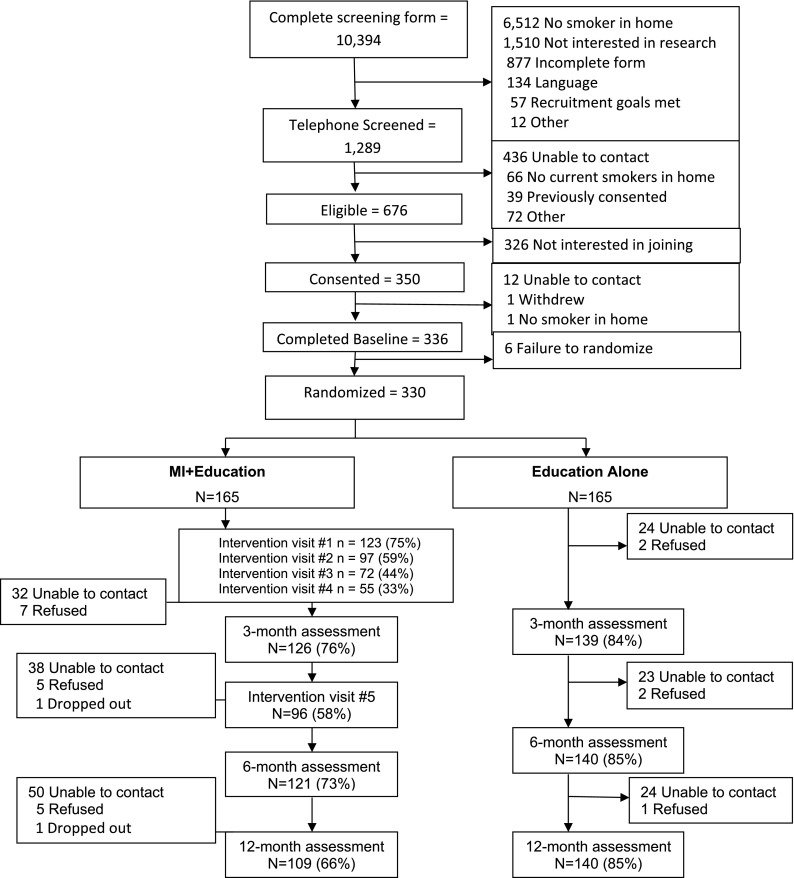
Methods: A total of 350 children enrolled in Baltimore City Head Start whose caregivers reported a smoker living in the home were recruited. Caregivers were randomized to MI + education or education alone. Assessments were conducted at baseline, 3, 6, and 12 months.
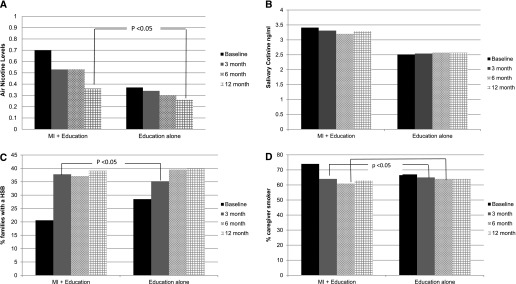
Measurements and main results: The primary outcome measure was household air nicotine levels measured by passive dosimeters. Secondary outcomes included child salivary cotinine, self-report of home smoking ban (HSB), and smoking status. Participants in the MI + education group had significantly lower air nicotine levels (0.29 vs. 0.40 mg), 17% increase in prevalence of caregiver-reported HSBs, and a 13% decrease in caregiver smokers compared with education-alone group (all P values < 0.05). Although group differences in salivary cotinine were not significant, among all families who reported having an HSB, salivary cotinine and air nicotine levels declined in both groups (P < 0.05).
Conclusions: MI may be effective in community settings to reduce child SHSe. More research is needed to identify ways to tailor interventions to directly impact child SHSe and to engage more families to make behavioral change. Clinical trial registered with www.clinicaltrials.gov (NCT 00927264).
Trial registration: ClinicalTrials.gov NCT00927264.
Keywords: community engaged research; preschool children; randomized controlled trial; secondhand smoke.
Figures
Comment in
-
The challenge of reducing smoking in low-income parents.Am J Respir Crit Care Med. 2014 Jun 15;189(12):1457-8. doi: 10.1164/rccm.201405-0893ED. Am J Respir Crit Care Med. 2014. PMID: 24930527 No abstract available.
References
-
- Treyster Z, Gitterman B. Second hand smoke exposure in children: environmental factors, physiological effects, and interventions within pediatrics. Rev Environ Health. 2011;26:187–195. - PubMed
-
- US Department of Health and Human ServicesThe health consequences of involuntary exposure to tobacco smoke: a report of the Surgeon GeneralAtlanta, GA: US Department of Health and Human Services, Centers for Disease Control and Prevention, Coordinating Center for Health Promotion, National Center for Chronic Disease Prevention and Health Promotion, Office on Smoking and Health; 2006
-
- Burke H, Leonardi-Bee J, Hashim A, Pine-Abata H, Chen Y, Cook DG, Britton JR, McKeever TM. Prenatal and passive smoke exposure and incidence of asthma and wheeze: systematic review and meta-analysis. Pediatrics. 2012;129:735–744. - PubMed
-
- Neogi T, Neher JO, Safranek S. Clinical inquiry. How does smoking in the home affect children with asthma? J Fam Pract. 2012;61:292–293. - PubMed
-
- Mitchell EA, Milerad J. Smoking and the sudden infant death syndrome. Rev Environ Health. 2006;21:81–103. - PubMed
Publication types
MeSH terms
Substances
Associated data
Grants and funding
LinkOut - more resources
Full Text Sources
Other Literature Sources
Medical
