Review
. 2014 Dec;24(4):389-408.
doi: 10.1007/s11065-014-9261-x. Epub 2014 May 13.

Functional plasticity in childhood brain disorders: when, what, how, and whom to assess

Affiliations
Review

Functional plasticity in childhood brain disorders: when, what, how, and whom to assess

Maureen Dennis et al. Neuropsychol Rev. 2014 Dec.

Abstract

At every point in the lifespan, the brain balances malleable processes representing neural plasticity that promote change with homeostatic processes that promote stability. Whether a child develops typically or with brain injury, his or her neural and behavioral outcome is constructed through transactions between plastic and homeostatic processes and the environment. In clinical research with children in whom the developing brain has been malformed or injured, behavioral outcomes provide an index of the result of plasticity, homeostasis, and environmental transactions. When should we assess outcome in relation to age at brain insult, time since brain insult, and age of the child at testing? What should we measure? Functions involving reacting to the past and predicting the future, as well as social-affective skills, are important. How should we assess outcome? Information from performance variability, direct measures and informants, overt and covert measures, and laboratory and ecological measures should be considered. In whom are we assessing outcome? Assessment should be cognizant of individual differences in gene, socio-economic status (SES), parenting, nutrition, and interpersonal supports, which are moderators that interact with other factors influencing functional outcome.


Figures

Figure 1
Figure 1
Model of typical development (solid line) and brain disorders (dashed line). Models A-D include two time points (Early Intercept #1, Mature Intercept #2), and one slope (Developmental Slope #3). Models E-J include four additional time points (Early intercept #1, Mature intercept #2, Injury Intercept #4, Recovery Intercept #6), and four additional slopes (Developmental Slope #3, Loss Slope #5, Recovery Slope #7, and New Skills Slope #8). Intercepts are shown in regular font, slopes in italics; star represents timing of insult.
Figure 2
Figure 2
At 3 months the loss of fiber tracts indicates early degeneration which could be primary, reflecting neuronal cell death and Wallerian degeneration, or secondary to retrograde and/or anterograde degeneration specific to axonal injury and shearing. By 18 months fiber tracts are still reduced in number and level of dispersion, but some have either reconstituted, remyelinated or maturational changes have occurred in existing aggregate axonal tracts. As a consequence of neural degeneration from traumatic brain injury, it takes hours to several days to begin to detect degenerative effects with neuroimaging techniques like MRI, but maximal changes typically peak in the 3-6 month post-injury timeframe. As seen in this case thinning of corpus callosum tracts as a consequence of TBI is evident by 3 months and although the 18 month follow-up shows some difference, the overall pattern of loss of tracts retains the frontal distribution. Dynamic changes that occur after that 3-6 month timeframe likely reflect aspects of compensatory changes and neural plasticity involving connectivity via different tracts and networks. As explicitly shown in this figure, if a tract is lost as a consequence of trauma, it may be permanently absent (note some of the gaps in fiber tracts are permanently reduced and no different at 18 months). As such, interhemispheric transfer of information must flow via alternate connections.
Figure 3
Figure 3
Cerebellar macrostructure in spina bifida meningomyelocele (see Juranek et al, 2010). Parcellation shows a four-compartment model (one white matter and three principally gray matter) of the cerebellum. 1) Corpus medullare (light blue): central white matter and output nuclei; 2) Anterior lobe (green) lobules I-V, bounded by the most posterior point of fourth ventricle, corpus medullare, and primary fissure; 3) Superior posterior lobe (dark blue): lobe VI and crus I of VIIA, bounded by primary fissure, corpus medullare, and horizontal fissure; 4) Inferior posterior lobe (khaki): crus II of VIIA, VIIB, VIII, IX, X, bounded by the most posterior point of the fourth ventricle, corpus medullare, and horizontal fissure. The total cerebellar volume is smaller. However, the configurative is distinctive to spina bifida. After correcting for total cerebellum volume, and relative to controls, the spina bifida group shows:
  1. posterior lobe significantly smaller

  2. corpus medullare not different

  3. anterior lobe enlarged.

  4. Cerebellar volume deficits in SBM group involves a reconfiguration involving anterior lobe enlargement and posterior lobe reduction.
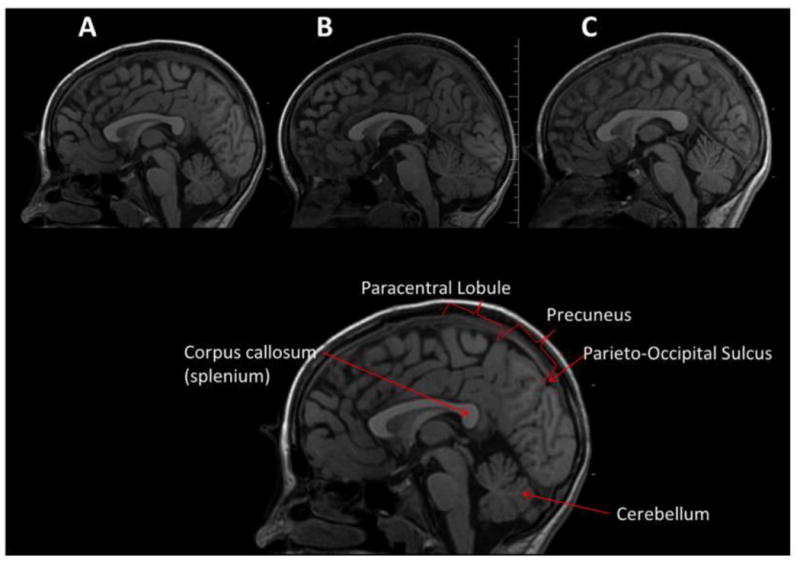
Figure 4
Figure 4
Mid-sagittal view of the brain from three typically developing children of approximately the same age and SES, who served as orthopedically injured controls in the Social Outcome in Brain Injury in Kids (SOBIK) study (see Bigler et al., 2013; Dennis et al., 2012). The cutting plane is identical in all three at the level of the aqueduct of Sylvius, a traditional midline marker. While similar in general appearance, each brain is unique in shape, size and morphology. For example, a prominent posterior corpus callosum with a rather bulbous splenium is evident in A and C, but not B. The cerebellum in B is substantially larger than in A or C. The bottom figure is the same as “A” and used to label regions of interest for comparison to show the heterogeneity in brain morphology. Note the individual differences: the unique shape of the corpus callosum, the different gyral patterns within identifiable regions like the paracentral lobule and precuneus, and the distinctiveness of the parieto-occipital sulcus.

References

    1. Aarsen FK, Van Dongen HR, Paquier PF, Van Mourik M, Catsman-Berrevoets CE. Long-term sequelae in children after cerebellar astrocytoma surgery. Neurology. 2004;62(8):1311–1316. - PubMed
    1. Anderson VA, Anderson P, Northam E, Jacobs R, Mikiewicz O. Relationships between cognitive and behavioral measures of executive function in children with brain disease. Child Neuropsychol. 2002;8(4):231–240. - PubMed
    1. Anderson V, Anderson D, Anderson P. Comparing attentional skills in children with acquired and developmental central nervous system disorders. J Int Neuropsychol Soc. 2006;12(4):519–531. - PubMed
    1. Arnett AB, Peterson RL, Kirkwood MW, Taylor HG, Stancin T, Brown TM, et al. Behavioral and cognitive predictors of educational outcomes in pediatric traumatic brain injury. J Int Neuropsychol Soc. 2013;19(8):881–889. - PMC - PubMed
    1. Ater JL, Moore BD, 3rd, Francis DJ, Castillo R, Slopis J, Copeland DR. Correlation of medical and neurosurgical events with neuropsychological status in children at diagnosis of astrocytoma: utilization of a neurological severity score. J Child Neurol. 1996;11(6):462–469. - PubMed

Publication types
