


Time trends in glucocorticoid use in rheumatoid arthritis: results from a population-based inception cohort, 1980-1994 versus 1995-2007
- PMID: 24821680
- PMCID: PMC4177279
- DOI: 10.1002/acr.22365
Time trends in glucocorticoid use in rheumatoid arthritis: results from a population-based inception cohort, 1980-1994 versus 1995-2007
Abstract
Objective: To examine trends in glucocorticoid (GC) use and dosing among patients diagnosed with rheumatoid arthritis (RA) over time.
Methods: A population-based inception cohort of RA patients diagnosed during 1980-2007 was followed longitudinally through their medical records until death, migration, or December 31, 2008. GC start and stop dates were collected, along with doses in prednisone equivalents.
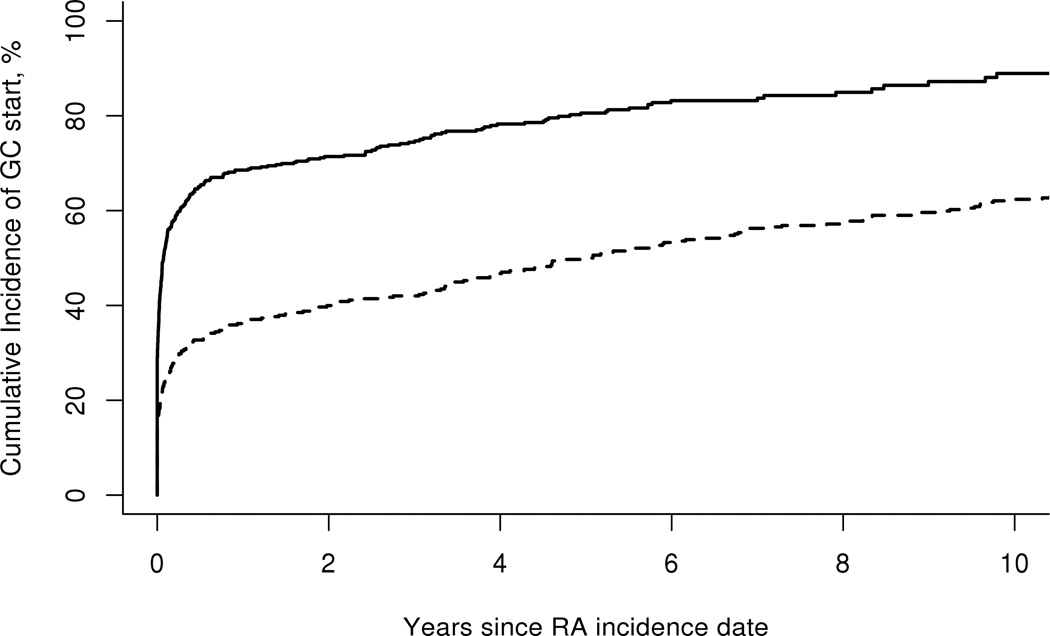
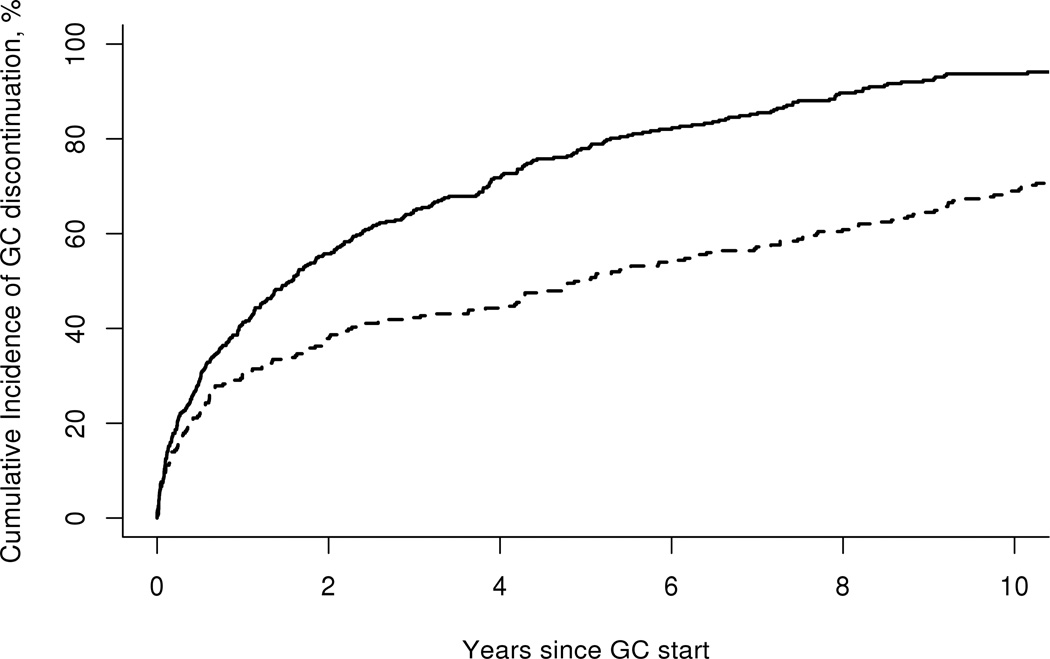
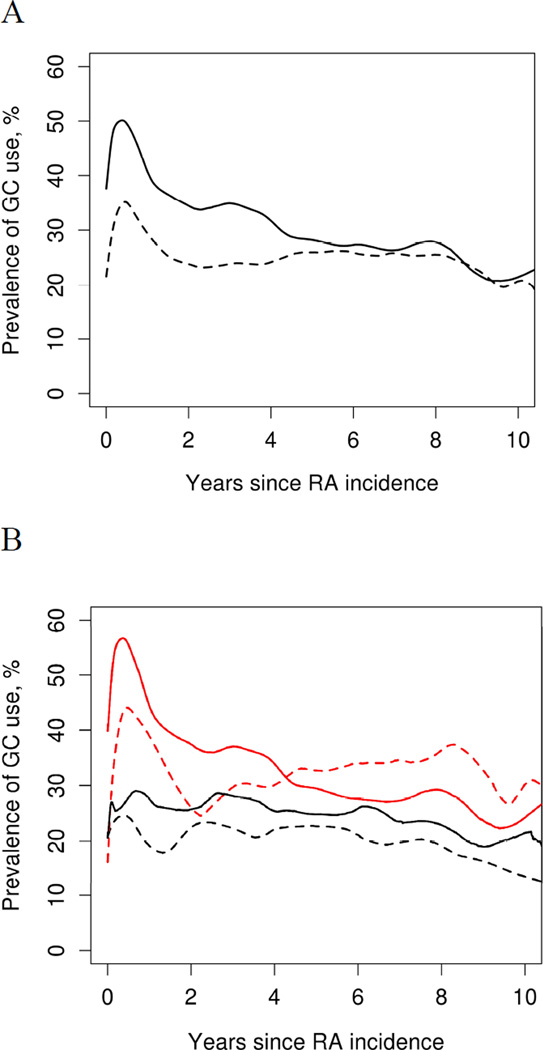
Results: The study population comprised 349 patients (68% women) diagnosed in 1980-1994 and 464 (69% women) diagnosed in 1995-2007, with a median followup of 15.3 and 5.7 years, respectively. A higher proportion of patients started GCs in their first year of disease in 1995-2007 (68% versus 36%; P < 0.001), but the starting dose (mean 8.7 versus 10.3 mg; P = 0.08) and cumulative dose in the first year of use (mean 1.8g [mean daily dose 4.9 mg] versus 2.1 gm [mean daily dose 5.8 mg]; P = 0.48) were not different. A higher proportion also discontinued GCs in their first year of disease in the 1995-2007 cohort (P < 0.001). These differences in GC initiation and discontinuation persisted throughout followup. Prevalence of GC use was higher in the 1995-2007 cohort for the first 3 years of disease.
Conclusion: More patients are starting GCs early in their disease course now compared to previously, which is consistent with established treatment guidelines. A higher proportion are also discontinuing GCs, but the proportion of patients taking GCs at any given point of disease during the first 4 years is higher now than previously. Despite early addition of a disease-modifying antirheumatic drug, some patients may not be able to discontinue GCs over the long term.
Copyright © 2014 by the American College of Rheumatology.
Conflict of interest statement
None of the authors have any relevant financial or other conflicts of interests to disclose relevant to this manuscript.
Figures
References
-
- Hillier SG. Diamonds are forever: the cortisone legacy. J Endocrinol. 2007;195(1):1–6. - PubMed
-
- Bakker MF, Jacobs JW, Welsing PM, Verstappen SM, Tekstra J, Ton E, et al. Low-dose prednisone inclusion in a methotrexate-based, tight control strategy for early rheumatoid arthritis: a randomized trial. Ann Intern Med. 2012;156(5):329–339. - PubMed
-
- van Everdingen AA, Jacobs JW, Siewertsz Van Reesema DR, Bijlsma JW. Low-dose prednisone therapy for patients with early active rheumatoid arthritis: clinical efficacy, disease-modifying properties, and side effects: a randomized, double-blind, placebo-controlled clinical trial. Ann Intern Med. 2002;136(1):1–12. - PubMed
-
- Caplan L, Wolfe F, Russell AS, Michaud K. Corticosteroid use in rheumatoid arthritis: prevalence, predictors, correlates, and outcomes. J Rheumatol. 2007;34(4):696–705. - PubMed
Publication types
MeSH terms
Substances
Grants and funding
LinkOut - more resources
Full Text Sources
Other Literature Sources
Medical
Miscellaneous
