Review
. 2014 May 12;369(1645):20130437.
doi: 10.1098/rstb.2013.0437. Print 2014.

The ongoing challenge of latent tuberculosis

Affiliations
Review

The ongoing challenge of latent tuberculosis

H Esmail et al. Philos Trans R Soc Lond B Biol Sci. .

Abstract

The global health community has set itself the task of eliminating tuberculosis (TB) as a public health problem by 2050. Although progress has been made in global TB control, the current decline in incidence of 2% yr(-1) is far from the rate needed to achieve this. If we are to succeed in this endeavour, new strategies to reduce the reservoir of latently infected persons (from which new cases arise) would be advantageous. However, ascertainment of the extent and risk posed by this group is poor. The current diagnostics tests (tuberculin skin test and interferon-gamma release assays) poorly predict who will develop active disease and the therapeutic options available are not optimal for the scale of the intervention that may be required. In this article, we outline a basis for our current understanding of latent TB and highlight areas where innovation leading to development of novel diagnostic tests, drug regimens and vaccines may assist progress. We argue that the pool of individuals at high risk of progression may be significantly smaller than the 2.33 billion thought to be immune sensitized by Mycobacterium tuberculosis and that identifying and targeting this group will be an important strategy in the road to elimination.

Keywords: Mycobacterium tuberculosis; diagnosis; elimination; latent tuberculosis; natural history; treatment.


Figures
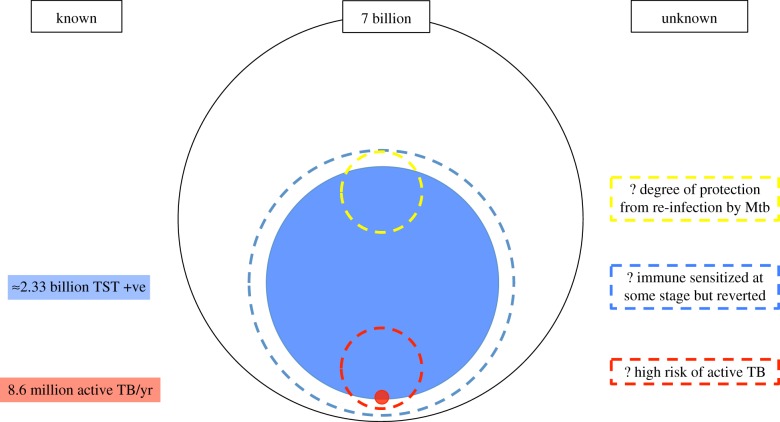
Figure 1.
Figure 1.
Reservoir of TB—we currently have estimates for proportion of population that are immune sensitized (large circle) and number of cases of active TB annually (small filled circle). As TST and IGRA reversion can occur, total number of exposed persons may be greater than this (larger dashed circle), in addition TST and IGRA are only moderately sensitive for active TB. A much smaller pool of people may be at much higher risk of TB (bottom small dashed circle) and also a proportion of people may receive considerable protection against reinfection (top small dashed circle). Identifying these additional populations may be very valuable. (Online version in colour.)
Figure 2.
Figure 2.
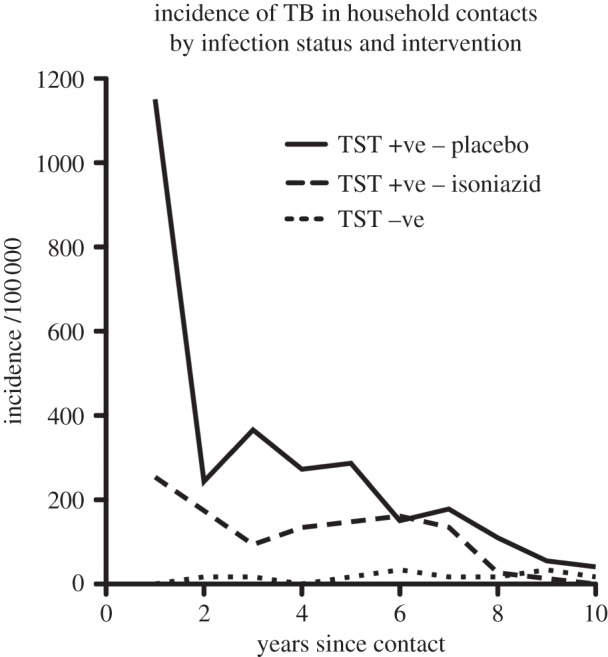
Incidence of TB in household contacts of TB treated with isoniazid or placebo over 10 years by TST status (TST − ve less than 5 mm). Based on data for 26 833 persons from Ferebee [22].
Figure 3.
Figure 3.
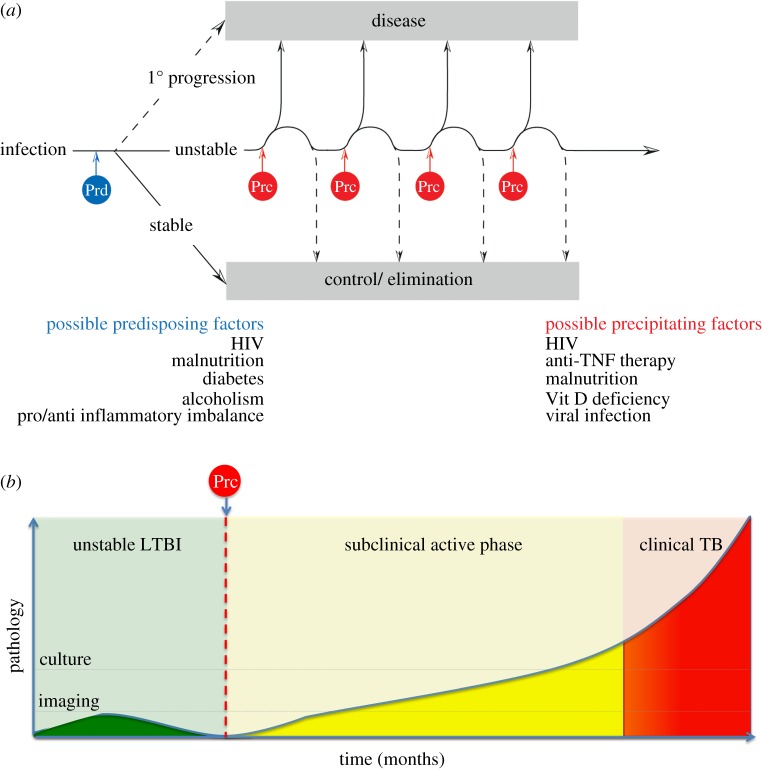
(a) Following infection, there may be a critical period where fate of infection is determined with predisposing factors (Prd) influencing this outcome. In a small proportion, the primary infection may be progressive; in those that control primary infection, a proportion may eliminate TB or exert highly effective control and be at very low risk of reactivation. In the third group, control may be unstable waxing and waning in response to a variety of precipitating factors (Prc) with reactivation of TB most likely to occur in this high-risk group. (b) Precipitating factors (Prc) may lead to progression of disease. Prior to presentation these individuals may pass through a subclinical phase of active infection which may last months; during this phase Mtb may be isolated by culture or pathology may be visible through imaging prior to symptomatic presentation. (Online version in colour.)
Figure 4.
Figure 4.
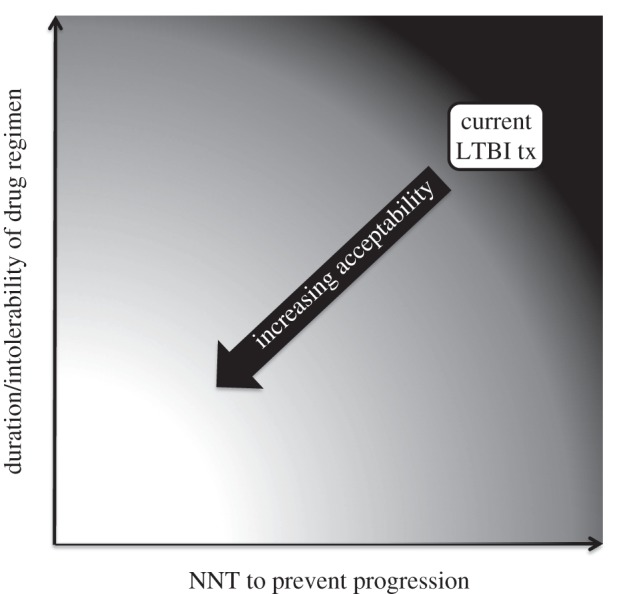
Acceptability of treatment relates to the duration and tolerability of treatment and the likelihood of benefit (prevention of progression to active disease). Improvements in drug regimens and/or improvements in predictability of diagnostic tests should lead to improved acceptability of treating LTBI.

References

    1. Gagneux S. 2012. Host–pathogen coevolution in human tuberculosis. Phil. Trans. R. Soc. B 367, 850–859. (10.1098/rstb.2011.0316) - DOI - PMC - PubMed
    1. Comas I, et al. 2013. Out-of-Africa migration and Neolithic coexpansion of Mycobacterium tuberculosis with modern humans. Nat. Genet. 45, 1176–1182. (10.1038/ng.2744) - DOI - PMC - PubMed
    1. Wirth T, et al. 2008. Origin, spread and demography of the Mycobacterium tuberculosis complex. PLoS Pathog. 4, e1000160 (10.1371/journal.ppat.1000160) - DOI - PMC - PubMed
    1. Blaser MJ, Kirschner D. 2007. The equilibria that allow bacterial persistence in human hosts. Nature 449, 843–849. (10.1038/nature06198) - DOI - PubMed
    1. Hershberg R, et al. 2008. High functional diversity in Mycobacterium tuberculosis driven by genetic drift and human demography. PLoS Biol. 6, e311 (10.1371/journal.pbio.0060311) - DOI - PMC - PubMed

MeSH terms