


Lateralization of motor cortex excitability in stroke patients during action observation: a TMS study
- PMID: 24822187
- PMCID: PMC4009102
- DOI: 10.1155/2014/251041
Lateralization of motor cortex excitability in stroke patients during action observation: a TMS study
Abstract
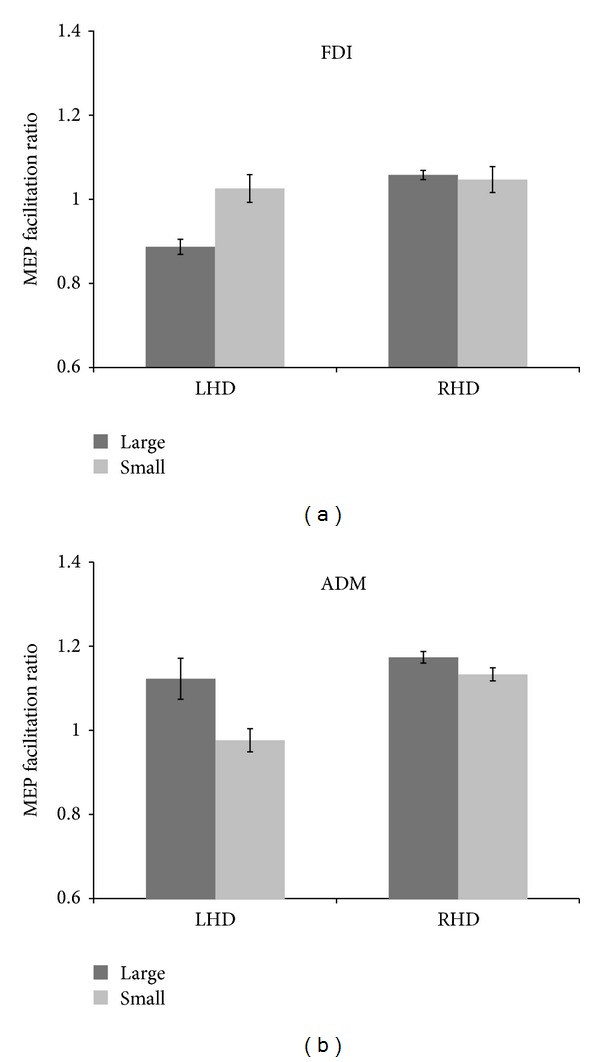
Action observation activates the same motor areas as those involved in the performance of the observed actions and promotes functional recovery following stroke. Movement observation is now considered a promising tool for motor rehabilitation, by allowing patients to train their motor functions when voluntary movement is partially impaired. We asked chronic-stroke patients, affected by either left (LHD) or right hemisphere (RHD) lesions, to observe either a left or right hand, while grasping a small target (eliciting a precision grip) or a large target (eliciting a whole hand grasp directed towards a target object). To better understand the effects of action observation on damaged motor circuits, we used transcranial magnetic stimulation (TMS) to induce motor evoked potentials (MEP) from two muscles of the unaffected hand in 10 completely hemiplegic participants. Results revealed that LHD patients showed MEP facilitation on the right (contralesional) M1 during action observation of hand-object interactions. In contrast, results showed no facilitation of the left (contralesional) M1 in RHD patients. Our results confirm that action observation might have a positive influence on the recovery of motor functions after stroke. Activating the motor system by means of action observation might provide a mechanism for improving function, at least in LHD patients.
Figures
References
-
- Granger CV, Hamilton BB, Gresham GE. The stroke rehabilitation outcome study—part I: general description. Archives of Physical Medicine and Rehabilitation. 1988;69(7):506–509. - PubMed
-
- Patel AT, Duncan PW, Lai S-M, Studenski S. The relation between impairments and functional outcomes poststroke. Archives of Physical Medicine and Rehabilitation. 2000;81(10):1357–1363. - PubMed
-
- Han L, Law-Gibson D, Reding M. Key neurological impairments influence function-related group outcomes after stroke. Stroke. 2002;33(7):1920–1924. - PubMed
-
- Hankey GJ, Jamrozik K, Broadhurst RJ, Forbes S, Anderson CS. Long-term disability after first-ever stroke and related prognostic factors in the Perth Community Stroke Study, 1989–1990. Stroke. 2002;33(4):1034–1040. - PubMed
-
- Sharma N, Pomeroy VM, Baron J-C. Motor imagery: a backdoor to the motor system after stroke? Stroke. 2006;37(7):1941–1952. - PubMed
MeSH terms
LinkOut - more resources
Full Text Sources
Other Literature Sources
Medical
