


Impact of socioeconomic status measures on hospital profiling in New York City
- PMID: 24823956
- PMCID: PMC4072036
- DOI: 10.1161/CIRCOUTCOMES.113.000520
Impact of socioeconomic status measures on hospital profiling in New York City
Abstract
Background: Current 30-day readmission models used by the Center for Medicare and Medicaid Services for the purpose of hospital-level comparisons lack measures of socioeconomic status (SES). We examined whether the inclusion of an SES measure in 30-day congestive heart failure readmission models changed hospital risk-standardized readmission rates in New York City (NYC) hospitals.
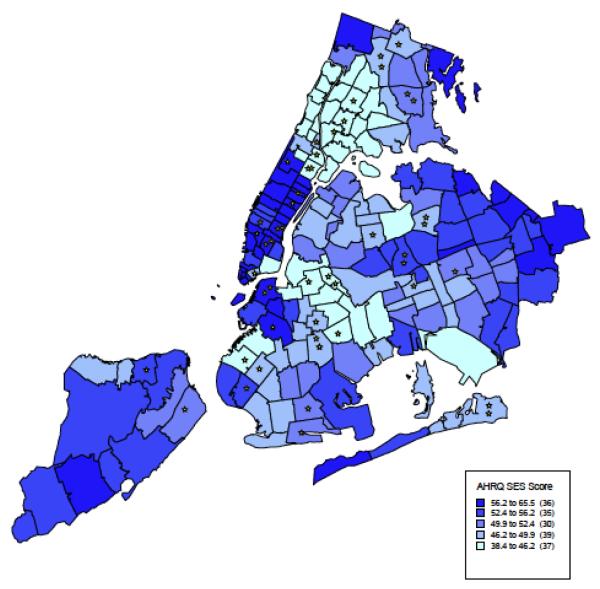
Methods and results: Using a Centers for Medicare & Medicaid Services (CMS)-like model, we estimated 30-day hospital-level risk-standardized readmission rates by adjusting for age, sex, and comorbid conditions. Next, we examined how hospital risk-standardized readmission rates changed relative to the NYC mean with inclusion of the Agency for Healthcare Research and Quality (AHRQ)-validated SES index score. In a secondary analysis, we examined whether inclusion of the AHRQ SES index score in 30-day readmission models disproportionately impacted the risk-standardized readmission rates of minority-serving hospitals. Higher AHRQ SES scores, indicators of higher SES, were associated with lower odds (0.99) of 30-day readmission (P<0.019). The addition of the AHRQ SES index did not change the model's C statistic (0.63). After adjustment for the AHRQ SES index, 1 hospital changed status from worse than the NYC average to no different than the NYC average. After adjustment for the AHRQ SES index, 1 NYC minority-serving hospital was reclassified from worse to no different than average.
Conclusions: Although patients with higher SES were less likely to be admitted, the impact of SES on readmission was small. In NYC, inclusion of the AHRQ SES score in a CMS-based model did not impact hospital-level profiling based on 30-day readmission.
Keywords: heart failure; patient readmission; social class.
© 2014 American Heart Association, Inc.
Figures
Comment in
-
Measuring quality and enacting policy: readmission rates and socioeconomic factors.Circ Cardiovasc Qual Outcomes. 2014 May;7(3):350-2. doi: 10.1161/CIRCOUTCOMES.114.001037. Epub 2014 May 13. Circ Cardiovasc Qual Outcomes. 2014. PMID: 24823951 No abstract available.
References
-
- Schocken DD, Arrieta MI, Leaverton PE, Ross EA. Prevalence and mortality rate of congestive heart failure in the united states. J Am Coll Cardiol. 1992;20:301–306. - PubMed
-
- Ho KK, Anderson KM, Kannel WB, Grossman W, Levy D. Survival after the onset of congestive heart failure in framingham heart study subjects. Circulation. 1993;88:107–115. - PubMed
-
- Report to congress: Promoting greater efficiency in medicare. 2007;2010
-
- Krumholz H, Normand S-L, Keenan P, Lin Z, Drye E, Bhat K, Wang Y, Ross J, Schuur J, Stauffer B, Bernheim S, Epstein A, Herrin J, Federer J, Mattera J, Wang Y, Mulvey G, Schreiner G. Hospital 30-day heart failure readmission measure methodology. 2008. - PubMed
-
- Halasyamani LK, Davis MM. Conflicting measures of hospital quality: Ratings from “hospital compare” versus “best hospitals”. Journal of hospital medicine : an official publication of the Society of Hospital Medicine. 2007;2:128–134. - PubMed
Publication types
MeSH terms
Grants and funding
LinkOut - more resources
Full Text Sources
Other Literature Sources
Medical
