Randomized Controlled Trial
. 2014 May 12;6(5):1913-30.
doi: 10.3390/nu6051913.

Urinary metabolite profiles in premature infants show early postnatal metabolic adaptation and maturation

Affiliations
Randomized Controlled Trial

Urinary metabolite profiles in premature infants show early postnatal metabolic adaptation and maturation

Sissel J Moltu et al. Nutrients. .

Abstract

Objectives: Early nutrition influences metabolic programming and long-term health. We explored the urinary metabolite profiles of 48 premature infants (birth weight < 1500 g) randomized to an enhanced or a standard diet during neonatal hospitalization.

Methods: Metabolomics using nuclear magnetic resonance spectroscopy (NMR) was conducted on urine samples obtained during the first week of life and thereafter fortnightly.

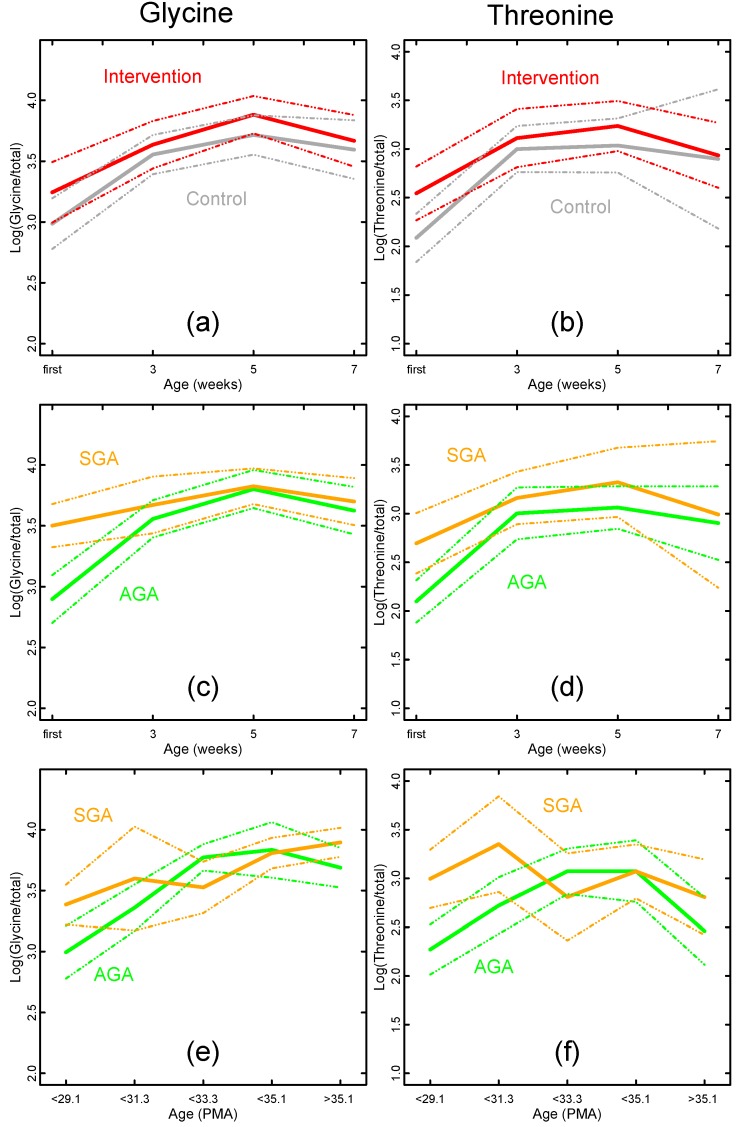
Results: The intervention group received significantly higher amounts of energy, protein, lipids, vitamin A, arachidonic acid and docosahexaenoic acid as compared to the control group. Enhanced nutrition did not appear to affect the urine profiles to an extent exceeding individual variation. However, in all infants the glucogenic amino acids glycine, threonine, hydroxyproline and tyrosine increased substantially during the early postnatal period, along with metabolites of the tricarboxylic acid cycle (succinate, oxoglutarate, fumarate and citrate). The metabolite changes correlated with postmenstrual age. Moreover, we observed elevated threonine and glycine levels in first-week urine samples of the small for gestational age (SGA; birth weight < 10th percentile for gestational age) as compared to the appropriate for gestational age infants.

Conclusion: This first nutri-metabolomics study in premature infants demonstrates that the physiological adaptation during the fetal-postnatal transition as well as maturation influences metabolism during the breastfeeding period. Elevated glycine and threonine levels were found in the first week urine samples of the SGA infants and emerged as potential biomarkers of an altered metabolic phenotype.


Figures
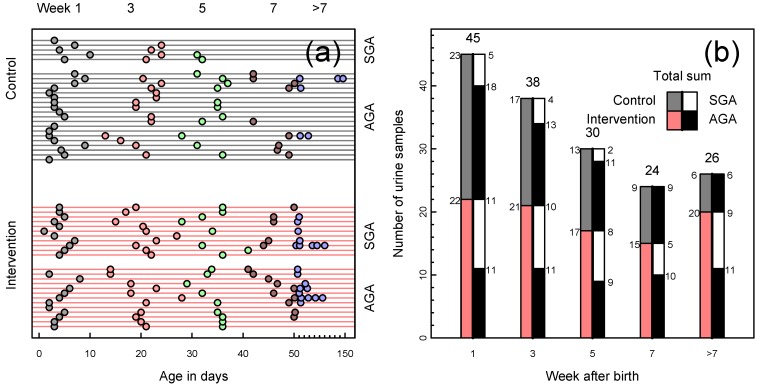
Figure 1
Figure 1
(a) Available urine samples by infants’ age in days, one infant per line, one sample per symbol. Grouped by intervention and control (red and gray lines, respectively), color-coded by week of life. Age in days was imputed for eight samples where only the week was recorded; (b) Available urine samples by infants’ week of life. Bars divided by nutritional intervention vs. control (left half of bar; red and gray, respectively) and further subdivided by small for gestational age (SGA) or appropriate for gestational age (AGA) infants (right half of bar; SGA white, AGA black).
Figure 2
Figure 2
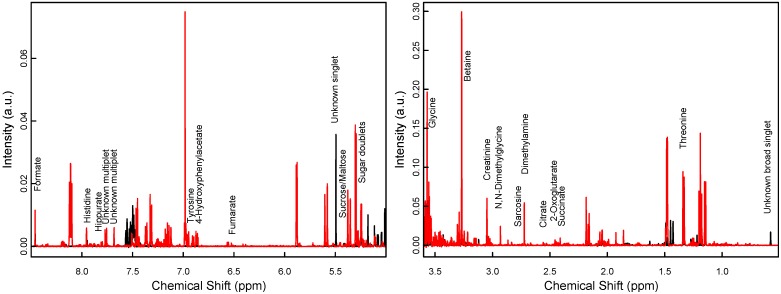
Selected regions of two NMR spectra (black for week 1 and red for week 1) of an SGA infant in the intervention group.
Figure 3
Figure 3
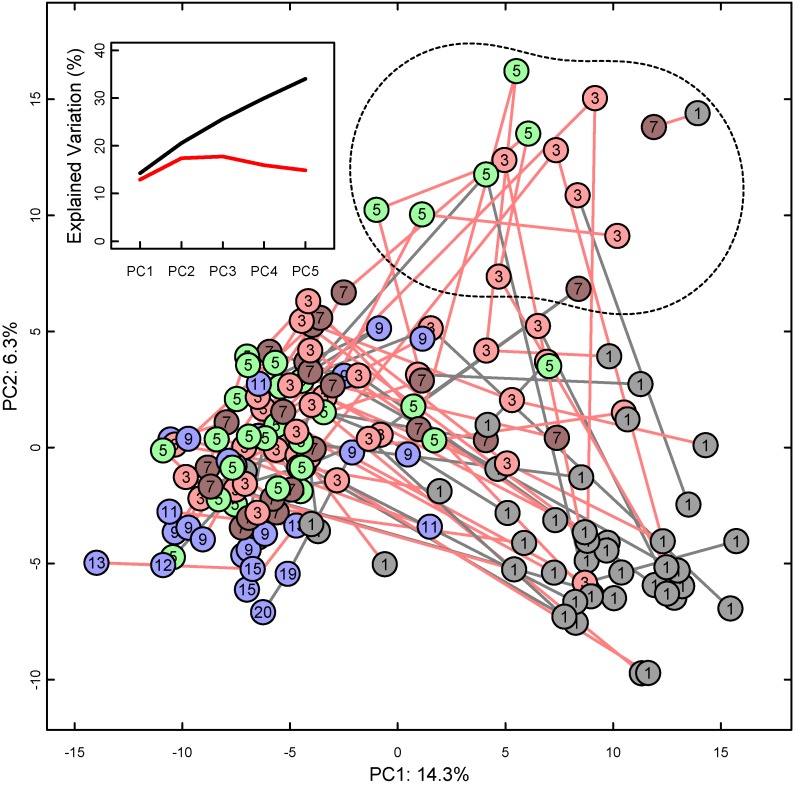
PCA score plot of NMR spectra of all available urine samples, presented as points marked with infant age in weeks and color-coded as earlier. PCA: Principal component analysis, NMR: Nuclear magnetic resonance, PC: Principal component with percent of explained total variation. Lines connect consecutive samples from one infant; line color red for intervention, gray for control group. Outlier samples marked with a dashed line in the upper right quadrant. Inset: Cumulative explained variation (black) and cross-validation (red) of the first five PCs.
Figure 4
Figure 4
Temporal development of glycine and threonine log-pseudo-concentrations (means and 95% CIs) related to nutritional intervention, SGA status and age. (a) Glycine levels by nutritional intervention (intervention red, control gray); (c) Glycine levels by SGA status (SGA orange, AGA green) for samples from weeks 1, 3, 5 and 7; (e) As above, but samples selected by PMA instead of weeks of life; (b, d, f) Corresponding figures for threonine.

References

    1. Lapillonne A., O’Connor D.L., Wang D., Rigo J. Nutritional recommendations for the late-preterm infant and the preterm infant after hospital discharge. J. Pediatr. 2013;162:S90–S100. doi: 10.1016/j.jpeds.2012.11.058. - DOI - PubMed
    1. Henriksen C., Westerberg A.C., Ronnestad A., Nakstad B., Veierod M.B., Drevon C.A., Iversen P.O. Growth and nutrient intake among very-low-birth-weight infants fed fortified human milk during hospitalisation. Br. J. Nutr. 2009;102:1179–1186. doi: 10.1017/S0007114509371755. - DOI - PubMed
    1. Lapillonne A., Griffin I.J. Feeding preterm infants today for later metabolic and cardiovascular outcomes. J. Pediatr. 2013;162:S7–S16. doi: 10.1016/j.jpeds.2012.11.048. - DOI - PubMed
    1. Lucas A. Long-term programming effects of early nutrition—Implications for the preterm infant. J. Perinatol. 2005;25(Suppl. 2):S2–S6. doi: 10.1038/sj.jp.7211308. - DOI - PubMed
    1. Koletzko B., Brands B., Poston L., Godfrey K., Demmelmair H. Early nutrition programming of long-term health. Proc. Nutr. Soc. 2012;71:371–378. doi: 10.1017/S0029665112000596. - DOI - PubMed

Publication types

LinkOut - more resources