. 2014 May 13;9(5):e97010.
doi: 10.1371/journal.pone.0097010. eCollection 2014.

Intra-urban human mobility and activity transition: evidence from social media check-in data

Affiliations

Intra-urban human mobility and activity transition: evidence from social media check-in data

Lun Wu et al. PLoS One. .

Abstract

Most existing human mobility literature focuses on exterior characteristics of movements but neglects activities, the driving force that underlies human movements. In this research, we combine activity-based analysis with a movement-based approach to model the intra-urban human mobility observed from about 15 million check-in records during a yearlong period in Shanghai, China. The proposed model is activity-based and includes two parts: the transition of travel demands during a specific time period and the movement between locations. For the first part, we find the transition probability between activities varies over time, and then we construct a temporal transition probability matrix to represent the transition probability of travel demands during a time interval. For the second part, we suggest that the travel demands can be divided into two classes, locationally mandatory activity (LMA) and locationally stochastic activity (LSA), according to whether the demand is associated with fixed location or not. By judging the combination of predecessor activity type and successor activity type we determine three trip patterns, each associated with a different decay parameter. To validate the model, we adopt the mechanism of an agent-based model and compare the simulated results with the observed pattern from the displacement distance distribution, the spatio-temporal distribution of activities, and the temporal distribution of travel demand transitions. The results show that the simulated patterns fit the observed data well, indicating that these findings open new directions for combining activity-based analysis with a movement-based approach using social media check-in data.


Conflict of interest statement

Competing Interests: The authors have declared that no competing interests exist.

Figures

Figure 1
Figure 1. Spatial distribution of check-ins and the study area.
(a) The study area in Shanghai. The red lattices represent the study area, and covers two airports, Pudong airport and Hongqiao airport. (b) Spatial distribution of check-ins by activities in the study. One check-in record is geo-referenced as one point according to its location. Different colors of the points denote different activities.
Figure 2
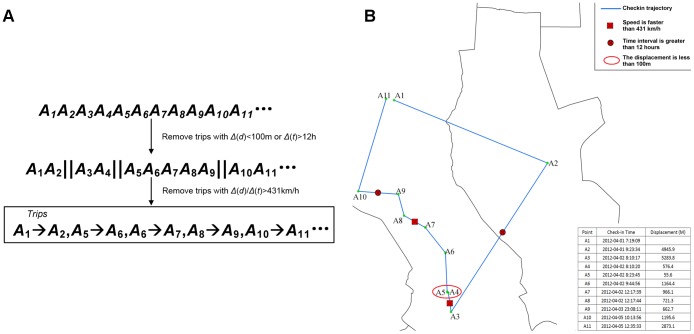
Figure 2. Criteria for extracting trips.
(a) Two steps for extracting trips from one individual check-in trajectory. A1A2A3A4A5A6… is one individual trajectory sequence. (b) The demonstration of applying the criterions into the anonymous individuals' trajectories. The blue line is the original check-in trajectory. When segmenting this trajectory to trips, we filter the successive check-in pairs that the speed is faster than 431 km/h, such as A3->A4 and A7->A8; or time interval is greater than 12 hours, such as A2->A3 and A9->A10; or the displacement is less than 100 m, such as A4->A5.
Figure 3
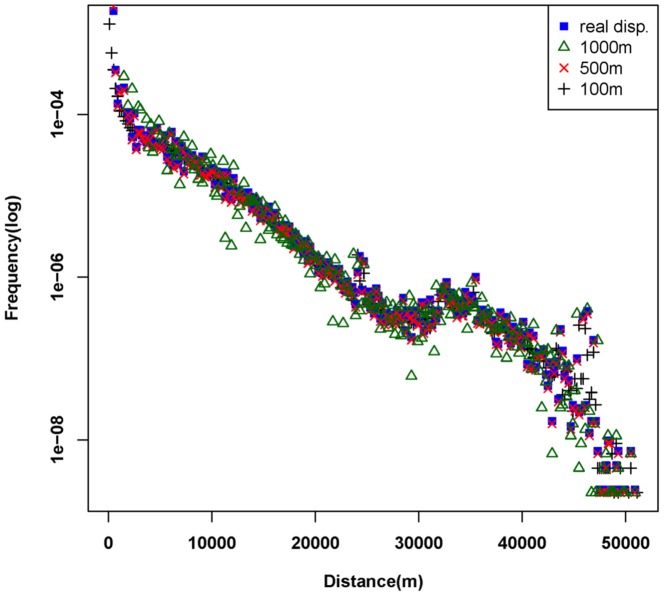
Figure 3. Distribution comparison between distances approximated in different lattice sizes and actual distances.
The 1000's.
Figure 4
Figure 4. Diurnal temporal distribution of different activities.
a) Transportation. b) Dining. c) Work. d) Entertainment. e) Home. f) Other. The frequency curves of Tr, D, and W each have two peaks that emerge during different periods throughout the day. The first peaks for both Tr and W appear in the period from 7 am to 9 am; at lunchtime, the D reaches its first peak. The W's second peak is earlier than the other two's. The trend lines for both E and H remain at a low level during the daytime and rise after 5 pm. The curve of O is almost same as the W's.
Figure 5
Figure 5. Spatial distributions of different activities.
In order to make the spatial distribution more clear, the kernel density estimation (KDE) method is adopted. a) Transportation. b) Dining. c) Work. d) Entertainment. e) Home. f) Other. The demands for W, D, E and O are mainly accumulated in the central area, but the demand O is more discrete than the other three. Tr has two special hot spots, which are the Pudong airport and the Hongqiao airport.
Figure 6
Figure 6. Temporal transition probability matrix of activities.
The horizontal axis is the predecessor demand and time, formula imageand the vertical axis is the successor demand and time, formula image. The transition probability is negligible if the successor time is twelve hours greater than the predecessor time. Obviously, the values for both the dining and entertainment demands during the 7 pm to 9pm from other demands are high. Especially, a high transition probability exists if the successor activity is entertainment at time from 7pm to 9pm on the condition that the predecessor activity is dining at time from 6pm to 7pm.
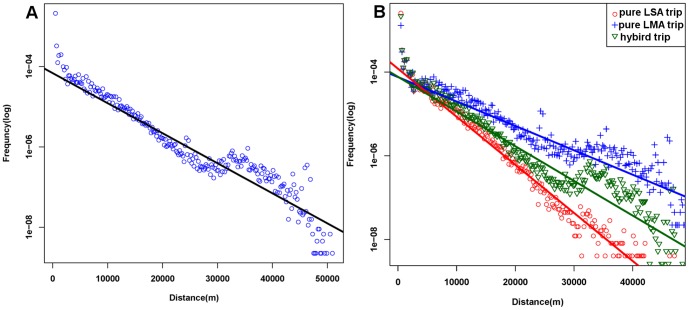
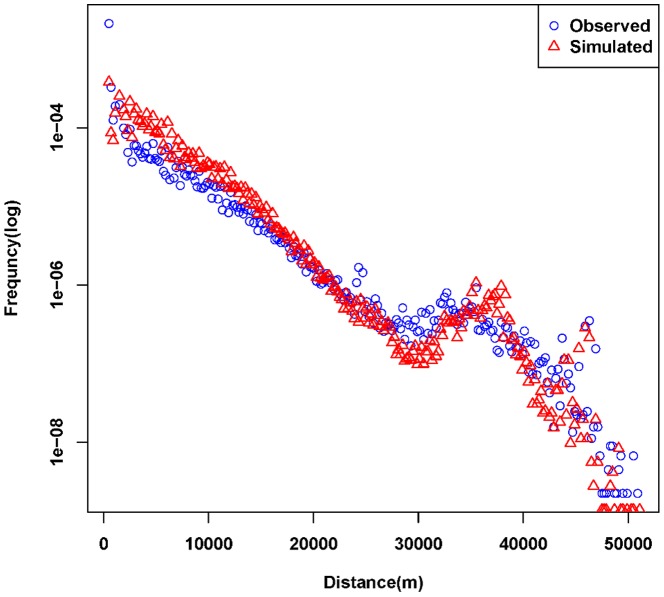
Figure 7
Figure 7. Distribution of trip distances.
A) The distance distribution of all trips. B) The distance distribution of three trip patterns. The exponent of pure LMA trips is 0.134 km−1 (R2 = 0.713) whereas the pure LSA's is 0.264 km−1 (R2 = 0.9312). The exponent for hybrid pattern is 0.191 km−1 (R2 = 0.814).
Figure 8
Figure 8. Comparison between distance distributions of observed and simulated trips.
The Hellinger coefficients is 0.8829, and a peak also exists between 30
Figure 9
Figure 9. Comparison between spatial distributions of observed and simulated trips.
The KDE method is adopted, and the output cell size is 250,000 square meters. a) The observed successor activities. b) The simulated successor activities. The vast majority part of the observed data can be illustrated by the simulated one, and the Hellinger coefficient is 0.8430.
Figure 10
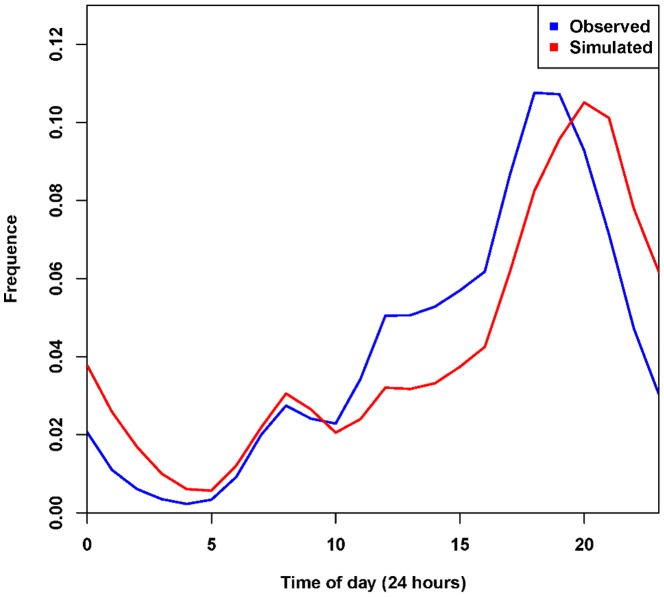
Figure 10. Comparison between temporal distributions of observed and simulated trips.
The Hellinger coefficient is 0.9803. In evening time, we can find a one-hour lag exists between two peaks. The lag should be attributed to the one-hour temporal resolution in simulations.
Figure 11
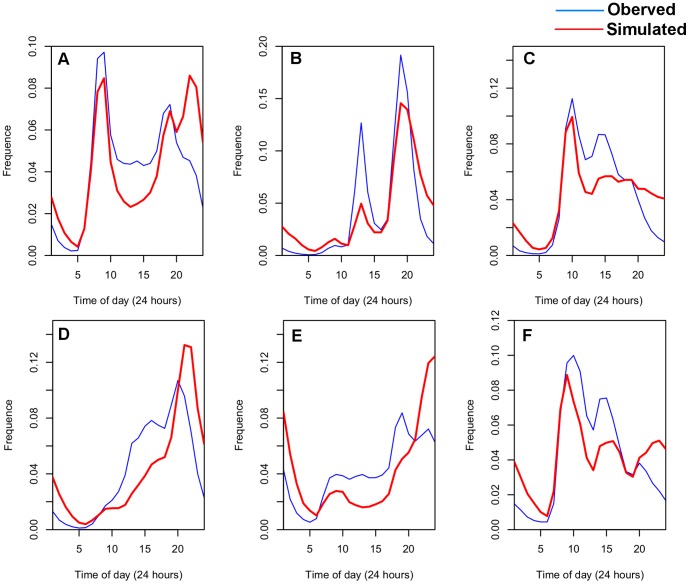
Figure 11. Comparison between temporal distributions of observed and simulated categories.
a) Transportation, the Hellinger coefficient is 0.976. b) Dining, the Hellinger coefficient is 0.950. c) Work, the Hellinger coefficient is 0.969. d) Entertainment, the Hellinger coefficient is 0.956. e) Home, the Hellinger coefficient is 0.960. f) Other, the Hellinger coefficient is 0.973. Although deviations still exist in the simulated ones, the deviation values are only a few percent. Besides, all simulated results have similar peak shapes to the observed ones.

References

    1. Liu Y, Kang C, Gao S, Xiao Y, Tian Y (2012) Understanding intra-urban trip patterns from taxi trajectory data. Journal of Geographical Systems 14: 463–483.
    1. Liu Y, Wang F, Xiao Y, Gao S (2012) Urban land uses and traffic 'source-sink areas': Evidence from GPS-enabled taxi data in Shanghai. Landscape and Urban Planning 106: 73–87.
    1. Kang C, Ma X, Tong D, Liu Y (2012) Intra-urban human mobility patterns: An urban morphology perspective. Physica A: Statistical Mechanics and its Applications 391: 1702–1717.
    1. Peng C, Jin X, Wong K, Shi M, Liò P (2012) Collective human mobility pattern from taxi trips in urban area. PLoS ONE 7: e34487. - PMC - PubMed
    1. Liang X, Zhao J, Dong L, Xu K (2013) Unraveling the origin of exponential law in intra-urban human mobility. Scientific Reports. 3: 2983. - PMC - PubMed

Publication types