


Adjustment disorders as a stress-related disorder: a longitudinal study of the associations among stress, resources, and mental health
- PMID: 24825165
- PMCID: PMC4019534
- DOI: 10.1371/journal.pone.0097303
Adjustment disorders as a stress-related disorder: a longitudinal study of the associations among stress, resources, and mental health
Erratum in
- PLoS One. 2014;9(6):e101377
Abstract
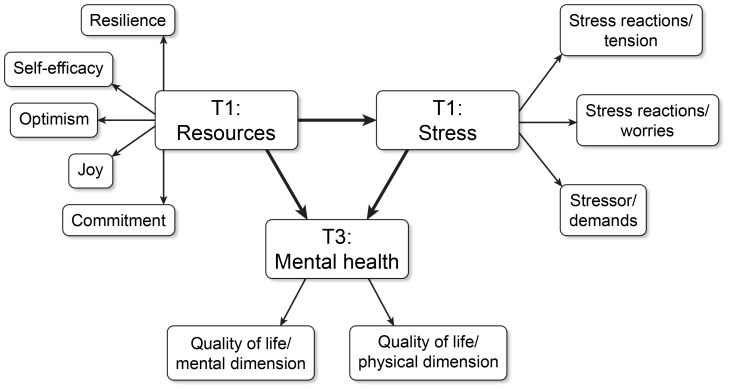
Objective: Adjustment disorders are re-conceptualized in the DSM-5 as a stress-related disorder; however, besides the impact of an identifiable stressor, the specification of a stress concept, remains unclear. This study is the first to examine an existing stress-model from the general population, in patients diagnosed with adjustment disorders, using a longitudinal design.
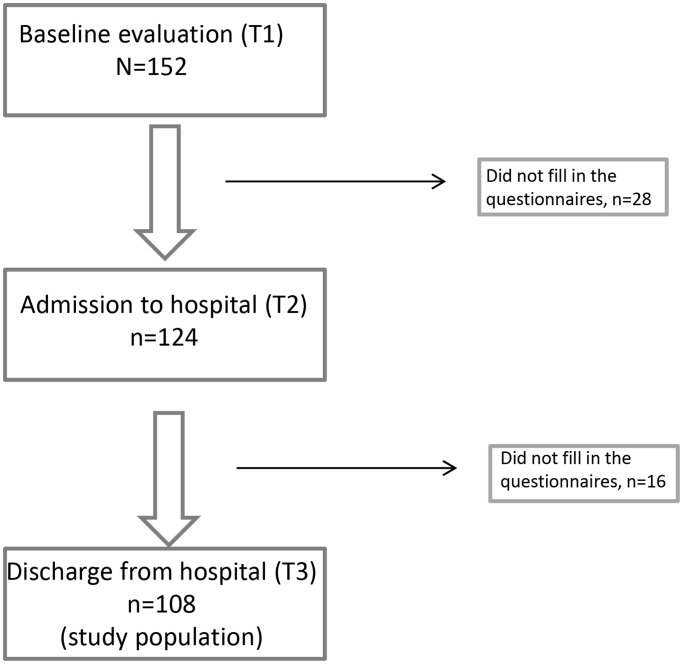
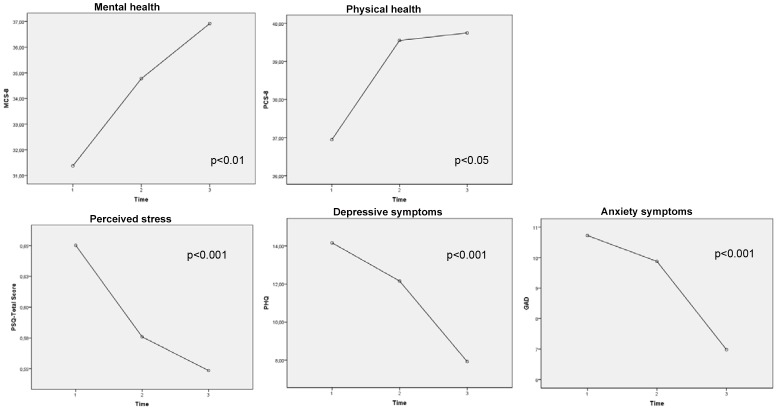
Methods: The study sample consisted of 108 patients consecutively admitted for adjustment disorders. Associations of stress perception, emotional distress, resources, and mental health were measured at three time points: the outpatients' presentation, admission for inpatient treatment, and discharge from the hospital. To evaluate a longitudinal stress model of ADs, we examined whether stress at admission predicted mental health at each of the three time points using multiple linear regressions and structural equation modeling. A series of repeated-measures one-way analyses of variance (rANOVAs) was performed to assess change over time.
Results: Significant within-participant changes from baseline were observed between hospital admission and discharge with regard to mental health, stress perception, and emotional distress (p<0.001). Stress perception explained nearly half of the total variance (44%) of mental health at baseline; the adjusted R2 increased (0.48), taking emotional distress (i.e., depressive symptoms) into account. The best predictor of mental health at discharge was the level of emotional distress (i.e., anxiety level) at baseline (β= -0.23, R2corr=0.56, p<0.001). With a CFI of 0.86 and an NFI of 0.86, the fit indices did not allow for acceptance of the stress-model (Cmin/df=15.26; RMSEA=0.21).
Conclusions: Stress perception is an important predictor in adjustment disorders, and mental health-related treatment goals are dependent on and significantly impacted by stress perception and emotional distress.
Conflict of interest statement
Figures
Similar articles
-
A longitudinal study on anxiety, depressive and adjustment disorder, suicide ideation and symptoms of emotional distress in patients with cancer undergoing radiotherapy.J Psychosom Res. 2016 Aug;87:14-21. doi: 10.1016/j.jpsychores.2016.05.010. Epub 2016 Jun 1. J Psychosom Res. 2016. PMID: 27411747
-
Integrated mental health care and vocational rehabilitation to improve return to work rates for people on sick leave because of exhaustion disorder, adjustment disorder, and distress (the Danish IBBIS trial): study protocol for a randomized controlled trial.Trials. 2017 Dec 2;18(1):579. doi: 10.1186/s13063-017-2273-0. Trials. 2017. PMID: 29197404 Free PMC article. Clinical Trial.
-
Psychiatric disorders and associated and predictive factors in patients with unresectable nonsmall cell lung carcinoma: a longitudinal study.Cancer. 2001 Nov 15;92(10):2609-22. doi: 10.1002/1097-0142(20011115)92:10<2609::aid-cncr1614>3.0.co;2-k. Cancer. 2001. PMID: 11745196
-
The psychobiology of stress, depression, adjustment disorders and resilience.World J Biol Psychiatry. 2018;19(sup1):S14-S20. doi: 10.1080/15622975.2018.1459049. World J Biol Psychiatry. 2018. PMID: 30204561 Review.
-
Behavioural modification interventions for medically unexplained symptoms in primary care: systematic reviews and economic evaluation.Health Technol Assess. 2020 Sep;24(46):1-490. doi: 10.3310/hta24460. Health Technol Assess. 2020. PMID: 32975190 Free PMC article.
Cited by
-
Prevalence Estimate for Adjustment Disorders in the South African Navy.Clin Pract Epidemiol Ment Health. 2024 Jun 5;20:e17450179301661. doi: 10.2174/0117450179301661240528064329. eCollection 2024. Clin Pract Epidemiol Ment Health. 2024. PMID: 39135946 Free PMC article.
-
A Modified Version of the Transactional Stress Concept According to Lazarus and Folkman Was Confirmed in a Psychosomatic Inpatient Sample.Front Psychol. 2021 Mar 5;12:584333. doi: 10.3389/fpsyg.2021.584333. eCollection 2021. Front Psychol. 2021. PMID: 33746820 Free PMC article.
-
Adjustment Disorders Are Uniquely Suited for eHealth Interventions: Concept and Case Study.JMIR Ment Health. 2015 May 8;2(2):e15. doi: 10.2196/mental.4157. eCollection 2015 Apr-Jun. JMIR Ment Health. 2015. PMID: 26543920 Free PMC article.
-
Elderly patients with adaptive disorder diagnosis in psychogeriatry interconsultation: clinical profile and therapeutic approach.Actas Esp Psiquiatr. 2023 Mar;51(2):46-55. Epub 2023 Mar 1. Actas Esp Psiquiatr. 2023. PMID: 37218099 Free PMC article.
-
Predicting Therapy Outcomes in Patients With Stress-Related Disorders: Protocol for a Predictive Modeling Study.JMIR Res Protoc. 2025 Mar 25;14:e65790. doi: 10.2196/65790. JMIR Res Protoc. 2025. PMID: 40132191 Free PMC article.
References
-
- Maercker A, Forstmeier S, Pielmaier L, Spangenberg L, Brahler E, et al. (2012) Adjustment disorders: prevalence in a representative nationwide survey in Germany. Soc Psychiatry Psychiatr Epidemiol 47: 1745–1752. - PubMed
-
- World Health Organization (2013) ICD-11 beta draft.
-
- Ayuso-Mateos JL, Vazquez-Barquero JL, Dowrick C, Lehtinen V, Dalgard OS, et al. (2001) Depressive disorders in Europe: prevalence figures from the ODIN study. Br J Psychiatry 179: 308–316. - PubMed
-
- Phillips MR, Zhang J, Shi Q, Song Z, Ding Z, et al. (2009) Prevalence, treatment, and associated disability of mental disorders in four provinces in China during 2001–05: an epidemiological survey. Lancet 373: 2041–2053. - PubMed
-
- Maercker A, Forstmeier S, Enzler A, Krusi G, Horler E, et al. (2008) Adjustment disorders, posttraumatic stress disorder, and depressive disorders in old age: findings from a community survey. Compr Psychiatry 49: 113–120. - PubMed
MeSH terms
LinkOut - more resources
Full Text Sources
Other Literature Sources
Medical
Miscellaneous
