


Coronary vasospasm while treating supraventricular tachycardia: is adenosine really to blame?
- PMID: 24826297
- PMCID: PMC4008346
- DOI: 10.1155/2013/897813
Coronary vasospasm while treating supraventricular tachycardia: is adenosine really to blame?
Abstract
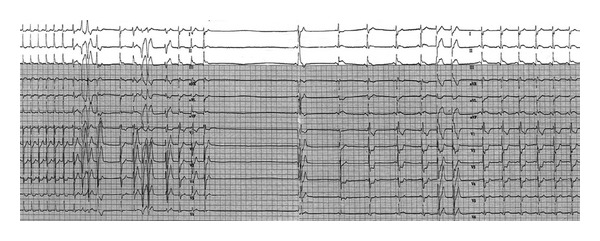
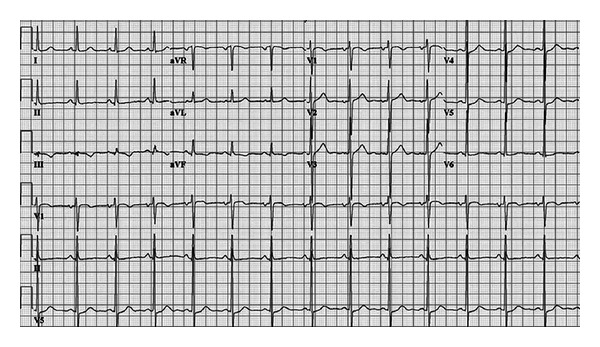
Coronary artery spasm has been reported during adenosine stress testing. Herein, we describe a transient ST-segment elevation following adenosine therapy for supraventricular tachycardia. A 38-year-old male presented to the emergency department with palpitations. Electrocardiogram showed supraventricular tachycardia with short RP interval. Vagal maneuvers were unsuccessful. Adenosine was then administered in two successive injections of 6 and 12 mg dosages, respectively. A subsequent 12-lead electrocardiogram revealed ST-segment elevation in inferior leads with reciprocal changes. Coronary angiography disclosed nonobstructive coronary disease. A postprocedure electrocardiogram exhibited normal sinus rhythm with nonspecific T wave abnormalities. Cardiac biomarkers were elevated with a peak troponin I of 0.32. Echocardiogram depicted bicuspid aortic valve and normal systolic function. Electrophysiological study revealed a concealed left accessory pathway and successful radiofrequency ablation was performed. Given the dynamic changes in the electrocardiogram, we hypothesize that this event was most likely a coronary vasospasm. The mechanism of coronary spasm following adenosine injection remains uncertain. Potential mediators include KATP channels and adenosine-2 receptors.
Figures



References
-
- Cerqueira MD, Verani MS, Schwaiger M, Heo J, Iskandrian AS. Safety profile of adenosine stress perfusion imaging: results from the adenoscan multicenter trial registry. Journal of the American College of Cardiology. 1994;23(2):384–389. - PubMed
-
- Yasue H, Nakagawa H, Itoh T, Harada E, Mizuno Y. Coronary artery spasm—clinical features, diagnosis, pathogenesis, and treatment. Journal of Cardiology. 2008;51(1):2–17. - PubMed
-
- Nakayama M, Morishima T, Chikamori T, Aiga M, Takazawa K, Yamashina A. Coronary arterial spasm during adenosine myocardial perfusion imaging. Journal of Cardiology. 2009;53(2):288–292. - PubMed
-
- Han PP, Tian YQ, Wei HX, Wang Q, He ZX. Coronary spasm after completion of adenosine pharmacologic stress test. Annals of Nuclear Medicine. 2011;25(8):580–585. - PubMed
-
- Weissman G, Scandrett RM, Howes CJ, Russell RR., 3rd Coronary vasospasm during an adenosine stress test. Journal of Nuclear Cardiology. 2004;11(6):747–750. - PubMed
LinkOut - more resources
Full Text Sources
Other Literature Sources
Research Materials
