


Hair loss and hypothalamic-pituitary-adrenocortical axis activity in captive rhesus macaques (Macaca mulatta)
- PMID: 24827567
- PMCID: PMC4128563
Hair loss and hypothalamic-pituitary-adrenocortical axis activity in captive rhesus macaques (Macaca mulatta)
Abstract
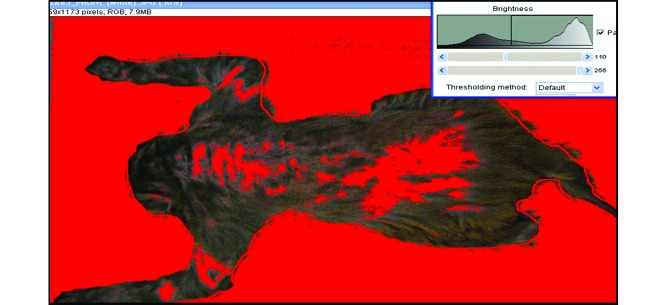
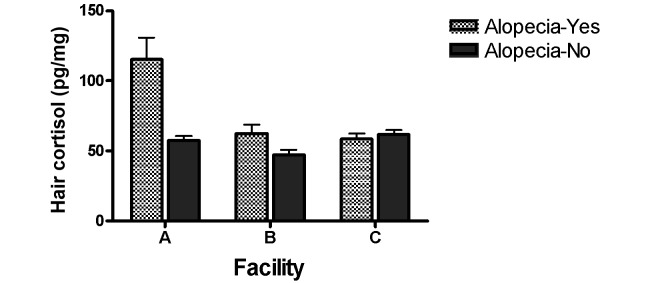
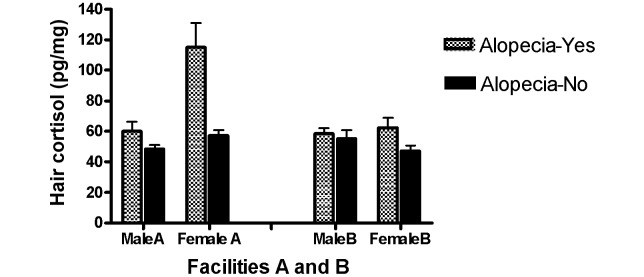
Hair loss is a common problem in captive macaque colonies. A potential factor is the possible influence of stressful environments in the development of hair loss. We examined the relationship between hair loss and chronic hypothalamic-pituitary-adrenal (HPA) axis activity by measuring cortisol in hair. Adult male and female rhesus macaques housed at 3 primate facilities in the United States were screened for degree of hair loss and observed for evidence of hair-plucking behavior. Hair samples and photographic data were obtained from 99 subjects, none of which were hair-pluckers. Macaques with greater than 30% hair loss (alopecia group) showed higher concentrations of hair cortisol than did those with less than 5% hair loss (control group), a finding that was unrelated to age, body weight, or the month in which the sample was collected. Hair loss scores were positively correlated with hair cortisol levels across all monkeys and within the alopecic group alone. In addition, the strong relationship between hair cortisol and alopecia was noted in 2 but not the third facility. Friction with cage surfaces appeared to contribute to hair loss in 18 monkeys. These findings suggest that stress may be one of several factors related to hair loss in some captive nonhuman primates, although whether this relationship is causal or merely correlational is unclear. Moreover, the source of the additional cortisol in the hair of alopecic monkeys (that is, from the circulation or from local synthesis in the skin) remains to be determined.
Figures
References
-
- Aoki E, Shibasaki T, Kawana S. 2003. Intermittent foot-shock stress prolongs the telogen stage in the hair cycle of mice. Exp Dermatol 12:371–377 - PubMed
-
- Davenport MD, Tiefenbacher ST, Lutz CK, Novak MA, Meyer JS. 2006. Analysis of endogenous cortisol concentrations in the hair of rhesus macaques. Gen Comp Endocrinol 147:255–261 - PubMed
-
- Dettenborn L, Tietze A, Bruckner F, Kirschbaum C. 2010. Higher cortisol content in hair among long-term unemployed individuals compared to controls. Psychoneuroendocrinology 35:1404–1409 - PubMed
-
- Djordjević J, Cvijić G, Davidović V. 2003. Different activation of ACTH and corticosterone release in response to various stressors in rats. Physiol Res 52:67–72 - PubMed
Publication types
MeSH terms
Substances
Grants and funding
LinkOut - more resources
Full Text Sources