


Measles vaccination in the presence or absence of maternal measles antibody: impact on child survival
- PMID: 24829213
- PMCID: PMC4111916
- DOI: 10.1093/cid/ciu354
Measles vaccination in the presence or absence of maternal measles antibody: impact on child survival
Abstract
Background: Measles vaccine (MV) has a greater effect on child survival when administered in early infancy, when maternal antibody may still be present.
Methods: To test whether MV has a greater effect on overall survival if given in the presence of maternal measles antibody, we reanalyzed data from 2 previously published randomized trials of a 2-dose schedule with MV given at 4-6 months and at 9 months of age. In both trials antibody levels had been measured before early measles vaccination.
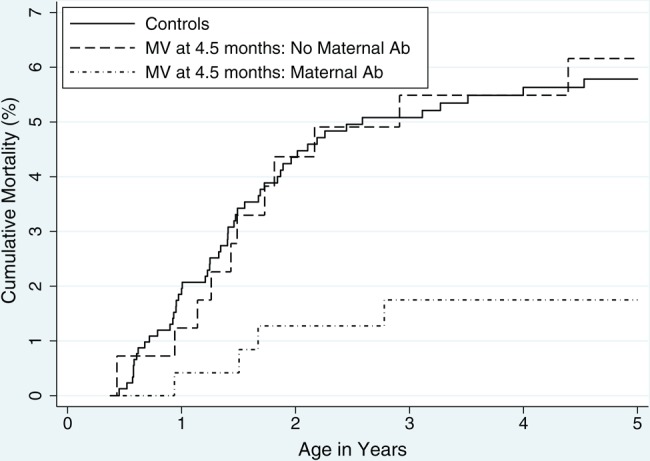
Results: In trial I (1993-1995), the mortality rate was 0.0 per 1000 person-years among children vaccinated with MV in the presence of maternal antibody and 32.3 per 1000 person-years without maternal antibody (mortality rate ratio [MRR], 0.0; 95% confidence interval [CI], 0-.52). In trial II (2003-2007), the mortality rate was 4.2 per 1000 person-years among children vaccinated in presence of maternal measles antibody and 14.5 per 1000 person-years without measles antibody (MRR, 0.29; 95% CI, .09-.91). Possible confounding factors did not explain the difference. In a combined analysis, children who had measles antibody detected when they received their first dose of MV at 4-6 months of age had lower mortality than children with no maternal antibody, the MRR being 0.22 (95% CI, .07-.64) between 4-6 months and 5 years.
Conclusions: Child mortality in low-income countries may be reduced by vaccinating against measles in the presence of maternal antibody, using a 2-dose schedule with the first dose at 4-6 months (earlier than currently recommended) and a booster dose at 9-12 months of age.
Clinical trials registration: NCT00168558.
Keywords: 2-dose measles vaccination; age of measles vaccination; maternal measles antibodies; nonspecific beneficial effects of measles vaccine.
© The Author 2014. Published by Oxford University Press on behalf of the Infectious Diseases Society of America.
Figures
References
-
- Expanded Programme on Immunization. The optimal age for measles immunization. Weekly Epidemiol Rec. 1982;57:89–91.
-
- Gans H, Yasukawa L, Rinki M, et al. Immune responses to measles and mumps vaccination of infants at 6, 9, and 12 months. J Infect Dis. 2001;184:817–26. - PubMed
-
- De Quadros CA, Izurieta H, Venczel L, Carrasco P. Measles eradication in the Americas : Progress to date. J Infect Dis. 2004;189(suppl 1):S227. - PubMed
-
- Strategic Advisory Group of Experts. Meeting of the immunization Strategic Advisory Group of experts, November 2006—conclusions and recommendations. Weekly Epidemiol Rec. 2007;82:1–16. - PubMed
Publication types
MeSH terms
Substances
Associated data
LinkOut - more resources
Full Text Sources
Other Literature Sources
Medical
