


Effect that an educational program for cystic fibrosis patients and caregivers has on the contamination of home nebulizers
- PMID: 24831395
- PMCID: PMC4083641
- DOI: 10.1590/s1806-37132014000200004
Effect that an educational program for cystic fibrosis patients and caregivers has on the contamination of home nebulizers
Abstract
Objective: To describe the pathogens found in home nebulizers and in respiratory samples of cystic fibrosis (CF) patients, and to evaluate the effect that a standardized instruction regarding cleaning and disinfection of nebulizers has on the frequency of nebulizer contamination.
Methods: We included 40 CF patients (22 males), all of whom used the same model of nebulizer. The median patient age was 11.2 ± 3.74 years. We collected samples from the nebulizer mouthpiece and cup, using a sterile swab moistened with sterile saline. Respiratory samples were collected by asking patients to expectorate into a sterile container or with oropharyngeal swabs after cough stimulation. Cultures were performed on selective media, and bacteria were identified by classical biochemical tests. Patients received oral and written instructions regarding the cleaning and disinfection of nebulizers. All determinations were repeated an average of two months later.
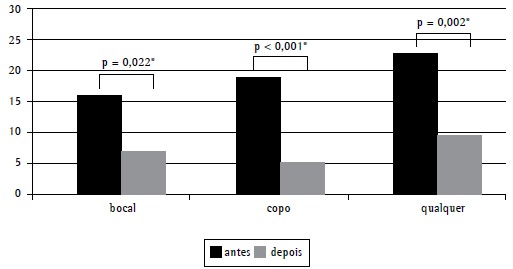
Results: Contamination of the nebulizer (any part) was detected in 23 cases (57.5%). The nebulizer mouthpiece and cup were found to be contaminated in 16 (40.0%) and 19 (47.5%), respectively. After the standardized instruction had been given, there was a significant decrease in the proportion of contaminated nebulizers (43.5%).
Conclusions: In our sample of CF patients, nebulizer contamination was common, indicating the need for improvement in patient practices regarding the cleaning and disinfection of their nebulizers. A one-time educational intervention could have a significant positive impact.
OBJETIVO:: Descrever os patógenos encontrados nos nebulizadores de uso domiciliar e nas amostras de trato respiratório de pacientes com fibrose cística (FC) e verificar o efeito de uma instrução padronizada de higiene e desinfecção de nebulizadores na contaminação dos mesmos.
MÉTODOS:: Foram incluídos no estudo 40 pacientes com FC (22 do sexo masculino) que utilizavam um mesmo modelo de nebulizador. A mediana de idade foi de 11,2 ± 3,74 anos. Amostras dos nebulizadores foram coletadas do bocal e do copo reservatório utilizando-se um swab estéril umedecido em solução salina estéril. As amostras de trato respiratório dos pacientes foram colhidas por expectoração em coletor estéril ou com swab de orofaringe após estímulo de tosse. As culturas foram realizadas em meios seletivos, e a identificação bacteriana foi feita através de provas bioquímicas clássicas. Instruções verbais e escritas sobre higiene e desinfecção dos nebulizadores foram ministradas. Todas as determinações foram repetidas dois meses após, em média.
RESULTADOS:: A contaminação de alguma parte dos nebulizadores foi observada em 23 casos (57,5%). A contaminação do bocal e do copo foi similar, em 16 (40.0%) e 19 casos (47.5%), respectivamente. Houve uma redução significativa da proporção de nebulizadores contaminados (43,5%) após a instrução padronizada.
CONCLUSÕES:: Nesta amostra de pacientes com FC, a contaminação dos nebulizadores foi alta, o que indica a necessidade de melhoria nas práticas de higiene e desinfecção dos nebulizadores de pacientes com FC. Uma única intervenção educacional pode ter um impacto positivo significativo.
Figures

References
-
- Lester MK, Flume PA, Gray SL, Anderson D, Bowman CM. Nebulizer use and maintenance by cystic fibrosis patients: a survey study. Respir Care. 2004;49(12):1504–1508. - PubMed
MeSH terms
LinkOut - more resources
Full Text Sources
Other Literature Sources
Medical
