


Budget impact analysis of switching to digital mammography in a population-based breast cancer screening program: a discrete event simulation model
- PMID: 24832200
- PMCID: PMC4022526
- DOI: 10.1371/journal.pone.0097459
Budget impact analysis of switching to digital mammography in a population-based breast cancer screening program: a discrete event simulation model
Abstract
Objective: To assess the budgetary impact of switching from screen-film mammography to full-field digital mammography in a population-based breast cancer screening program.
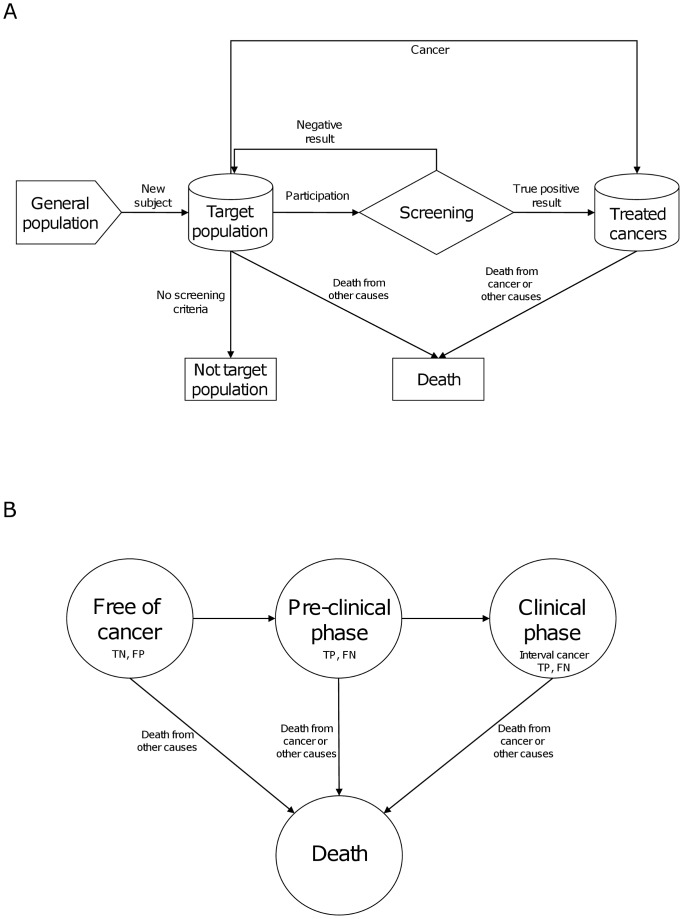
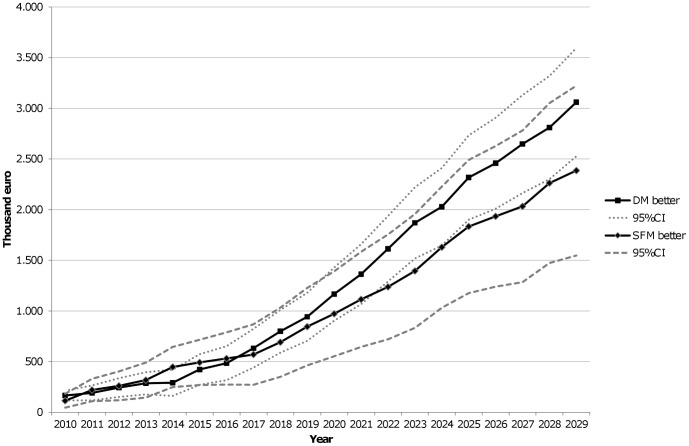
Methods: A discrete-event simulation model was built to reproduce the breast cancer screening process (biennial mammographic screening of women aged 50 to 69 years) combined with the natural history of breast cancer. The simulation started with 100,000 women and, during a 20-year simulation horizon, new women were dynamically entered according to the aging of the Spanish population. Data on screening were obtained from Spanish breast cancer screening programs. Data on the natural history of breast cancer were based on US data adapted to our population. A budget impact analysis comparing digital with screen-film screening mammography was performed in a sample of 2,000 simulation runs. A sensitivity analysis was performed for crucial screening-related parameters. Distinct scenarios for recall and detection rates were compared.
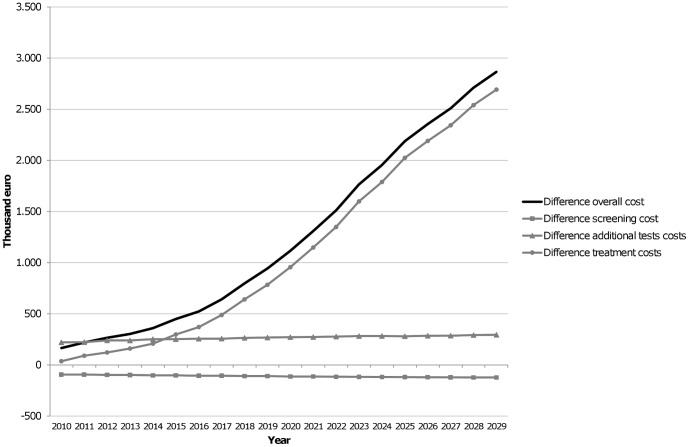
Results: Statistically significant savings were found for overall costs, treatment costs and the costs of additional tests in the long term. The overall cost saving was 1,115,857€ (95%CI from 932,147 to 1,299,567) in the 10th year and 2,866,124€ (95%CI from 2,492,610 to 3,239,638) in the 20th year, representing 4.5% and 8.1% of the overall cost associated with screen-film mammography. The sensitivity analysis showed net savings in the long term.
Conclusions: Switching to digital mammography in a population-based breast cancer screening program saves long-term budget expense, in addition to providing technical advantages. Our results were consistent across distinct scenarios representing the different results obtained in European breast cancer screening programs.
Conflict of interest statement
Figures
References
-
- Perry N, Broeders M, de Wolf C, Tornberg S, Holland R, et al. (2008) European guidelines for quality assurance in breast cancer screening and diagnosis. Fourth edition—summary document. Ann Oncol 19: 614–622. - PubMed
-
- von Karsa L, Anttila A, Ronco G, Ponti A, Malila N, et al.. (2008) Cancer screening in the European Union. Report on the implementation of the Council Recommendation on cancer screening – First Report. Luxembourg: Services of the European Commission.
-
- Ascunce N, Salas D, Zubizarreta R, Almazan R, Ibanez J, et al. (2010) Cancer screening in Spain. Ann Oncol 21 Suppl 3 iii43–iii51. - PubMed
-
- Ciatto S, Brancato B, Baglioni R, Turci M (2006) A methodology to evaluate differential costs of full field digital as compared to conventional screen film mammography in a clinical setting. Eur J Radiol 57: 69–75. - PubMed
-
- Wang S, Merlin T, Kreisz F, Craft P, Hiller JE (2009) Cost and cost-effectiveness of digital mammography compared with film-screen mammography in Australia. Aust N Z J Public Health 33: 430–436. - PubMed
Publication types
MeSH terms
LinkOut - more resources
Full Text Sources
Other Literature Sources
Medical
