Review
. 2014 May 6:5:84.
doi: 10.3389/fphar.2014.00084. eCollection 2014.

Influence of host iron status on Plasmodium falciparum infection

Affiliations
Review

Influence of host iron status on Plasmodium falciparum infection

Martha A Clark et al. Front Pharmacol. .

Abstract

Iron deficiency affects one quarter of the world's population and causes significant morbidity, including detrimental effects on immune function and cognitive development. Accordingly, the World Health Organization (WHO) recommends routine iron supplementation in children and adults in areas with a high prevalence of iron deficiency. However, a large body of clinical and epidemiological evidence has accumulated which clearly demonstrates that host iron deficiency is protective against falciparum malaria and that host iron supplementation may increase the risk of malaria. Although many effective antimalarial treatments and preventive measures are available, malaria remains a significant public health problem, in part because the mechanisms of malaria pathogenesis remain obscured by the complexity of the relationships that exist between parasite virulence factors, host susceptibility traits, and the immune responses that modulate disease. Here we review (i) the clinical and epidemiological data that describes the relationship between host iron status and malaria infection and (ii) the current understanding of the biological basis for these clinical and epidemiological observations.

Keywords: Plasmodium falciparum; iron; iron deficiency anemia; iron supplementation; malaria.


Figures
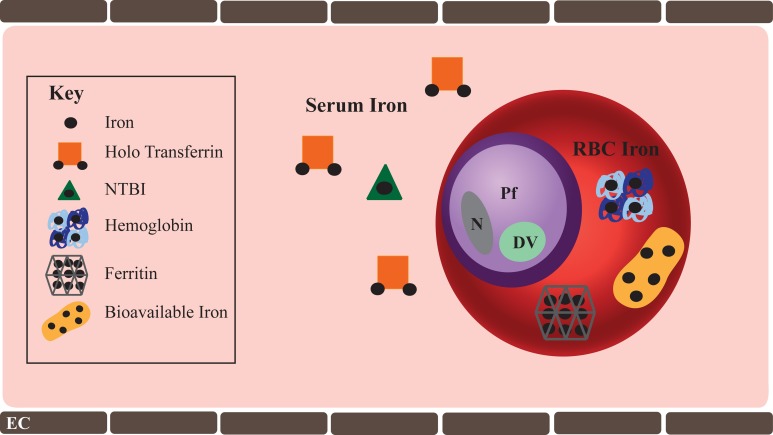
Figure 1
Figure 1
Host Iron available to erythrocytic stage P. falciparum. Host iron immediately available to the erythrocytic stage of P. falciparum include serum and intra-erythrocytic iron. Serum iron ranges from 10 to 27 μM. Transferrin bound iron is the predominant form of iron in the serum, though trace amounts of non-transferrin bound iron (NTBI) are present. In some pathologic conditions such as hemochromatosis, NTBI may be significantly greater. While iron deficiency anemia is characterized by a significant decline in serum iron. RBC iron is found within hemoglobin (20 mM), ferritin (0.7 nM), and as bioavailable iron (1–10 μM). Iron deficiency anemia significantly reduces RBC iron, specifically hemoglobin iron. Shown in the figure are: Pf, P. falciparum; DV, digestive vacuole; N, parasite nucleus; and EC, endothelial cell.
Figure 2
Figure 2
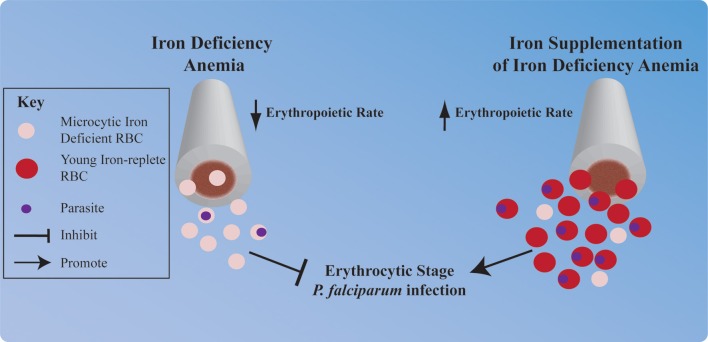
Hypothesized impact of iron deficiency anemia and iron supplementation on P. falciparum erythrocytic infection. Iron deficiency anemia and iron supplementation each profoundly influence human erythropoiesis, and this may influence erythrocytic stage malaria infection. Iron deficiency induced reduction in the erythropoietic rate and synthesis of microcytic iron deficient RBCs may provide protection against P. falciparum infection. Conversely, stimulation of the human host's erythropoietic rate by iron supplementation and subsequent replacement of microcytic iron deficient RBCs with young iron-replete RBCs may increase an individual's risk of erythrocytic stage P. falciparum infection.

References

    1. Acharya J., Punchard N. A., Taylor J. A., Thompson R. P., Pearson T. C. (1991). Red cell lipid peroxidation and antioxidant enzymes in iron deficiency. Eur. J. Haematol. 47, 287–291 10.1111/j.1600-0609.1991.tb01573.x - DOI - PubMed
    1. Aguilar R., Moraleda C., Quintó L., Renom M., Mussacate L., Macete E., et al. (2012). Challenges in the diagnosis of iron deficiency in children exposed to high prevalence of infections. PLoS ONE 7:e50584 10.1371/journal.pone.0050584 - DOI - PMC - PubMed
    1. Ariey F., Witkowski B., Amaratunga C., Beghain J., Langlois A.-C., Khim N., et al. (2014). A molecular marker of artemisinin-resistant Plasmodium falciparum malaria. Nature 505, 50–55 10.1038/nature12876 - DOI - PMC - PubMed
    1. Armitage A. E., Eddowes L. A., Gileadi U., Cole S., Spottiswoode N., Selvakumar T. A., et al. (2011). Hepcidin regulation by innate immune and infectious stimuli. Blood 118, 4129–4139 10.1182/blood-2011-04-351957 - DOI - PubMed
    1. Brandão M. M., Castro Mde L., Fontes A., Cesar C. L., Costa F. F., Saad S. T. (2009). Impaired red cell deformability in iron deficient subjects. Clin. Hemorheol. Microcirc. 43, 217–221 10.3233/CH-2009-1211 - DOI - PubMed

LinkOut - more resources