. 2014 Jul:124:67-73.
doi: 10.1016/j.exer.2014.04.011. Epub 2014 May 15.

The clinically used photosensitizer Verteporfin (VP) inhibits YAP-TEAD and human retinoblastoma cell growth in vitro without light activation

Affiliations

The clinically used photosensitizer Verteporfin (VP) inhibits YAP-TEAD and human retinoblastoma cell growth in vitro without light activation

Katarzyna Brodowska et al. Exp Eye Res. 2014 Jul.

Abstract

Verteporfin (VP), a benzoporphyrin derivative, is clinically used in photodynamic therapy for neovascular macular degeneration. Recent studies indicate that VP may inhibit growth of hepatoma cells without photoactivation through inhibition of YAP-TEAD complex. In this study, we examined the effects of VP without light activation on human retinoblastoma cell lines. Verteporfin but not vehicle control inhibited the growth, proliferation and viability of human retinoblastoma cell lines (Y79 and WERI) in a dose-dependent manner and was associated with downregulation of YAP-TEAD associated downstream proto-oncogenes such as c-myc, Axl, and surviving. In addition VP affected signals involved in cell migration and angiogenesis such as CTGF, cyr61, and VEGF-A but was not associated with significant effect on the mTOR/autophagy pathway. Of interest the pluripotency marker Oct4 were downregulated by Verteporfin treatment. Our results indicate that the clinically used photosensitizer VP is a potent inhibitor of cell growth in retinoblastoma cells, disrupting YAP-TEAD signaling and pluripotential marker OCT4. This study highlights for the first time the role of the YAP-TEAD pathway in Retinoblastoma and suggests that VP may be a useful adjuvant therapeutic tool in treating Rb patients.

Keywords: Hippo; Oct4; YAP; cancer; eye; intraocular.


Figures

Figure 1
Figure 1. Verteporfin (VP) inhibits growth of retinoblastoma cells Y79 and WERI without light activation
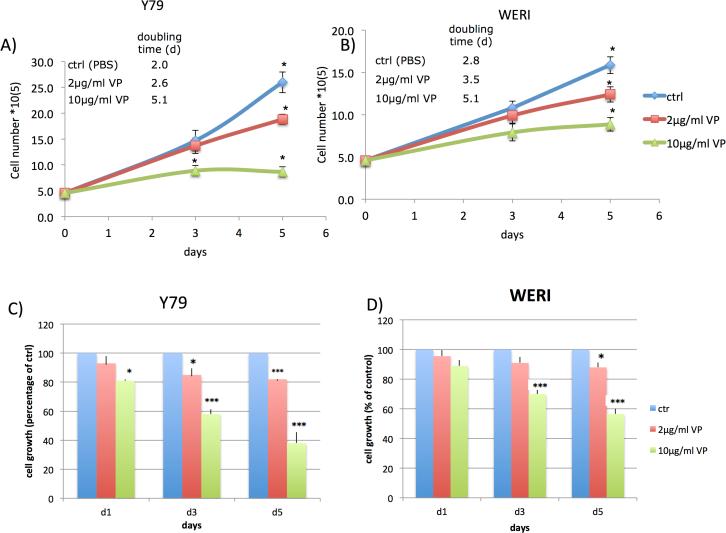
Y79 and WERI retinoblastoma cells were left untreated (PBS control) or treated with VP for five days; control (blue), VP concentration 2μg/ml (red) and 10μg/ml (green). (A,B) VP treatment resulted in an inhibition of cell growth and a decrease of the cell number of Y79 and WERI cells in a dose-dependent manner. The doubling time was increased. (C,D) VP treatment resulted in a significant, time- and dose-dependent inhibition of Y79 and WERI cell growth and viability as determined by MTT assays. The results are expressed as percentage of growth (%) relative to control values. Results are average of three independent experiments. Data are presented as mean +/− SEM (n=9, *p<0.05, *** p<0.001).
Figure 2
Figure 2. Verteporfin (VP) blocks cell cycle progression in retinoblastoma cells
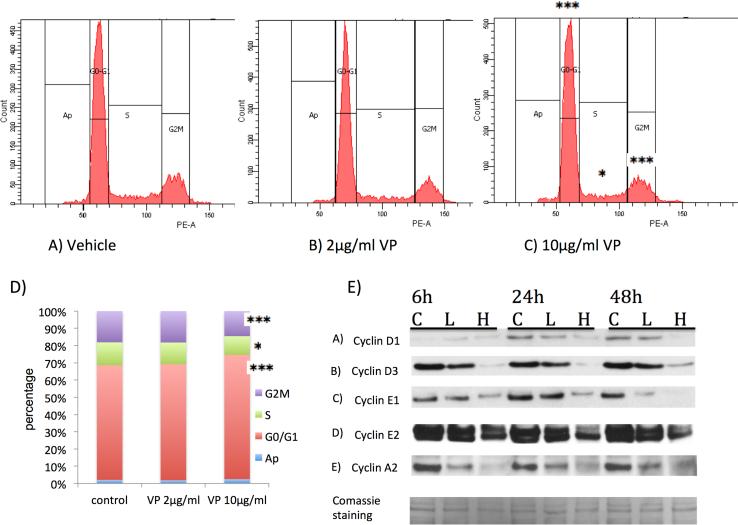
(A) Y79 retinoblastoma cells left untreated (PBS control) (B) treated with 2μg/ml or (C) 10μg/ml VP for 48h, were analyzed regarding their cell cycle phases for nuclear DNA content by propidium-iodide staining and flow cytometry. (D) Quantification of results shows, that VP treatment at a high concentration of 10μg/ml resulted in a significant increase of Y79 cells in G0/G1 phase, a significant decrease of cells in S-phase and a significant decrease of cells in G2/M phase. Representative data from three independent experiments are shown (n=6 per condition, *p<0.05, *** p<0.001). Data are presented as mean +/− SEM (n=6). (E) Verteporfin (VP) affects the levels of cyclins in retinoblastoma cells. Y79 retinoblastoma cells were treated with vehicle control (letter C above first blot) or with VP 2μg/ml (L) or 10μg/ml (H), for 6, 24 and 48 hours as indicated, while being protected from light any time. Western blots of cyclins D1, D3, E1, E2, A2ares shown. Data are representative out of at least two independent experiments.
Figure 3
Figure 3. VP affects YAP-TEAD proto-oncogene pathway in retinoblastoma cells
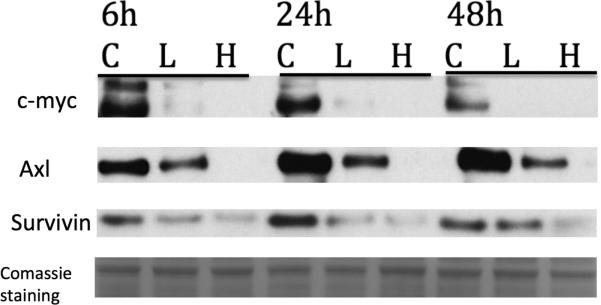
Y79 retinoblastoma cells were treated with vehicle (letter C) or with VP 2μg/ml (L) or 10μg/ml (H) for 6, 24 and 48hours. Protein expression of c-Myc, Axl, and surviving was assessed by Western Blot. Data are representative out of at least two independent experiments.
Figure 4
Figure 4. Verteporfin (VP) affects YAP-TEAD signaling pathway in retinoblastoma cells involved in angiogenesis and migration (CYR 61, CTGF and VEGF )
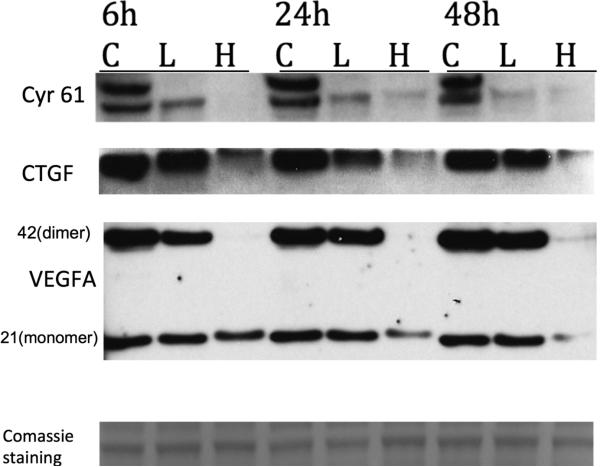
Y79 retinoblastoma cells were treated with vehicle (letter C) or with VP 2μg/ml (L) or 10μg/ml (H) for 6, 24 and 48hours. Protein expression of Cyr61,CTGF and VEGF-A was assessed by Western Blot. Data are representative out of at least two independent experiments.
Figure 5
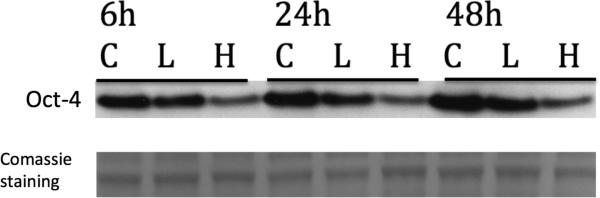
Figure 5. Verteporfin down-regulates pluripotency marker OCT-4 in retinoblastoma cells
Y79 retinoblastoma cells were treated with vehicle (letter C) or with VP 2μg/ml (L) or 10μg/ml (H) for 6, 24 and 48hours. OCT-4 expression was assessed by Western Blot. Data are representative out of at least two independent experiments.

References

    1. Agostinis P, Berg K, Cengel KA, Foster TH, Girotti AW, Gollnick SO, Hahn SM, Hamblin MR, Juzeniene A, Kessel D, et al. Photodynamic therapy of cancer: An update. CA: a Cancer Journal for Clinicians. 2011;61:250–281. - PMC - PubMed
    1. Bellou S, Pentheroudakis G, Murphy C, Fotsis T. Anti-angiogenesis in cancer therapy: Hercules and hydra. Cancer Lett. 2013;338:219–228. - PubMed
    1. Benz MSM, Scott IUI, Murray TGT, Kramer DD, Toledano SS. Complications of systemic chemotherapy as treatment of retinoblastoma. Arch Ophthalmol. 2000;118:577–578. - PubMed
    1. Bianciotto C, Shields CL, Iturralde JC, Sarici A, Jabbour P, Shields JA. Fluorescein angiographic findings after intra-arterial chemotherapy for retinoblastoma. Ophthalmology. 2012;119:843–849. - PubMed
    1. Brancho D, Tanaka N, Jaeschke A, Ventura J-J, Kelkar N, Tanaka Y, Kyuuma M, Takeshita T, Flavell RA, Davis RJ. Mechanism of p38 MAP kinase activation in vivo. Genes Dev. 2003;17:1969–1978. - PMC - PubMed

Publication types

MeSH terms