Distinct characteristics of e13a2 versus e14a2 BCR-ABL1 driven chronic myeloid leukemia under first-line therapy with imatinib
- PMID: 24837466
- PMCID: PMC4562532
- DOI: 10.3324/haematol.2013.096537
Distinct characteristics of e13a2 versus e14a2 BCR-ABL1 driven chronic myeloid leukemia under first-line therapy with imatinib
Abstract
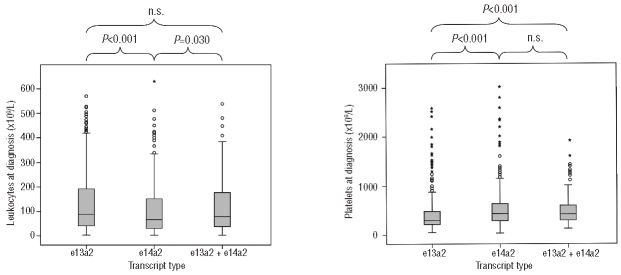
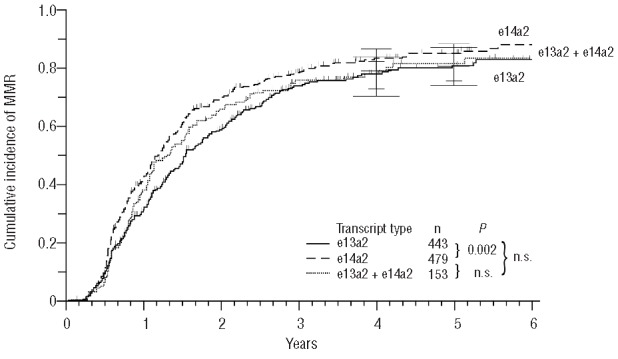
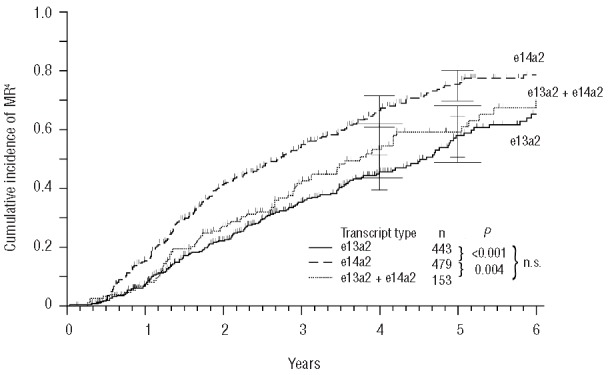
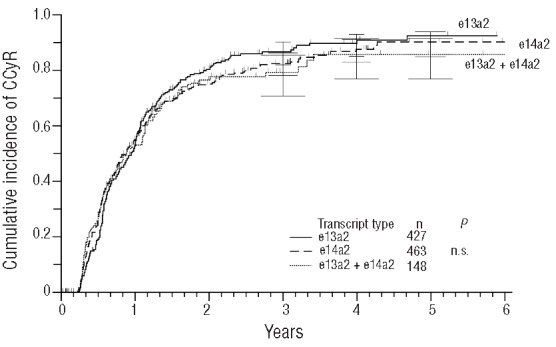
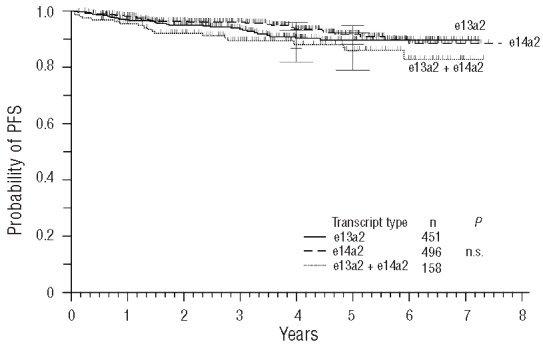
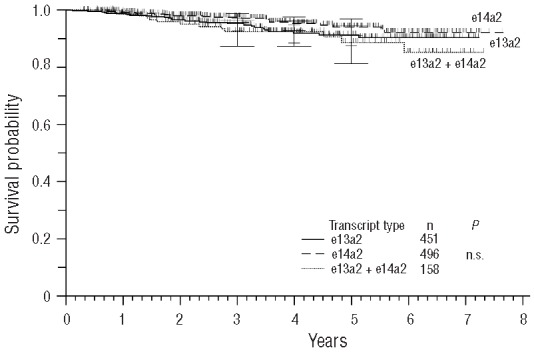
The vast majority of chronic myeloid leukemia patients express a BCR-ABL1 fusion gene mRNA encoding a 210 kDa tyrosine kinase which promotes leukemic transformation. A possible differential impact of the corresponding BCR-ABL1 transcript variants e13a2 ("b2a2") and e14a2 ("b3a2") on disease phenotype and outcome is still a subject of debate. A total of 1105 newly diagnosed imatinib-treated patients were analyzed according to transcript type at diagnosis (e13a2, n=451; e14a2, n=496; e13a2+e14a2, n=158). No differences regarding age, sex, or Euro risk score were observed. A significant difference was found between e13a2 and e14a2 when comparing white blood cells (88 vs. 65 × 10(9)/L, respectively; P<0.001) and platelets (296 vs. 430 × 10(9)/L, respectively; P<0.001) at diagnosis, indicating a distinct disease phenotype. No significant difference was observed regarding other hematologic features, including spleen size and hematologic adverse events, during imatinib-based therapies. Cumulative molecular response was inferior in e13a2 patients (P=0.002 for major molecular response; P<0.001 for MR4). No difference was observed with regard to cytogenetic response and overall survival. In conclusion, e13a2 and e14a2 chronic myeloid leukemia seem to represent distinct biological entities. However, clinical outcome under imatinib treatment was comparable and no risk prediction can be made according to e13a2 versus e14a2 BCR-ABL1 transcript type at diagnosis. (clinicaltrials.gov identifier:00055874).
Trial registration: ClinicalTrials.gov NCT00055874.
Copyright© Ferrata Storti Foundation.
Figures
References
-
- Goldman JM, Melo JV. Chronic myeloid leukemia–advances in biology and new approaches to treatment. N Engl J Med. 2003;349(15):1451–64. - PubMed
-
- Deininger MW, Goldman JM, Melo JV. The molecular biology of chronic myeloid leukemia. Blood. 2000;96(10):3343–56. - PubMed
-
- Shtivelman E, Lifshitz B, Gale RP, Roe BA, Canaani E. Alternative splicing of RNAs transcribed from the human abl gene and from the bcr-abl fused gene. Cell. 1986;47(2):277–84. - PubMed
-
- Perego RA, Costantini M, Cornacchini G, Gargantini L, Bianchi C, Pungolino E, et al. The possible influences of B2A2 and B3A2 BCR/ABL protein structure on thrombopoiesis in chronic myeloid leukaemia. Eur J Cancer. 2000;36(11):1395–401. - PubMed
-
- Clark RE, Dodi IA, Hill SC, Lill JR, Aubert G, Macintyre AR, et al. Direct evidence that leukemic cells present HLA-associated immunogenic peptides derived from the BCR-ABL b3a2 fusion protein. Blood. 2001;98(10):2887–93. - PubMed
Publication types
MeSH terms
Substances
Associated data
LinkOut - more resources
Full Text Sources
Other Literature Sources
Medical
Miscellaneous