


Trauma, PTSD, and binge and hazardous drinking among women and men: findings from a national study
- PMID: 24838049
- PMCID: PMC4094352
- DOI: 10.1016/j.jpsychires.2014.04.018
Trauma, PTSD, and binge and hazardous drinking among women and men: findings from a national study
Abstract
Objective: To examine whether trauma and posttraumatic stress disorder (PTSD) are differentially associated with binge and hazardous patterns of drinking among women and men.
Methods: Secondary analysis of the Wave 2 National Epidemiologic Survey on Alcohol and Related Conditions (NESARC); the analytic sample included 31,487 respondents (54.6% female) without past-year alcohol abuse/dependence. Participants' trauma-exposure/PTSD status was characterized as: no exposure to trauma in lifetime (reference), lifetime trauma exposure, PTSD before past-year, or past-year PTSD. Past-year binge and hazardous drinking were examined with multinomial logistic regression models (past-year abstinence was modeled as the non-event); models included the main effects of trauma-exposure/PTSD status and gender, the trauma-exposure/PTSD status-by-gender interaction, psychiatric comorbidity, and socio-demographic covariates.
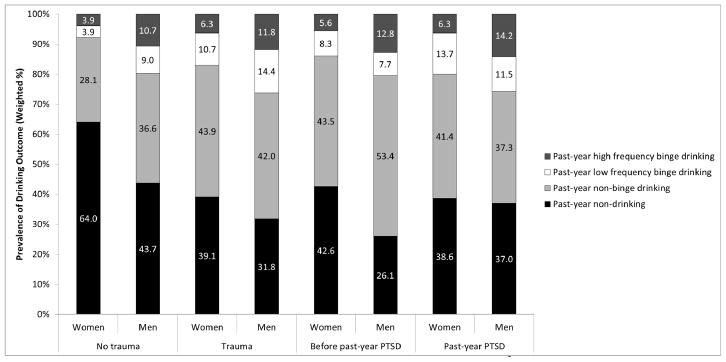
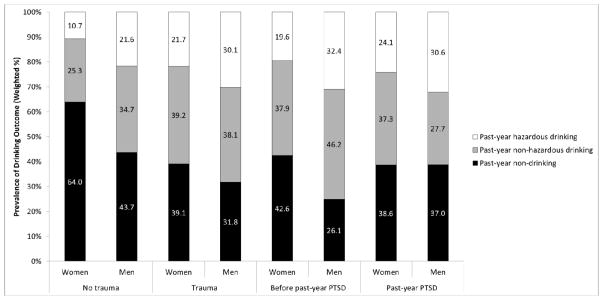
Results: The gender-specific effects of trauma, before past-year PTSD, and past-year PTSD were significantly elevated for all drinking behaviors in women (range of odds ratios (ORs) = 1.8-4.8), and for some drinking behaviors in men (range of ORs = 1.3-2.0), relative to no trauma exposure. Trauma exposure was more strongly associated with high-frequency binge drinking, low-frequency binge drinking, and non-binge drinking among women as compared to men. Past-year PTSD was also more strongly associated with low-frequency binge drinking and non-binge drinking among women compared to men. Findings for hazardous drinking followed a similar pattern, with significant gender-related differences in ORs for hazardous drinking and non-hazardous drinking observed with respect to trauma exposure and past-year PTSD..
Conclusion: Mental health practitioners should be mindful of the extent to which trauma-exposed individuals both with and without PTSD engage in binge and hazardous drinking, given the negative consequences associated with these patterns of drinking..
Keywords: Binge drinking; Epidemiology; Gender; Hazardous drinking; PTSD; Trauma.
Copyright © 2014 Elsevier Ltd. All rights reserved.
Conflict of interest statement
Figures
References
-
- American Psychiatric Association. Diagnostic and Statistical Manual of Mental Disorders. 4. American Psychiatric Association; Washington, DC: 1994.
-
- Brady KT, Killeen T, Saladin M, Dansky BS, Becker S. Comorbid substance abuse and PTSD: Characteristics of women in treatment. American Journal on Addictions. 1994;3:160–164.
-
- Breslau N, Chilcoat HD, Kessler RC, Peterson EL, Lucia VC. Vulnerability to assaultive violence: Further specification of the sex difference in post-traumatic stress disorder. Psychological Medicine. 1999;29:813–821. - PubMed
Publication types
MeSH terms
Grants and funding
LinkOut - more resources
Full Text Sources
Other Literature Sources
Medical
Miscellaneous
