


Emergency pancreatoduodenectomy for complex injuries of the pancreas and duodenum
- PMID: 24841125
- PMCID: PMC4487756
- DOI: 10.1111/hpb.12244
Emergency pancreatoduodenectomy for complex injuries of the pancreas and duodenum
Abstract
Background: This single-centre study evaluated the outcome of a pancreatoduodenectomy for Grade 5 injuries of the pancreas and duodenum.
Methods: Prospectively recorded data of patients who underwent a pancreatoduodenectomy for trauma at a Level I Trauma Centre during a 22-year period were analysed.
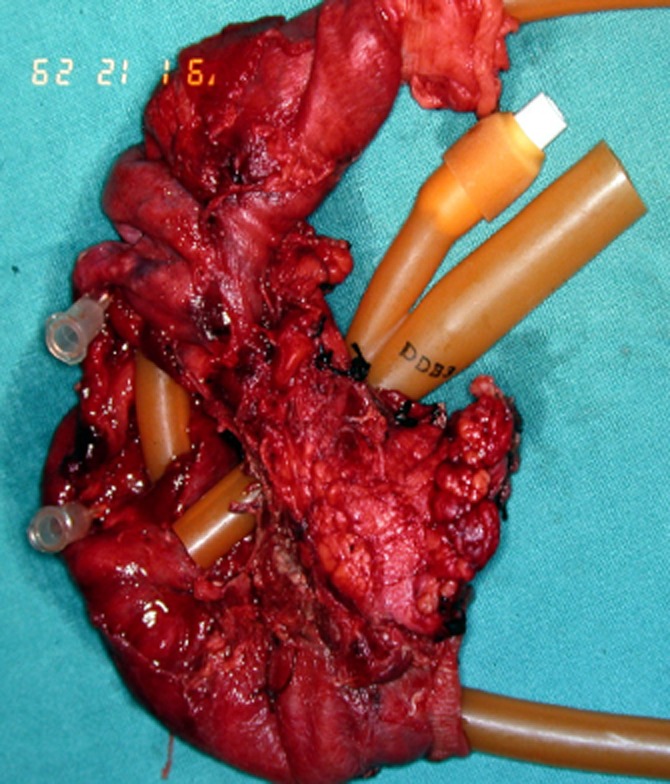
Results: Nineteen (17 men and 2 women, median age 28 years, range 14-53 years) out of 426 patients with pancreatic injuries underwent a pancreatoduodenectomy (gunshot n = 12, blunt trauma n = 6 and stab wound n = 1). Nine patients had associated inferior vena cava (IVC) or portal vein (PV) injuries. Five patients had initial damage control procedures and underwent a definitive operation at a median of 15 h (range 11-92) later. Twelve had a pylorus-preserving pancreatoduodenectomy (PPPD) and 7 a standard Whipple. Three patients with APACHE II scores of 15, 18, 18 died post-operatively of multi-organ failure. All 16 survivors had Dindo-Clavien grade I (n = 1), grade II (n = 7), grade IIIa (n = 2), grade IVa (n = 6) post-operative complications. Factors complicating surgery were shock on admission, number of associated injuries, coagulopathy, hypothermia, gross bowel oedema and traumatic pancreatitis.
Conclusions: A pancreatoduodenectomy is a life-saving procedure in a small cohort of stable patients with non-reconstructable pancreatic head injuries. Damage control before a pancreatoduodenectomy will salvage a proportion of the most severely injured patients who have multiple injuries.
© 2014 International Hepato-Pancreato-Biliary Association.
Figures
References
-
- Krige JEJ, Bornman PC, Terblanche J. The role of pancreatoduodenectomy in the management of complex pancreatic trauma. In: Hanyu F, Takasaki K, editors. Pancreatoduodenectomy. Tokyo: Springer-Verlag; 1997. pp. 49–62.
-
- Krige JE, Beningfield SJ, Nicol AJ, Navsaria P. The management of complex pancreatic injuries. S Afr J Surg. 2005;43:92–102. - PubMed
-
- Krige JE, Kotze UK, Hameed M, Nicol AJ, Navsaria PH. Pancreatic injuries after blunt abdominal trauma: an analysis of 110 patients treated at a level 1 trauma centre. S Afr J Surg. 2011;49:62–64. 58, 60. - PubMed
-
- Krige JE, Thomson SR. Operative strategies in pancreatic trauma – keep it safe and simple. S Afr J Surg. 2011;49:106–109. - PubMed
-
- Kao LS, Bulger EM, Parks DL, Byrd GF, Jurkovich GJ. Predictors of morbidity after traumatic pancreatic injury. J Trauma. 2003;55:898–905. - PubMed
Publication types
MeSH terms
LinkOut - more resources
Full Text Sources
Other Literature Sources
