Review
. 2014 Jun:6:61-9.
doi: 10.1016/j.coviro.2014.04.007. Epub 2014 May 17.

Systems approaches to Coronavirus pathogenesis

Affiliations
Review

Systems approaches to Coronavirus pathogenesis

Alexandra Schäfer et al. Curr Opin Virol. 2014 Jun.

Abstract

Coronaviruses comprise a large group of emergent human and animal pathogens, including the highly pathogenic SARS-CoV and MERS-CoV strains that cause significant morbidity and mortality in infected individuals, especially the elderly. As emergent viruses may cause episodic outbreaks of disease over time, human samples are limited. Systems biology and genetic technologies maximize opportunities for identifying critical host and viral genetic factors that regulate susceptibility and virus-induced disease severity. These approaches provide discovery platforms that highlight and allow targeted confirmation of critical targets for prophylactics and therapeutics, especially critical in an outbreak setting. Although poorly understood, it has long been recognized that host regulation of virus-associated disease severity is multigenic. The advent of systems genetic and biology resources provides new opportunities for deconvoluting the complex genetic interactions and expression networks that regulate pathogenic or protective host response patterns following virus infection. Using SARS-CoV as a model, dynamic transcriptional network changes and disease-associated phenotypes have been identified in different genetic backgrounds, leading to the promise of population-wide discovery of the underpinnings of Coronavirus pathogenesis.


Figures

Figure 1
Figure 1
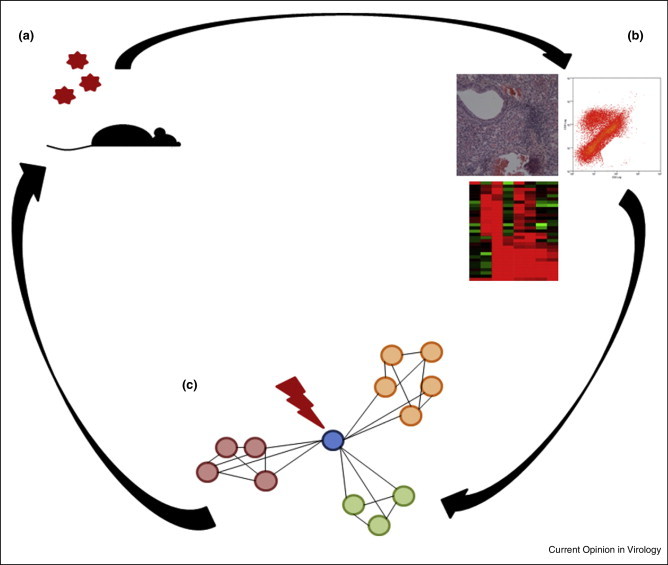
The Systems Biology Paradigm. Systems Biology focuses on an iterative cycle of experiments. In model system (a) mouse is infected. (b) Measurements of molecular (e.g. whole transcriptome, proteome) and disease related phenotypes (histopathology and flow cytometry) are taken at multiple timepoints and contrasted with mock infected animals. (c) Transcriptional (or proteomic) data are assembled into networks of interacting and coexpressed transcripts. These networks are then correlated back to specific disease pathologies. These data are then fed into new sets of experiments where key members of networks (e.g. the blue gene central to the network) are then disrupted to alter pathologic outcomes in a predicted manner.
Figure 2
Figure 2
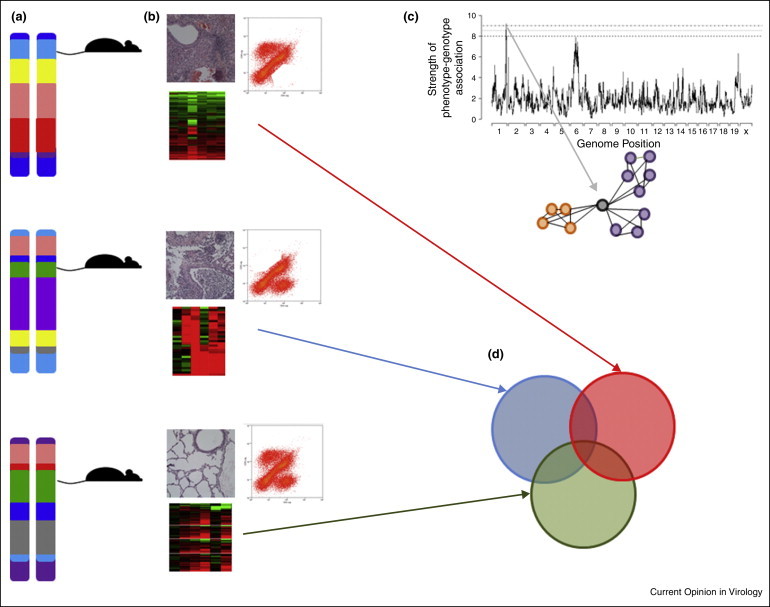
Systems Genetics integrates systems biology and genetic complexity. Here sets of genetically well-defined yet distinct mouse strains (a) are challenged with a pathogen and a variety (b) of disease and molecular phenotypes are collected. Integration of genetic variants within this population and disease phenotypes (c) can identify host genome regions containing polymorphisms controlling disease phenotypes (QTL mapping), and contrasting the expression profiles of individuals with variant polymorphisms at this loci can identify those groups of transcripts that are up-regulated (orange) or down-regulated (purple) due to polymorphisms at this genome location, highlighting mechanisms of virus induced pathology. Furthermore, by contrasting in a strain-specific manner all of those transcripts that are differentially expressed during infection (d), specific transcriptional subsets can be associated with variant disease outcomes. Here each of the three mouse strains have a pool of differentially expressed transcripts (colored circles) following infection. Therefore, the union of red, blue and green describes those transcripts commonly differentially regulated across all genotypes in response to infection. Similarly, the intersection of red and blue transcripts (excluding green transcripts) describes those transcripts differentially regulated in genotypes with severe lung pathologies.
Figure 3
Figure 3
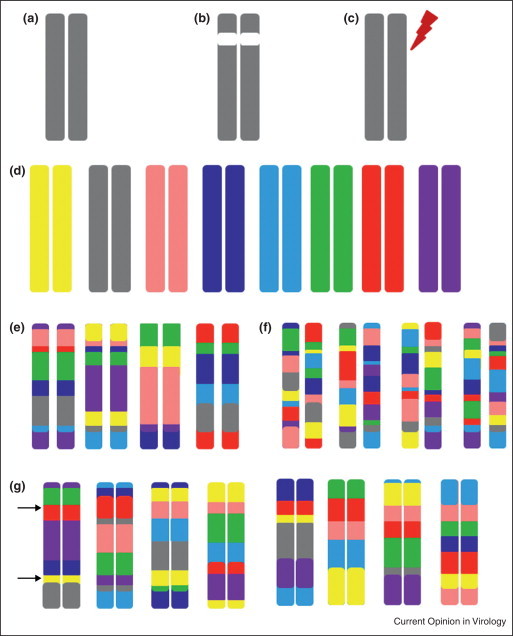
Platforms for Systems genetics discovery and validation. Traditionally, classical inbred strains such as C57BL/6J (a) have been used for systems biology approaches. These classical systems have utilized (b) gene knockouts or (c) the introduction of functional changing mutations as perturbation/validation systems. The Collaborative Cross (CC) and DO (DO) populations were derived from a set of eight genetically diverse founders whose genomes are represented by the following colors (d): A/J (yellow), C57BL/6J (gray), 129s1/SvImJ (pink), NOD/ShiLtJ (dk. blue), NZO/HILtJ (lt. blue), CAST/EiJ (green), PWK/PhJ (red), and WSB/EiJ (purple). CC lines (e) have inbred genomes that are mosaics of these eight founders (with the founder contributions keeping the color coding of D). CC lines have well-characterized genomes and being inbred are an infinitely reproducible population. Similarly (f) the Diversity Outbred (DO) is a completely outbred population of animals derived from the same eight founder strains. While this population is not reproducible, the genetic architecture of the population can be reproduced. In these ways, both the CC and DO facilitate systems genetics approaches. The CC and DO, by virtue of the large number of unique genomes, can be used (f) to create a variety of validation crosses, or sets of lines with unique genetic combinations for further mechanistic study of polymorphisms of interest. Here, a panel of CC lines is being used to contrast the PWK/PhJ (red) and 129S1/SvImJ (pink) alleles at Locus 1, while simultaneously being used to contrast A/J (yellow) and WSB/EiJ (purple) alleles at Locus 2.

References

    1. Peiris J.S., Guan Y., Yuen K.Y. Severe acute respiratory syndrome. Nat Med. 2004;10:S88–S97. - PMC - PubMed
    1. Li W., Wong S.K., Li F., Kuhn J.H., Huang I.C., Choe H., Farzan M. Animal origins of the severe acute respiratory syndrome coronavirus: insight from ACE2-S-protein interactions. J Virol. 2006;80:4211–4219. - PMC - PubMed
    1. Lau S.K., Woo P.C., Li K.S., Huang Y., Tsoi H.W., Wong B.H., Wong S.S., Leung S.Y., Chan K.H., Yuen K.Y. Severe acute respiratory syndrome coronavirus-like virus in Chinese horseshoe bats. Proc Natl Acad Sci USA. 2005;102:14040–14045. - PMC - PubMed
    1. Guan Y., Zheng B.J., He Y.Q., Liu X.L., Zhuang Z.X., Cheung C.L., Luo S.W., Li P.H., Zhang L.J., Guan Y.J. Isolation and characterization of viruses related to the SARS coronavirus from animals in southern China. Science. 2003;302:276–278. - PubMed
    1. Haagmans B.L., Al Dhahiry S.H., Reusken C.B., Raj V.S., Galiano M., Myers R., Godeke G.J., Jonges M., Farag E., Diab A. Middle East respiratory syndrome coronavirus in dromedary camels: an outbreak investigation. Lancet Infect Dis. 2014;14:140–145. - PMC - PubMed

Publication types