


Review
doi: 10.1016/j.biocel.2014.05.010.
Epub 2014 May 16.
Mitophagy mechanisms and role in human diseases
Affiliations
- PMID: 24842106
- PMCID: PMC4111979
- DOI: 10.1016/j.biocel.2014.05.010
Item in Clipboard
Review
Mitophagy mechanisms and role in human diseases
Int J Biochem Cell Biol.
2014 Aug.
Abstract
Mitophagy is a process of mitochondrial turnover through lysosomal mediated autophagy activities. This review will highlight recent studies that have identified mediators of mitophagy in response to starvation, loss of mitochondrial membrane potential or perturbation of mitochondrial integrity. Furthermore, we will review evidence of mitophagy dysfunction in various human diseases and discuss the potential for therapeutic interventions that target mitophagy processes.
Keywords: Cancer; Heart disease; Mitochondria; Mitophagy; Parkinson's disease.
Copyright © 2014 Elsevier Ltd. All rights reserved.
Figures
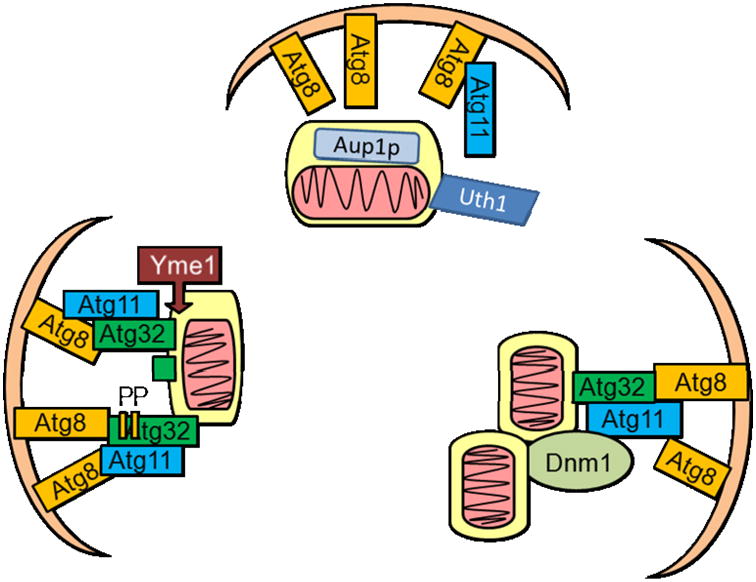
In yeast, selective autophagy of mitochondria is mediated by mitochondrial targeted proteins such as Uth1, Aup1p, or Atg32. While the mechanisms of interaction between Aup1p and Uth1 and the autophagy machinery are still unclear, more is known regarding Atg32 function in mitophagy. Under starvation conditions, Atg32 localizes to the mitochondria and interacts with Atg8 and Atg11 to bring mitochondria to the autophagosome. Phosphorylation of Atg32 at Ser-114 and Ser-119, or cleavage of Atg32 by Yme1, facilitates its interaction with Atg11. Atg11 interaction with mitochondrial fission protein Dnm1 and recruitment of fission complex to the mitochondria are also required for mitophagy in response to nitrogen starvation.
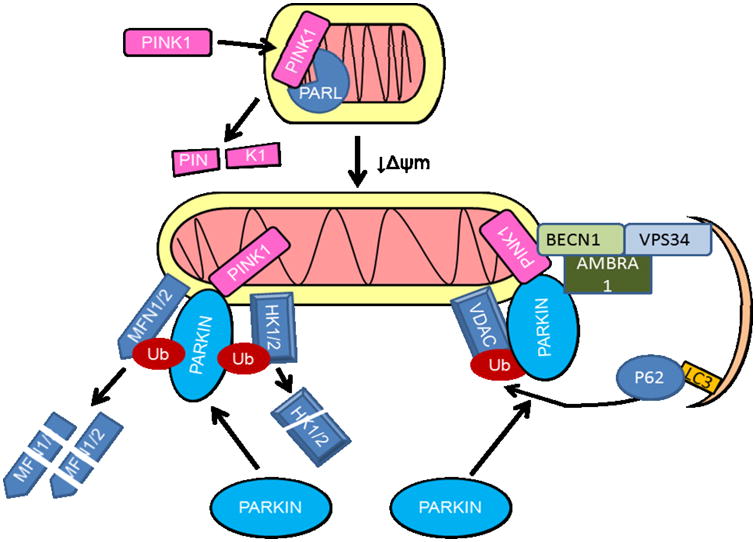
In healthy mitochondria PINK1 (PTEN – induced putative kinase 1) is targeted to the mitochondrial inner membrane where it is cleaved by the rhomboid protease of the IMM, presenilin associated rhomboid-like protease (PARL), and degraded. In stressed mitochondria with depleted membrane potential (↓Δψm), PARL is inactivated, and PINK1 accumulates in the mitochondria, recruiting the E3 ubiquitin ligase PARKIN. PARKIN can ubiquitinate Mitofusins 1 and 2 (MFN1 and 2), hexokinases, TOM complex components, FIS1, BAK, MIRO as well as VDAC. The ubiquitinated proteins are either degraded by the proteasome, or recognized by ubiquitin and LC3-binding autophagy adaptor protein p62/SQSTM1 which recruits them to autophagosomes. PARKIN-AMBRA1 interaction, or PINK1-BECN1 interaction can also facilitate mitophagy.
References
-
- Berthier A, Navarro S, Jimenez-Sainz J, et al. PINK1 displays tissue-specific subcellular location and regulates apoptosis and cell growth in breast cancer cells. Hum Pathol. 2011;42:75–87. - PubMed
Publication types
MeSH terms
Grants and funding
LinkOut - more resources
Full Text Sources
Other Literature Sources
Medical
