


doi: 10.1073/pnas.1321126111.
Epub 2014 May 19.
Removing T-cell epitopes with computational protein design
Affiliations
- PMID: 24843166
- PMCID: PMC4060723
- DOI: 10.1073/pnas.1321126111
Item in Clipboard
Removing T-cell epitopes with computational protein design
Proc Natl Acad Sci U S A.
.
Abstract
Immune responses can make protein therapeutics ineffective or even dangerous. We describe a general computational protein design method for reducing immunogenicity by eliminating known and predicted T-cell epitopes and maximizing the content of human peptide sequences without disrupting protein structure and function. We show that the method recapitulates previous experimental results on immunogenicity reduction, and we use it to disrupt T-cell epitopes in GFP and Pseudomonas exotoxin A without disrupting function.
Keywords: Rosetta; biotherapeutics; deimmunization; immunotoxin; machine learning.
Conflict of interest statement
The authors declare no conflict of interest.
Figures
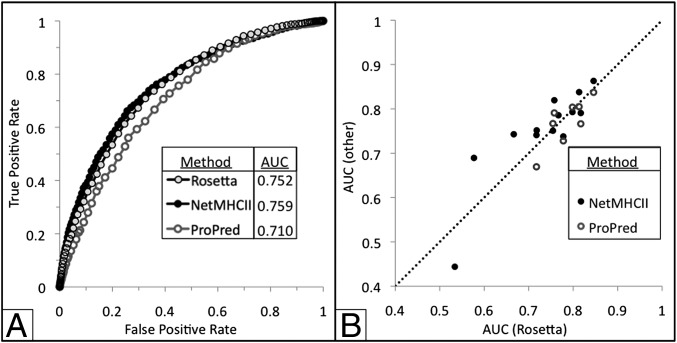
Performance of Rosetta SVM T-cell epitope prediction. (A) ROC curve true-positive rate vs. false-positive rate for all testing data and comparison with current methods. Total AUC is listed for each method. (B) Predictive performance over each allele test set. x Axis, Rosetta AUC; y axis, other method AUC. Points below the 1:1 dotted line indicate where Rosetta performs better than other methods.
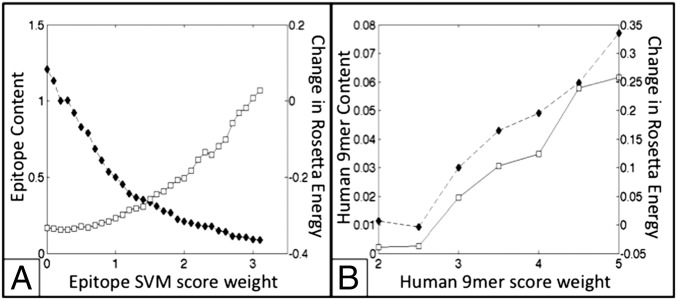
Tradeoffs between Rosetta energy and extent of deimmunization. Rosetta energy (□) of redesigned proteins increases, whereas (A) epitope content decreases and (B) human 9mer count increases (♦) as the weights on the associated score terms are increased.
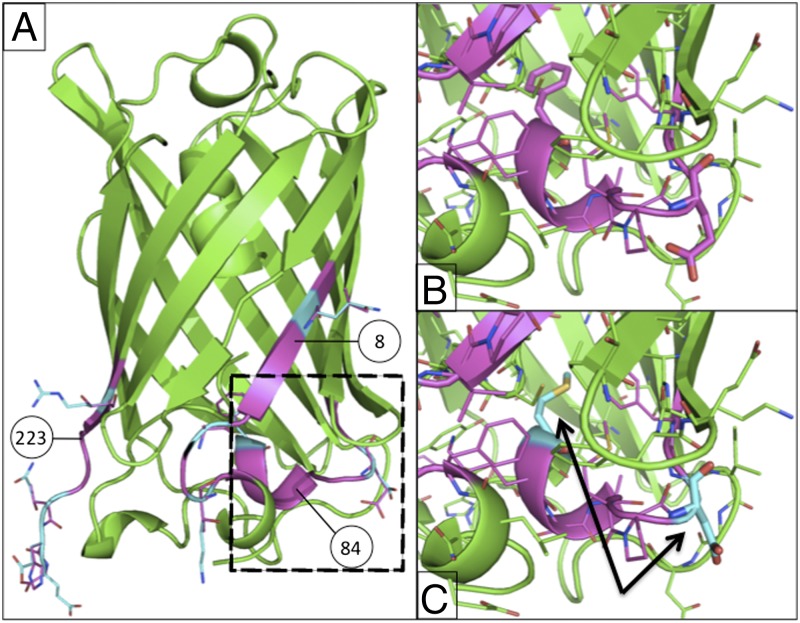
Rosetta design model for sfGFP deimmunization. (A) Published coordinates of sfGFP crystal structure. Both known and predicted epitopes were targeted for design. Epitope indices from Table 2 are labeled in circles. (B) Close-up view of immunodominant epitope. (C) Rosetta deimmunization design of B. Cyan, design mutations; green, sfGFP; magenta, predicted epitopes.
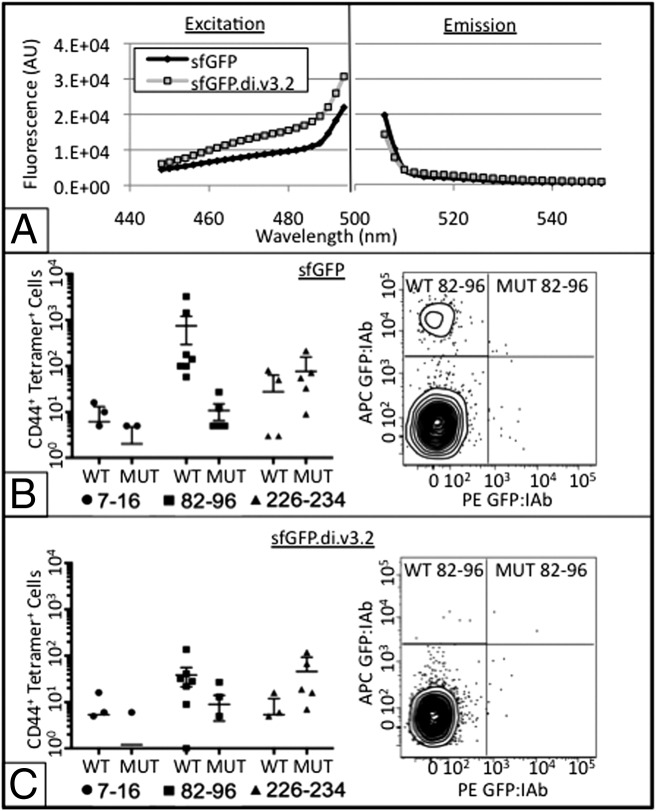
Redesign of sfGFP reduces T-cell reactivity without disrupting fluorescence. (A) Deimmunized sfGFP excitation and emission spectra in arbitrary units (AU). Excitation spectrum measured at 510-nm emission. Emission spectra measured at 488-nm excitation. (B) Flow cytometry analysis of tetramer-enriched populations of CD3+ CD4+ CD44+ GFP:I-Ab+ lymphocytes labeled with phycoerythrin (PE) and/or A-phycocyanin (APC). Total CD44+ CD4+ tetramer-positive cells for each of six GFP:I-Ab tetramers in mice immunized with WT sfGFP. Immunization with the native sfGFP leads to the expansion and activation of CD4+ T cells responding to epitopes 82–96. (C) Total CD44+ CD4+ tetramer-positive cells for each of six GFP:I-Ab tetramers in mice immunized with the designed sfGFP 3.2. Mice immunized with the designed sfGFP 3.2 no longer respond to the native sfGFP 82–96 epitopes or the designed epitopes 82–96 in sfGFP 3.2. MUT, mutant.
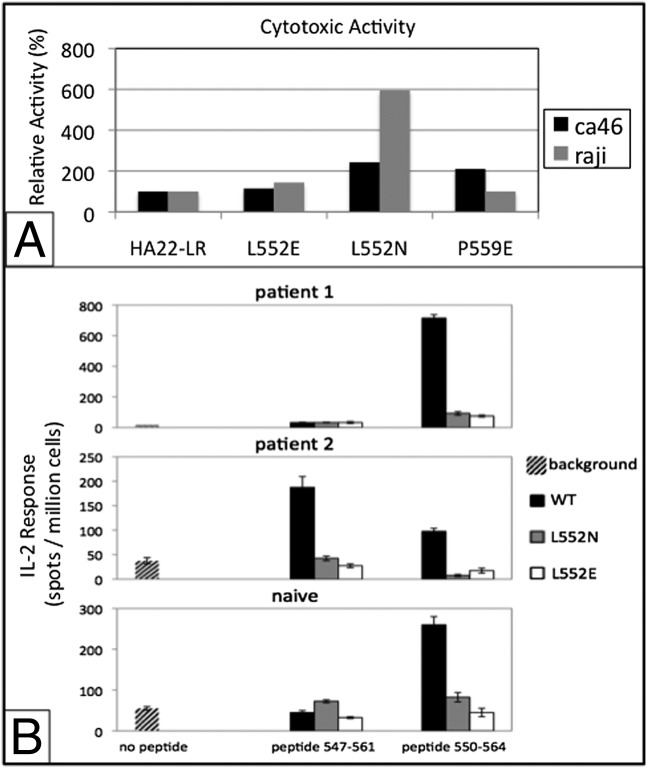
Redesign of exotoxin A reduces T-cell reactivity without loss of function. (A) Relative cytotoxicity for the original HA22-LR toxin and three computationally designed variants in two cell types. (B) ELISpot IL-2 response was measured for PBMCs derived from two patients and one naïve donor after restimulation with two WT peptides and four mutant peptides.
References
-
- Zubler RH. Naive and Memory B Cells in T-Cell-Dependent and T-Independent Responses. Springer Seminars in Immunopathology. Berlin: Springer; 2001. pp. 405–419. - PubMed
-
- Goldenberg MM. Trastuzumab, a recombinant DNA-derived humanized monoclonal antibody, a novel agent for the treatment of metastatic breast cancer. Clin Ther. 1999;21(2):309–318. - PubMed
-
- Harding FA, et al. A beta-lactamase with reduced immunogenicity for the targeted delivery of chemotherapeutics using antibody-directed enzyme prodrug therapy. Mol Cancer Ther. 2005;4(11):1791–1800. - PubMed
-
- Tangri S, et al. Rationally engineered therapeutic proteins with reduced immunogenicity. J Immunol. 2005;174(6):3187–3196. - PubMed
Publication types
MeSH terms
Substances
Grants and funding
LinkOut - more resources
Full Text Sources
Other Literature Sources
Molecular Biology Databases
