


Feasibility of a combined aerobic and strength training program and its effects on cognitive and physical function in institutionalized dementia patients. A pilot study
- PMID: 24844772
- PMCID: PMC4028210
- DOI: 10.1371/journal.pone.0097577
Feasibility of a combined aerobic and strength training program and its effects on cognitive and physical function in institutionalized dementia patients. A pilot study
Abstract
Objectives: We examined the feasibility of a combined aerobic and strength training program in institutionalized dementia patients and studied the effects on cognitive and physical function.
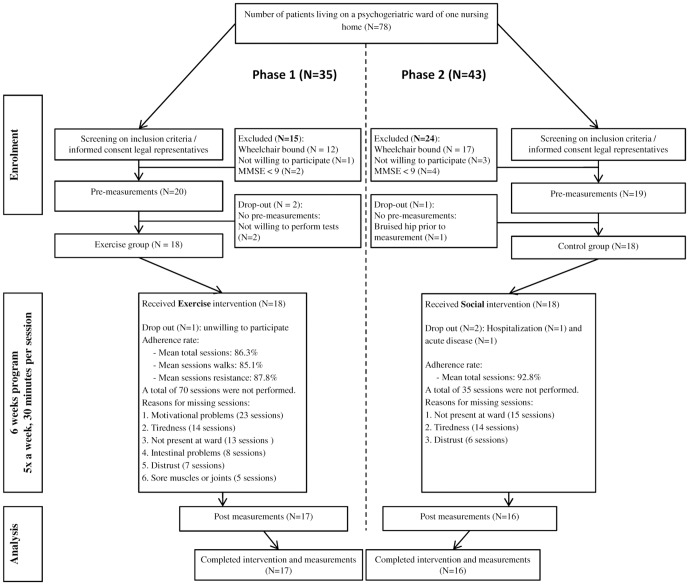
Methods: Thirty-three patients with dementia, recruited from one nursing home, participated in this non-randomized pilot study (25 women; age = 85.2±4.9 years; Mini Mental State Examination = 16.8±4.0). In phase 1 of the study, seventeen patients in the Exercise group (EG) received a combined aerobic and strength training program for six weeks, five times per week, 30 minutes per session, in an individually supervised format and successfully concluded the pre and posttests. In phase 2 of the study, sixteen patients in the Social group (SG) received social visits at the same frequency, duration, and format and successfully concluded the pre and posttests.
Results: Indices of feasibility showed that the recruitment and adherence rate, respectively were 46.2% and 86.3%. All EG patients completed the exercise program according to protocol without adverse events. After the six-week program, no significant differences on cognitive function tests were found between the EG and SG. There was a moderate effect size in favor for the EG for the Visual Memory Span Forward; a visual attention test. There were significant differences between groups in favor for the EG with moderate to large effects for the physical tests Walking Speed (p = .003), Six-Minute Walk Test (p = .031), and isometric quadriceps strength (p = .012).
Conclusions: The present pilot study showed that it is feasible to conduct a combined aerobic and strength training program in institutionalized patients with dementia. The selective cognitive visual attention improvements and more robust changes in motor function in favor of EG vs. SG could serve as a basis for large randomized clinical trials.
Trial registration: trialregister.nl 1230.
Conflict of interest statement
Figures
References
-
- Perri R, Monaco M, Fadda L, Caltagirone C, Carlesimo GA (2013) Neuropsychological correlates of behavioral symptoms in Alzheimer's disease, frontal variant of frontotemporal, subcortical vascular, and lewy body dementias: A comparative study. J Alzheimers Dis 39: 669–677. - PubMed
-
- Luppa M, Luck T, Weyerer S, Konig HH, Brahler E, et al. (2010) Prediction of institutionalization in the elderly. A systematic review. Age Ageing 39: 31–38. - PubMed
-
- Blankevoort CG, van Heuvelen MJ, Boersma F, Luning H, de Jong J, et al. (2010) Review of effects of physical activity on strength, balance, mobility and ADL performance in elderly subjects with dementia. Dement Geriatr Cogn Disord 30: 392–402. - PubMed
-
- Heyn P, Abreu BC, Ottenbacher KJ (2004) The effects of exercise training on elderly persons with cognitive impairment and dementia: A meta-analysis. Arch Phys Med Rehabil 85: 1694–1704. - PubMed
-
- Forbes D, Thiessen EJ, Blake CM, Forbes SC, Forbes S (2013) Exercise programs for people with dementia. Cochrane Database Syst Rev 12: CD006489. - PubMed
Publication types
MeSH terms
LinkOut - more resources
Full Text Sources
Other Literature Sources
Medical
