


Development and progress of Ireland's biobank network: Ethical, legal, and social implications (ELSI), standardized documentation, sample and data release, and international perspective
- PMID: 24845249
- PMCID: PMC4076973
- DOI: 10.1089/bio.2012.0028
Development and progress of Ireland's biobank network: Ethical, legal, and social implications (ELSI), standardized documentation, sample and data release, and international perspective
Abstract
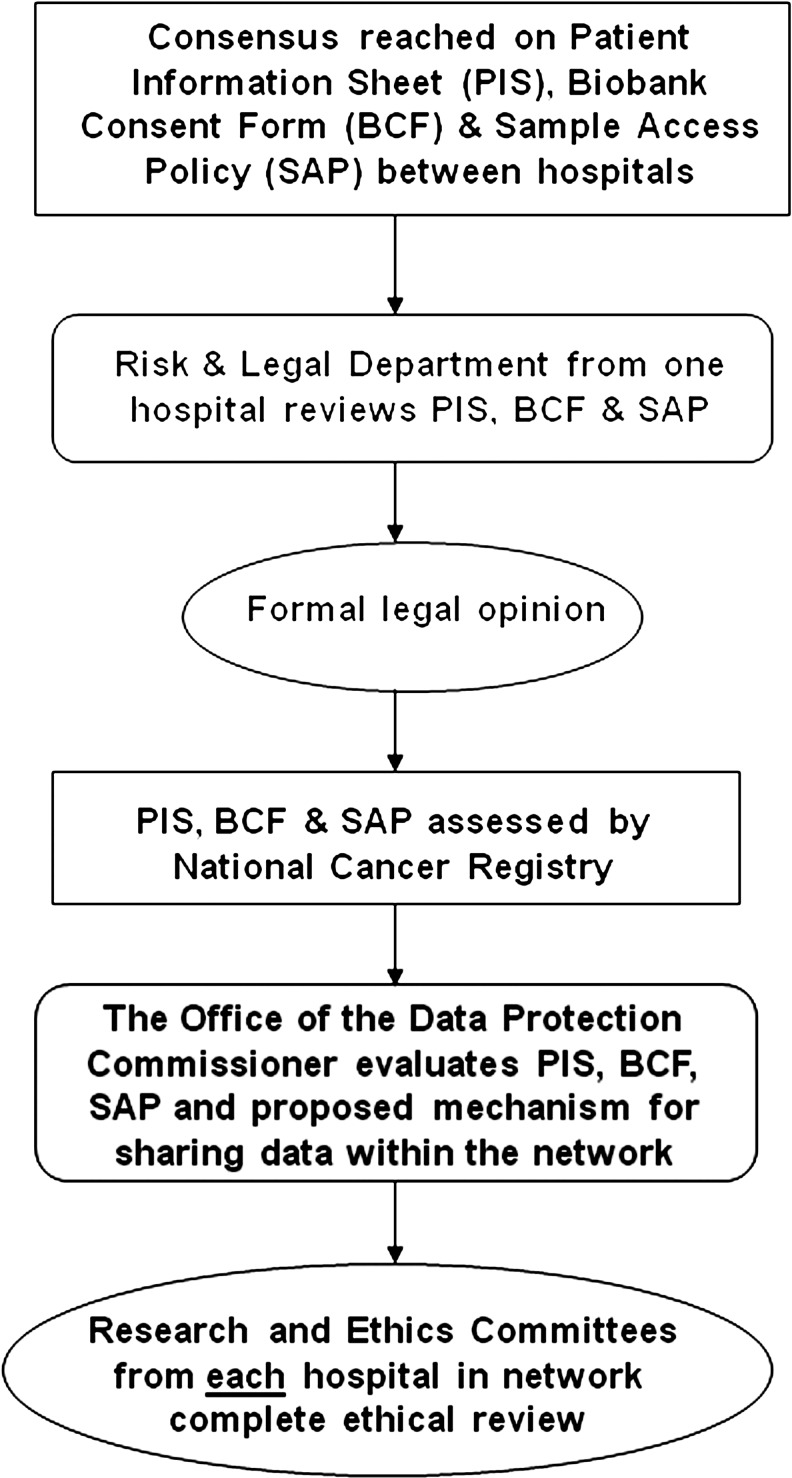
Biobank Ireland Trust (BIT) was established in 2004 to promote and develop an Irish biobank network to benefit patients, researchers, industry, and the economy. The network commenced in 2008 with two hospital biobanks and currently consists of biobanks in the four main cancer hospitals in Ireland. The St. James's Hospital (SJH) Biobank coordinates the network. Procedures, based on ISBER and NCI guidelines, are standardized across the network. Policies and documents-Patient Consent Policy, Patient Information Sheet, Biobank Consent Form, Sample and Data Access Policy (SAP), and Sample Application Form have been agreed upon (after robust discussion) for use in each hospital. An optimum sequence for document preparation and submission for review is outlined. Once consensus is reached among the participating biobanks, the SJH biobank liaises with the Research and Ethics Committees, the Office of the Data Protection Commissioner, The National Cancer Registry (NCR), patient advocate groups, researchers, and other stakeholders. The NCR provides de-identified data from its database for researchers via unique biobank codes. ELSI issues discussed include the introduction of prospective consent across the network and the return of significant research results to patients. Only 4 of 363 patients opted to be re-contacted and re-consented on each occasion that their samples are included in a new project. It was decided, after multidisciplinary discussion, that results will not be returned to patients. The SAP is modeled on those of several international networks. Biobank Ireland is affiliated with international biobanking groups-Marble Arch International Working Group, ISBER, and ESBB. The Irish government continues to deliberate on how to fund and implement biobanking nationally. Meanwhile BIT uses every opportunity to promote awareness of the benefits of biobanking in events and in the media.
References
-
- Department of Children and Health. A Strategy for Cancer Control in Ireland. National Cancer Form. 2006. http://www.hse.ie/eng/services/Publications/HealthProtection/Public_Heal.... [Sep 20;2012 ]. http://www.hse.ie/eng/services/Publications/HealthProtection/Public_Heal...
-
- Department of Children and Health. Recommendations for the Establishment of a National Cancer Biobank—Report of the Expert Group on a National Cancer Biobank. 2008. http://www.hrb.ie/uploads/tx_hrbpublications/Recommendations_for_the_Est.... http://www.hrb.ie/uploads/tx_hrbpublications/Recommendations_for_the_Est...
-
- Organization for Economic Co-operation and Development. OECD Guidelines on Human Biobanks and Genetic Research Databases. 2009.
-
- Organization for Economic Co-operation and Development. OECD Best Practice Guidelines for Biological Resource Centers. 2007.
-
- Best Practices for Repositories—Collection, Storage, Retrieval and Distribution of Biological Materials for Research. Cell Preserv Technol. 2008;6:3–58.
Publication types
MeSH terms
Grants and funding
LinkOut - more resources
Full Text Sources
Other Literature Sources
Miscellaneous
