. 2014 May 20;5(3):e01168-14.
doi: 10.1128/mBio.01168-14.

Chp8, a diguanylate cyclase from Pseudomonas syringae pv. Tomato DC3000, suppresses the pathogen-associated molecular pattern flagellin, increases extracellular polysaccharides, and promotes plant immune evasion

Affiliations

Chp8, a diguanylate cyclase from Pseudomonas syringae pv. Tomato DC3000, suppresses the pathogen-associated molecular pattern flagellin, increases extracellular polysaccharides, and promotes plant immune evasion

Christoph Engl et al. mBio. .

Abstract

The bacterial plant pathogen Pseudomonas syringae causes disease in a wide range of plants. The associated decrease in crop yields results in economic losses and threatens global food security. Competition exists between the plant immune system and the pathogen, the basic principles of which can be applied to animal infection pathways. P. syringae uses a type III secretion system (T3SS) to deliver virulence factors into the plant that promote survival of the bacterium. The P. syringae T3SS is a product of the hypersensitive response and pathogenicity (hrp) and hypersensitive response and conserved (hrc) gene cluster, which is strictly controlled by the codependent enhancer-binding proteins HrpR and HrpS. Through a combination of bacterial gene regulation and phenotypic studies, plant infection assays, and plant hormone quantifications, we now report that Chp8 (i) is embedded in the Hrp regulon and expressed in response to plant signals and HrpRS, (ii) is a functional diguanylate cyclase, (iii) decreases the expression of the major pathogen-associated molecular pattern (PAMP) flagellin and increases extracellular polysaccharides (EPS), and (iv) impacts the salicylic acid/jasmonic acid hormonal immune response and disease progression. We propose that Chp8 expression dampens PAMP-triggered immunity during early plant infection.

Importance: The global demand for food is projected to rise by 50% by 2030 and, as such, represents one of the major challenges of the 21st century, requiring improved crop management. Diseases caused by plant pathogens decrease crop yields, result in significant economic losses, and threaten global food security. Gaining mechanistic insights into the events at the plant-pathogen interface and employing this knowledge to make crops more resilient is one important strategy for improving crop management. Plant-pathogen interactions are characterized by the sophisticated interplay between plant immunity elicited upon pathogen recognition and immune evasion by the pathogen. Here, we identify Chp8 as a contributor to the major effort of the plant pathogen Pseudomonas syringae pv. tomato DC3000 to evade immune responses of the plant.


Figures

FIG 1
FIG 1
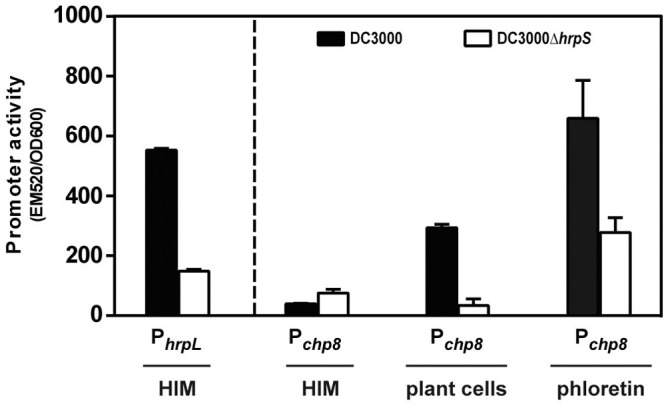
Activity of the chp8 promoter. The activity of the chp8 promoter was measured in P. syringae pv. tomato DC3000 and DC3000ΔhrpS in hrp-inducing medium (HIM) in the presence of plant cells or the plant flavonoid phloretin. Promoter activity was reported via production of GFP and expressed as the ratio of fluorescence intensity at 520 nm and OD600. PhrpL, cells contain a reporter fusion of the hrpL promoter to gfp; Pchp8, cells contain a reporter fusion of the chp8 promoter to gfp. Error bars show standard errors of the means. Statistical analysis of Pchp8 activity using unpaired t test gave results as follows (significant if P value is <0.05): DC3000 (HIM) versus DC3000ΔhrpS (HIM) was not significant, P = 0.0544; DC3000 (HIM) versus DC3000 (plant cells) was significant, P < 0.0001; DC3000 (plant cells) versus DC3000ΔhrpS (plant cells) was significant, P = 0.0005; DC3000 (HIM) versus DC3000 (phloretin) was significant, P = 0.0078; DC3000 (phloretin) versus DC3000ΔhrpS (phloretin) was significant, P = 0.0478.
FIG 2
FIG 2
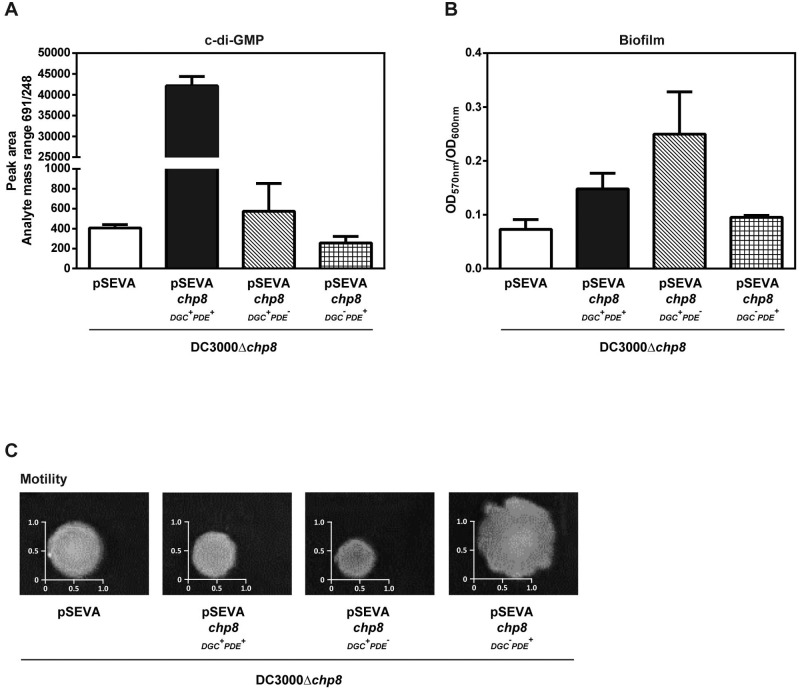
Effects of Chp8 on c-di-GMP production, biofilm formation, and motility of P. syringae pv. tomato DC3000 strains. (A) Cellular c-di-GMP levels were analyzed by LC-MS/MS. Shown are the peak area data from the c-di-GMP-specific analyte mass range 691/248. Error bars show standard errors of the means. Statistical analysis using unpaired t test gave results as follows (significant if P value is <0.05): DC3000Δchp8/pSEVA versus DC3000Δchp8/pSEVAchp8DGC+PDE+ was significant, P = 0.0029; DC3000Δchp8/pSEVAchp8DGC+PDE+ versus DC3000Δchp8/pSEVAchp8DGC+PDE was significant, P = 0.003; DC3000Δchp8/pSEVAchp8DGC+PDE+ versus DC3000Δchp8/pSEVAchp8DGCPDE+ was significant, P = 0.0029; DC3000Δchp8/pSEVAchp8DGC+PDE versus DC3000Δchp8/pSEVAchp8DGCPDE+ was not significant, P = 0.3856. (B) Biofilm formation was measured by the crystal violet-staining method and expressed as the ratio of the optical densities at 570 nm and 600 nm. Error bars show standard errors of the means. Statistical analysis using unpaired t test gave results as follows (significant if P value is <0.05): DC3000Δchp8/pSEVA versus DC3000Δchp8/pSEVAchp8DGC+PDE+ was significant, P = 0.0192; DC3000Δchp8/pSEVAchp8DGC+PDE+ versus DC3000Δchp8/pSEVAchp8DGC+PDE was not significant, P = 0.1037; DC3000Δchp8/pSEVAchp8DGC+PDE+ versus DC3000Δchp8/pSEVAchp8DGCPDE+ was significant, P = 0.0352. (C) Motility was measured as the diameter of bacterial spread on soft (0.4%) agar plates. DC3000Δchp8/pSEVA, vector control; DC3000Δchp8/pSEVAchp8DGC+PDE+, cells expressing wild-type Chp8; DC3000Δchp8/pSEVAchp8DGC+PDE, cells expressing Chp8 with intact GGDEF and inactivated EAL domain; DC3000Δchp8/pSEVAchp8DGCPDE+, cells expressing Chp8 with intact EAL and inactivated GGDEF domain.
FIG 3
FIG 3
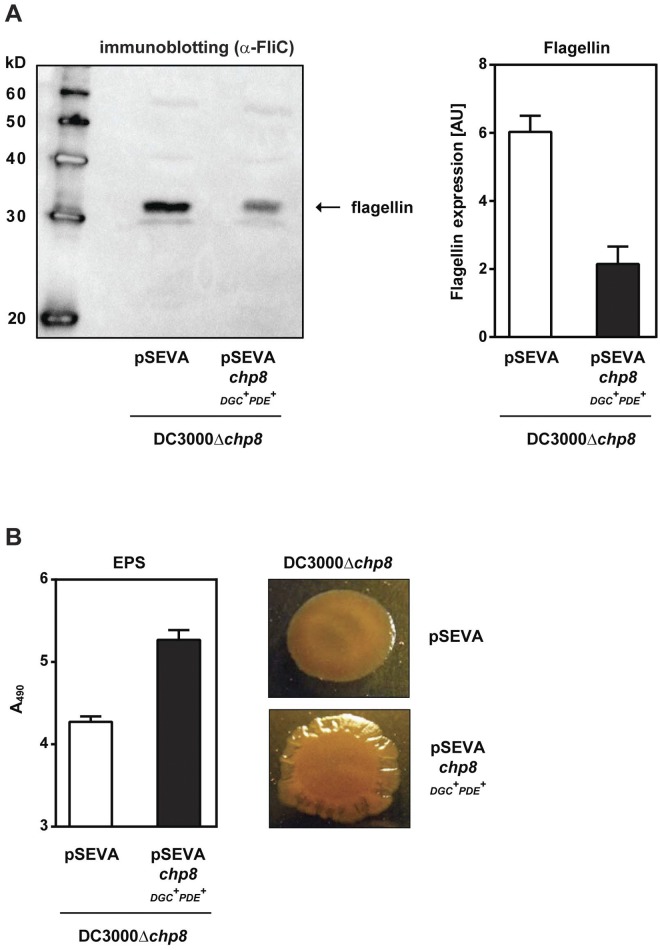
Effects of Chp8 on flagellin and EPS production in P. syringae pv. tomato DC3000 strains. (A) The effect of Chp8 on flagellin production was measured via immunoblotting with antibodies against FliC (77). The band corresponding to flagellin was quantified via densitometry, taking into account gel loading. The results for the loading control can be found in Fig. S4 in the supplemental material. Statistical analysis using unpaired t test gave results as follows (significant if P value is <0.05): DC3000Δchp8/pSEVA versus DC3000Δchp8/pSEVAchp8DGC+PDE+ was significant, P = 0.0310. AU, arbitrary units. (B) The effect of Chp8 on EPS production was measured via the change in absorbance at 490 nm through retention of the Congo red cell stain and visualized through the formation of wrinkly colony morphology. Statistical analysis using unpaired t test gave results as follows (significant if P value is <0.05): DC3000Δchp8/pSEVA versus DC3000Δchp8/pSEVAchp8DGC+PDE+ was significant, P = 0.0004. DC3000Δchp8/pSEVA, vector control; DC3000Δchp8/pSEVAchp8DGC+PDE+, cells expressing wild-type Chp8. Error bars show standard errors of the means.
FIG 4
FIG 4
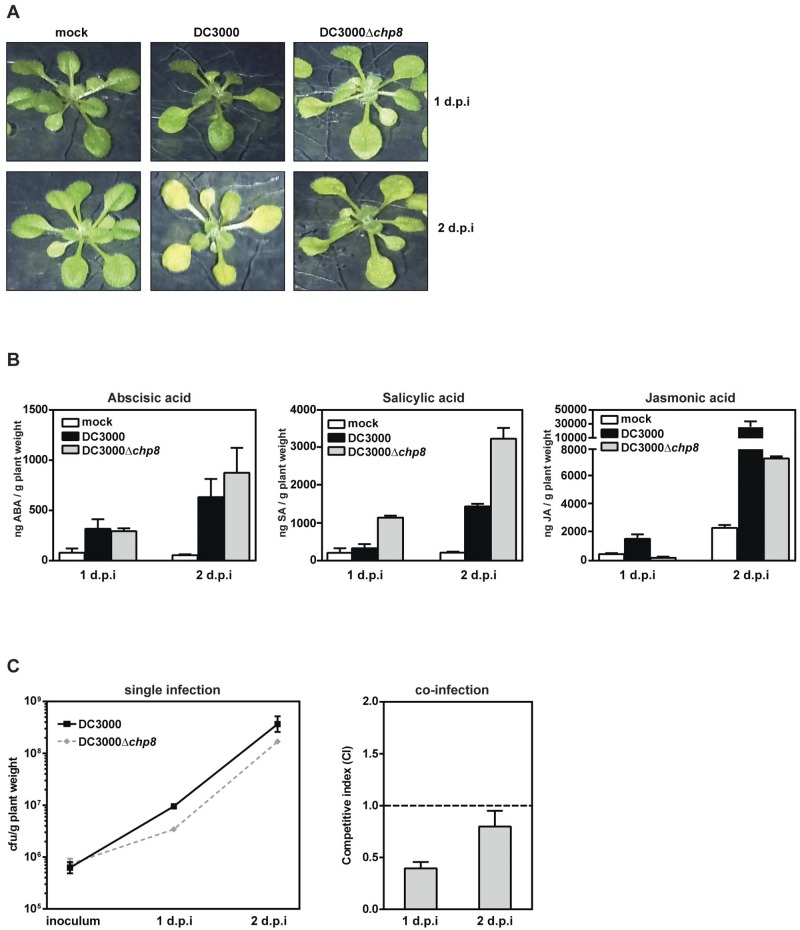
Effects of Chp8 on P. syringae pv. tomato DC3000 apoplast colonization and disease symptom development and hormonal immune responses of the plant. (A) Disease symptom development (yellowing of leaves) was followed after single infection of Arabidopsis thaliana with either DC3000 or DC3000Δchp8. Mock treatment was included as a negative control. Shown are representative images taken 1 and 2 d.p.i. (B) Levels of abscisic acid (ABA), salicylic acid (SA), and jasmonic acid (JA) were measured after single infection of Arabidopsis thaliana with either DC3000 or DC3000Δchp8. Mock treatment was included as a negative control. Shown are the levels measured 1 and 2 d.p.i. Statistical analysis using unpaired t test gave results as follows (significant if P value is <0.05): ABA at 1 d.p.i., DC3000 versus DC3000Δchp8 was not significant, P = 0.8307; ABA at 2 d.p.i., DC3000 versus DC3000Δchp8 was not significant, P = 0.5139; SA at 1 d.p.i., DC3000 versus DC3000Δchp8 was significant, P = 0.011; SA at 2 d.p.i., DC3000 versus DC3000Δchp8 was significant, P = 0.0134; JA at 1 d.p.i., DC3000 versus DC3000Δchp8 was significant, P = 0.0458; JA at 2 d.p.i., DC3000 versus DC3000Δchp8 was not significant, P = 0.144. (C) Chp8-dependent differences in apoplast colonization were assessed 1 and 2 d.p.i. by measuring CFU/g plant weight (left panel) after single infection with either DC3000 or DC3000Δchp8 and by calculating the competitive index (CI) after coinfection with both strains at a 1:1 ratio. For CI, the numerator is CFU/g plant recovered from the apoplast (DC3000Δchp8/DC3000) and the denominator is CFU in the initial inoculum (DC3000Δchp8/DC3000), and values indicate results as follows: CI < 1, mutant is less competitive than wild-type; CI = 1, mutant and wild-type are equally competitive; CI > 1, mutant is more competitive than wild-type. Statistical analysis using linear regression for single infection and unpaired t test for coinfection gave results as follows (significant if P value is <0.05): single infection, inoculum to 1 d.p.i., DC3000 (y = 8.9e6 × −625,000, R2 = 0.9763) versus DC3000Δchp8 (y = 2.69e6 × −735,000, R2 = 0.9681) was significant, P = 0.0039; single infection, 1 d.p.i. to 2 d.p.i., DC3000 (y = 3.57e8 × −3.474e8, R2 = 0.7377) versus DC3000Δchp8 (y = 1.656e8 × −1.622e8, R2 = 0.9974) was not significant, P = 0.2727; coinfection (CI ≠ 1), 1 d.p.i. was significant, P = 0.0048, and 2 d.p.i. was not significant, P = 0.1983. Error bars show standard errors of the means.

References

    1. Food and Agriculture Organization of the United Nations 2006. World agriculture: towards 2030/2050. Interim report. Prospects for food, nutrition, agriculture and major commodity groups. Global Perspectives Studies Unit, Food and Agriculture Organization of the United Nations, Rome, Italy: http://www.fao.org/docrep/009/a0607e/a0607e00.HTM
    1. Hirano SS, Upper CD. 1990. Population biology and epidemiology of Pseudomonas syringae. Annu. Rev. Phytopathol. 28:155–177. 10.1146/annurev.phyto.28.1.155 - DOI
    1. Armstrong EL, Lindbec KD, Richardson HJ, Coombes N, O’Connor G, Matthews PW, Gaynor L. 2010. Measuring the impact of bacterial blight (Pseudomonas syringae pv. syringae) on production of Australian field pea varieties. In Dove H, Culvenor RA. (ed), Proceedings of 15th Agronomy Conference 2010, 15 to 18 November 2010 Lincoln, New Zealand http://www.regional.org.au/au/asa/2010/crop-production/legumes/7048_arms...
    1. Whalen MC, Innes RW, Bent AF, Staskawicz BJ. 1991. Identification of Pseudomonas syringae pathogens of Arabidopsis and a bacterial locus determining avirulence on both Arabidopsis and soybean. Plant Cell 3:49–59. 10.2307/3869199 - DOI - PMC - PubMed
    1. Collmer A, Badel JL, Charkowski AO, Deng WL, Fouts DE, Ramos AR, Rehm AH, Anderson DM, Schneewind O, van Dijk K, Alfano JR. 2000. Pseudomonas syringae Hrp type III secretion system and effector proteins. Proc. Natl. Acad. Sci. U. S. A. 97:8770–8777. 10.1073/pnas.97.16.8770 - DOI - PMC - PubMed

Publication types

MeSH terms

LinkOut - more resources