


Lipid concentrations and couple fecundity: the LIFE study
- PMID: 24846535
- PMCID: PMC4121020
- DOI: 10.1210/jc.2013-3936
Lipid concentrations and couple fecundity: the LIFE study
Abstract
Context: A role of lipids in human fecundity is hypothesized as cholesterol is the main substrate for steroid synthesis and has also been shown to affect the hormonal milieu and steroidogenesis in both men and women.
Objective: The objective of the study was to evaluate the association between male and female serum lipid concentrations and time to pregnancy (TTP).
Design/setting: A population-based prospective cohort study recruiting couples from 16 counties in Michigan and Texas (2005-2009) using sampling frameworks allowing for identification of couples planning pregnancy in the near future.
Participants: Five hundred one couples desiring pregnancy and discontinuing contraception were followed up for 12 months or until a human chorionic gonadotropin pregnancy was detected.
Main outcome and measures: Fecundability odds ratios (FORs) and 95% confidence intervals (CIs) were estimated after adjusting for age, body mass index, race, and education in relationship to female, male, and joint couple lipid concentrations.
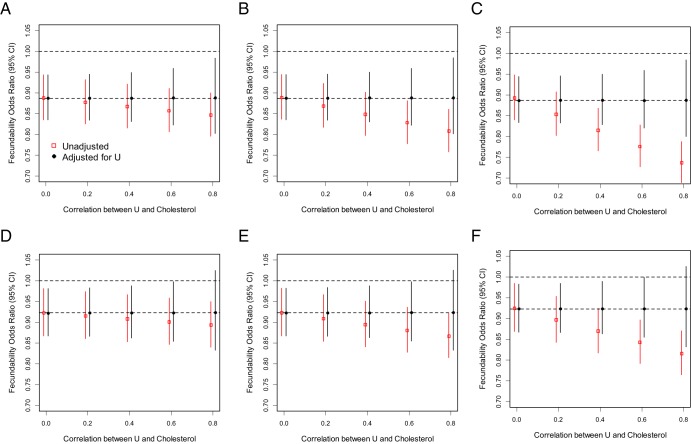
Results: Serum free cholesterol levels were higher on average among male and female partners of couples who did not became pregnant during the study follow-up (female, P = .04; male, P = .009), and levels in female partners were associated with significantly longer TTP in models based on both individual and couples concentrations (individual models: FOR 0.98, 95% CI 0.97, 0.99; couple models: FOR 0.98, 95% CI 0.97, 0.99). Male free cholesterol concentrations were associated with TTP only in the couple-based models (FOR 0.98, 95% CI 0.97, 0.99). Sensitivity analyses suggested that the observed associations are unlikely to be explained by potential unmeasured confounding such as diet.
Conclusions: Our results suggest that serum free cholesterol concentrations in both men and women have an effect on TTP, highlighting the importance of cholesterol and lipid homeostasis for male and female fecundity.
Figures
References
-
- Gwynne JT, Strauss JF., III The role of lipoproteins in steroidogenesis and cholesterol metabolism in steroidogenic glands. Endocr Rev. 1982;3:299–329 - PubMed
-
- Cardozo E, Pavone ME, Hirshfeld-Cytron JE. Metabolic syndrome and oocyte quality. Trends Endocrinol Metab. 2011;22:103–109 - PubMed
-
- Fujimoto VY, Kane JP, Ishida BY, Bloom MS, Browne RW. High-density lipoprotein metabolism and the human embryo. Hum Reprod Update. 2010;16:20–38 - PubMed
-
- Grummer RR, Carroll DJ. A review of lipoprotein cholesterol metabolism: importance to ovarian function. J Anim Sci. 1988;66:3160–3173 - PubMed
Publication types
MeSH terms
Substances
Grants and funding
LinkOut - more resources
Full Text Sources
Other Literature Sources
