


Return to intended oncologic treatment (RIOT): a novel metric for evaluating the quality of oncosurgical therapy for malignancy
- PMID: 24846705
- PMCID: PMC5527828
- DOI: 10.1002/jso.23626
Return to intended oncologic treatment (RIOT): a novel metric for evaluating the quality of oncosurgical therapy for malignancy
Abstract
Background: After cancer surgery, complications, and disability prevent some patients from receiving subsequent treatments. Given that an inability to complete all intended cancer therapies might negate the oncologic benefits of surgical therapy, strategies to improve return to intended oncologic treatment (RIOT), including minimally invasive surgery (MIS), are being investigated.
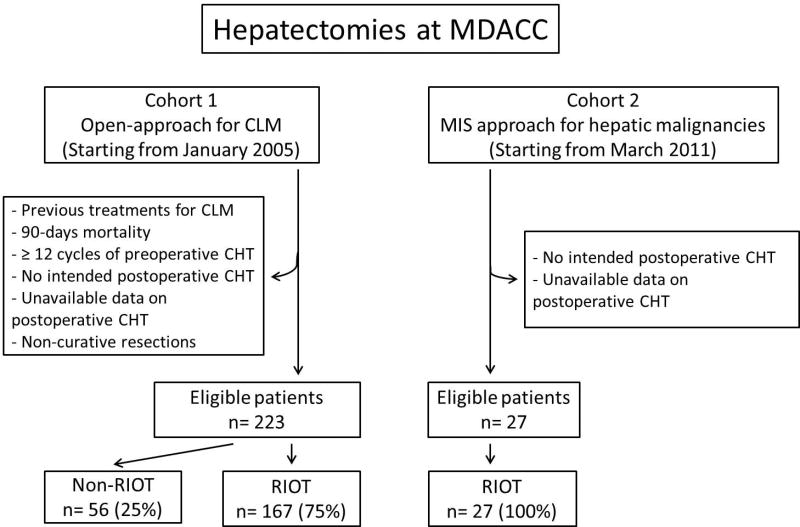
Methods: This project was designed to evaluate liver tumor patients to determine the RIOT rate, risk factors for inability to RIOT, and its impact on survivals. Outcomes for a homogenous cohort of 223 patients who underwent open-approach surgery for metachronous colorectal liver metastases and a group of 27 liver tumor patients treated with MIS hepatectomy were examined.
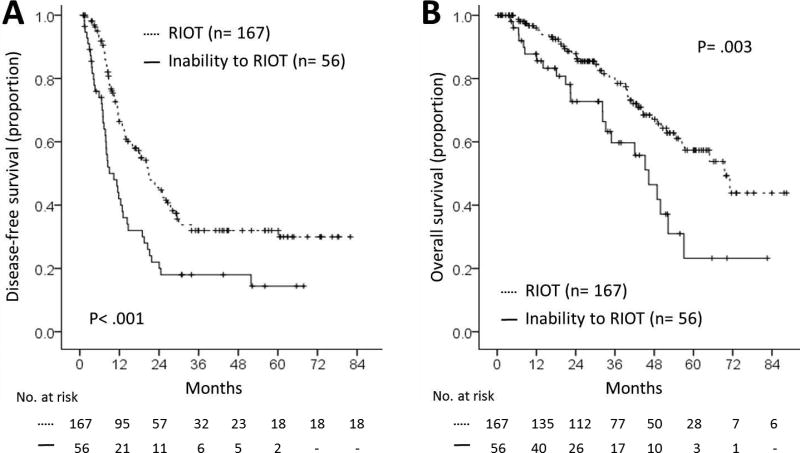
Results: Of the 223 open-approach patients, 167 were offered postoperative therapy, yielding a RIOT rate of 75%. The remaining 56 (25%) patients were unable to receive further treatment due to surgical complications (n = 29 pts) or poor performance status (n = 27 pts). Risk factors associated with inability to RIOT were hypertension (OR 2.2, P = 0.025), multiple preoperative chemotherapy regimens (OR 5.9, P = 0.039), and postoperative complications (OR 2.0, P = 0.039). Inability to RIOT correlated with shorter disease-free and overall survivals (P < 0.001, HR = 2.16; and P = 0.005, HR = 2.07, respectively). In contrast to the open surgery group, 100% of MIS patients who were intended to initiate postoperative therapy did so (P = 0.038) within a shorter median time interval (MIS: 15 days vs. open: 42 days; P < 0.001).
Conclusions: The relationship between RIOT and long-term oncologic outcomes suggests that RIOT rates for both open- and MIS-approach cancer surgery should routinely be reported as a quality indicator.
Keywords: adjuvant therapy; colorectal liver metastases; minimally invasive surgery; outcomes; surgical oncology.
© 2014 Wiley Periodicals, Inc.
Figures
References
-
- Bowater RJ, Abdelmalik SM, Lilford RJ. Efficacy of adjuvant chemotherapy after surgery when considered over all cancer types: a synthesis of meta-analyses. Ann Surg Oncol. 2012;19:3343–3350. - PubMed
Publication types
MeSH terms
Substances
Grants and funding
LinkOut - more resources
Full Text Sources
Other Literature Sources
Medical
