Review
. 2015 Mar;10(3):444-52.
doi: 10.1093/scan/nsu079. Epub 2014 May 19.

Brain disorders and the biological role of music

Affiliations
Review

Brain disorders and the biological role of music

Camilla N Clark et al. Soc Cogn Affect Neurosci. 2015 Mar.

Abstract

Despite its evident universality and high social value, the ultimate biological role of music and its connection to brain disorders remain poorly understood. Recent findings from basic neuroscience have shed fresh light on these old problems. New insights provided by clinical neuroscience concerning the effects of brain disorders promise to be particularly valuable in uncovering the underlying cognitive and neural architecture of music and for assessing candidate accounts of the biological role of music. Here we advance a new model of the biological role of music in human evolution and the link to brain disorders, drawing on diverse lines of evidence derived from comparative ethology, cognitive neuropsychology and neuroimaging studies in the normal and the disordered brain. We propose that music evolved from the call signals of our hominid ancestors as a means mentally to rehearse and predict potentially costly, affectively laden social routines in surrogate, coded, low-cost form: essentially, a mechanism for transforming emotional mental states efficiently and adaptively into social signals. This biological role of music has its legacy today in the disordered processing of music and mental states that characterizes certain developmental and acquired clinical syndromes of brain network disintegration.

Keywords: dementia; emotion; evolution; mentalizing; music.


Figures

Fig. 1
Fig. 1
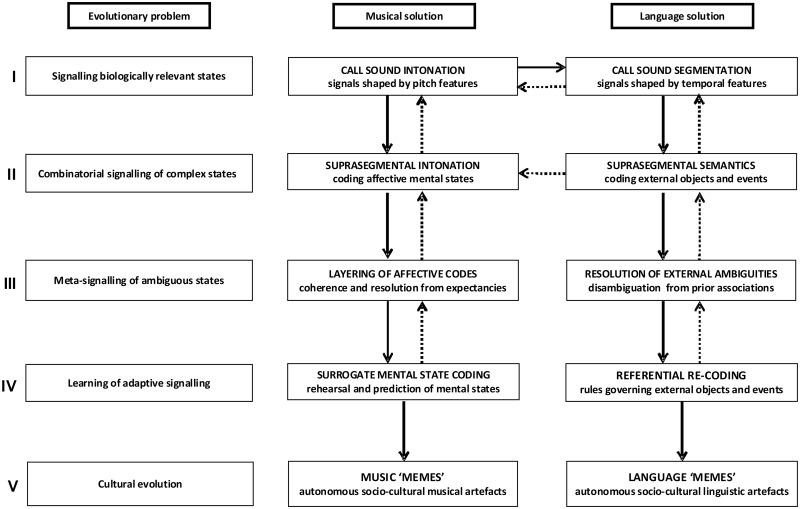
Proposed evolution of music as a code for transmitting surrogate mental states. The figure schematizes our model of the biological role of music in human evolution. Putative neurobiological problems that could have formed a basis for evolutionary selection are listed (left panels) together with proposed ‘solutions’ mediated by precursors of music (middle panels) and language (right panels), respectively. Although diagrammed here as a series of discrete ‘stages’ (I–V), we envisage the evolution of music as an essentially continuous process with successive stages, reciprocally influencing earlier processes as they became fully established (schematized here as reversible arrows) and increasingly abstract and autonomous coding at each stage; the final stage marks a transition from biological to cultural evolution that is arguably ‘irreversible’. In addition, we propose that earlier stages of music and language evolution shared processing mechanisms with increasing divergence at later stages. Our early primate ancestors may initially have used call sounds as vocal signals to convey to other members of the social group current states of immediate biological relevance (I), linking these with affective and perceptual brain mechanisms and establishing the earliest progenitors of music and speech through preferential use of pitch and temporal features, respectively. Extended ‘public’ vocal exchanges may have facilitated use of call sound sequences (II) for communicating more complex emotional states (proto-music) and objects and events in the environment (proto-speech), and ‘private’ off-line rehearsal of responses modulated by the listener’s own mental state. Combinatorial use of call sounds would, in turn, enable ‘meta-signalling’ of ambiguous emotional states and external phenomena (III) and resolution of these respective ambiguities through characteristically musical processes (e.g. harmonic expectancy) or language processes (e.g. association with prior object concepts). This meta-signalling capacity promoted the generation of emergent autonomous messages not closely tied to a particular mental state. Biologically and socially adaptive signalling (IV) for referential re-coding of objects and events in the world would then have entailed learning of language rules, whereas adaptive signalling for transmitting mental states engaged musical codes for rehearsing and predicting mental states in self and others. Stages I–III would have interacted cooperatively with development of an increasing capacity for mentalizing and ‘theory of mind’; music would then have been the most readily available vehicle for re-coding emotional mental states in surrogate form without engaging potentially costly social routines. Emergence of fully adaptive signalling would have enabled creation of musical and linguistic socio-cultural artefacts for autonomous transmission as ‘memes’ subject to cultural evolution.
Fig. 2
Fig. 2
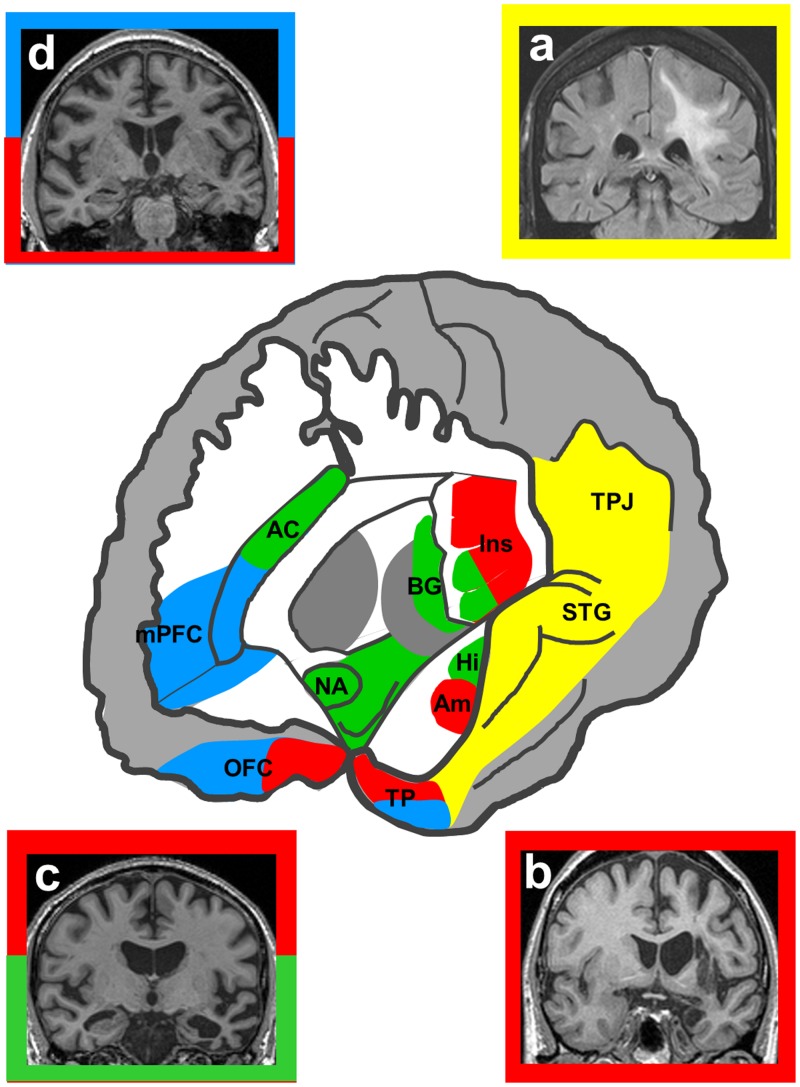
Neuroanatomy of music processing and effects of brain disorders. The central panel shows a schematic view of the brain dissected to reveal networks involved in music processing (the left hemisphere is projected forward here; however, relevant brain regions are bi-hemispherically distributed). Colours superimposed on the schematic code brain regions mediating broad cognitive operations underpinning music processing, based on normal functional imaging and clinical evidence. The primary cognitive operations associated with the regions are coded, as most regions are implicated in more than one operation (corresponding putative stages in the evolutionary model we proposed are numbered in parentheses, see Figure 1): yellow (I, II), perceptual analysis and imagery; green, biological motivation and reward encoding, autonomic responses (I, III); red, expectancies, associations and affective evaluation (III); blue, mental state processing and behavioural evaluation (IV). These operations are likely to be at least, in part, componential and hierarchically organized. Key: AC, anterior cingulate cortex; Am, amygdala; BG, basal ganglia; Hi, hippocampus; Ins, insula; mPFC, medial prefrontal cortex; NA, nucleus accumbens; OFC, orbitofrontal cortex; STG, superior temporal gyrus; TP, temporal pole; TPJ, temporo-parietal junction. The flanking panels show representative coronal brain sections from patients exhibiting abnormal music processing outlined according to the cognitive operations primarily implicated in that condition (the left hemisphere is displayed on the right in each case): (a) tumour involving temporo-parietal cortices and subcortical connections, associated with musical hallucinations; (b) infarction of insula and amygdala associated with selective loss of emotional response to music; (c) semantic dementia with focal, asymmetric anterior temporal lobe atrophy, associated with musicophilia and altered emotion coding in music; (d) frontotemporal dementia with selective bilateral frontal lobe atrophy associated with impaired ability to infer mental states from music and altered emotion coding in music. The scheme shown here complements the biological features presented in Table 2: each of these disorders (a–d) illustrates the componential neural architecture of music processing; (b) illustrates the effects of disrupted links with generic emotion processing mechanisms; (c) illustrates abnormal priming to particular musical codes; while (d) illustrates impaired modelling of surrogate mental states from music.

References

    1. Abu-Akel A, Shamay-Tsoory S. Neuroanatomical and neurochemical bases of theory of mind. Neuropsychologia. 2011;49(11):2971–84. - PubMed
    1. Allen R, Hill E, Heaton P. The subjective experience of music in autism spectrum disorder. Annals of the New York Academy of Sciences. 2009;1169:326–31. - PubMed
    1. Allen R, Walsh R, Zangwill N. The same, only different: what can responses to music in autism tell us about the nature of musical emotions? Frontiers in Psychology. 2013;4:156. - PMC - PubMed
    1. Arnold K, Zuberbühler K. Language evolution: semantic combinations in primate calls. Nature. 2006;441(7091):303. - PubMed
    1. Beaman CP, Williams TI. Earworms (stuck song syndrome): towards a natural history of intrusive thoughts. British Journal of Psychology. 2010;101(Pt 4):637–53. - PubMed

Publication types