


Mother's body mass index and food intake in school-aged children: results of the GINIplus and the LISAplus studies
- PMID: 24848629
- PMCID: PMC4283383
- DOI: 10.1038/ejcn.2014.92
Mother's body mass index and food intake in school-aged children: results of the GINIplus and the LISAplus studies
Abstract
Background/objectives: Mother's body mass index (BMI) is a strong predictor of child BMI. Whether mother's BMI correlates with child's food intake is unclear. We investigated associations between mother's BMI/overweight and child's food intake using data from two German birth cohorts.
Subjects/methods: Food intakes from 3230 participants were derived from parent-completed food frequency questionnaires. Intakes of 11 food groups were categorized into three levels using group- and sex-specific tertile cutoffs. Mother's BMI and overweight were calculated on the basis of questionnaire data. Multinomial regression models assessed associations between a child's food intake and mother's BMI/overweight. Linear regression models assessed associations between a child's total energy intake and mother's BMI. Models were adjusted for study region, maternal education, child's age, sex, pubertal status and energy intake and the BMIs of the child and father.
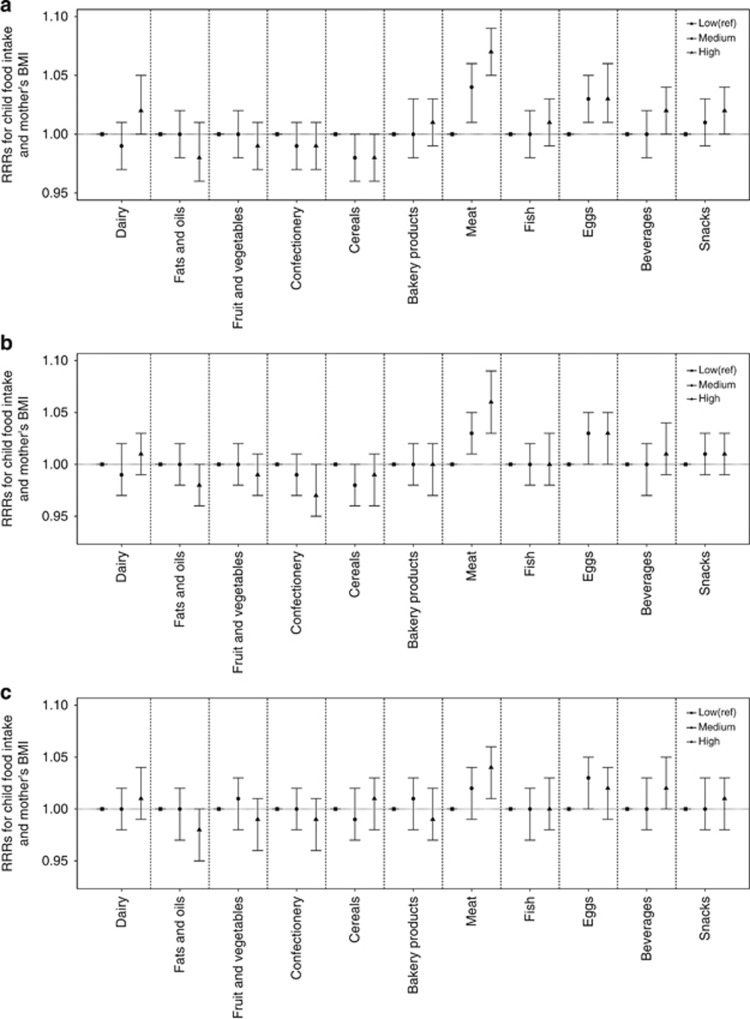
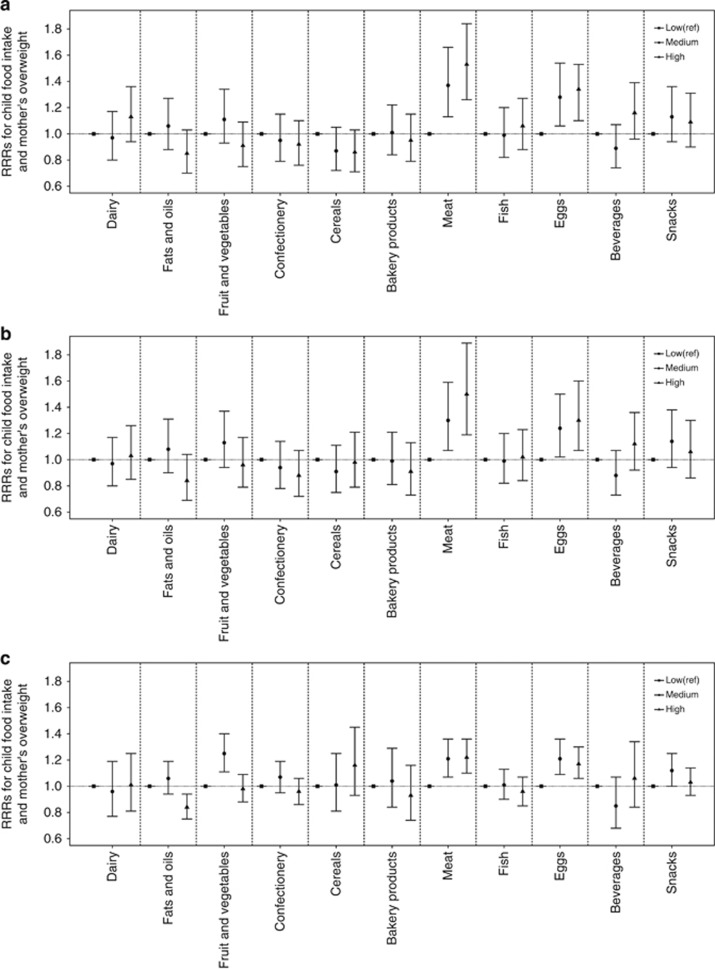
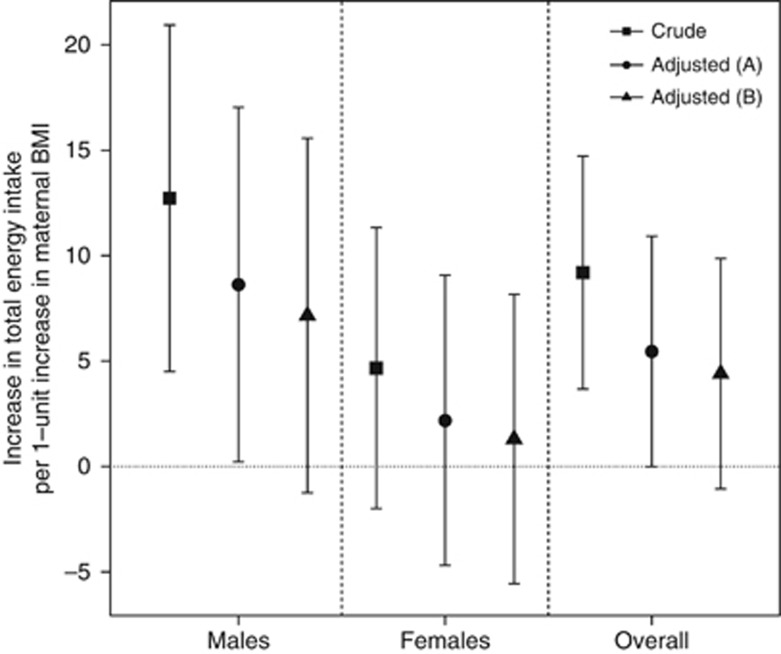
Results: Mothers' BMI was associated with high meat intake in children (adjusted relative risk ratio (RRR (95% confidence interval))=1.06 (1.03; 1.09)). Mothers' overweight was associated with the meat intake (medium versus low RRR=1.30 (1.07; 1.59); high versus low RRR=1.50 (1.19; 1.89)) and egg intake (medium versus low RRR=1.24 (1.02; 1.50); high versus low RRR=1.30 (1.07; 1.60)) of children. There were no consistent associations for rest of the food groups. For every one-unit increase in mothers' BMI, the total energy intake in children increased by 9.2 kcal (3.7; 14.7). However, this effect was not significant after adjusting for children's BMI.
Conclusions: Our results suggest that mother's BMI and mother's overweight are important correlates of a child's intake of energy, meat and eggs.
Figures
References
-
- James PT, Leach R, Kalamara E, Shayeghi M. The worldwide obesity epidemic. Obes Res. 2001;9:228S–233S. - PubMed
-
- International Obesity Taskforce. Obesity the global epidemic. 2011. Available at: http://www.iaso.org/iotf/obesity/obesitytheglobalepidemic/ .
-
- Birbilis M, Moschonis G, Mougios V, Manios Y. Obesity in adolescence is associated with perinatal risk factors, parental BMI and sociodemographic characteristics. Eur J Clin Nutr. 2013;67:115–121. - PubMed
-
- Danielzik S, Langnase K, Mast M, Spethmann C, Muller MJ. Impact of parental BMI on the manifestation of overweight 5-7 year old children. Eur J Clin Nutr. 2002;41:132–138. - PubMed
Publication types
MeSH terms
LinkOut - more resources
Full Text Sources
Other Literature Sources
Medical
