


Effects of the expansion of doctors' offices adjacent to private pharmacies in Mexico: secondary data analysis of a national survey
- PMID: 24852298
- PMCID: PMC4039785
- DOI: 10.1136/bmjopen-2013-004669
Effects of the expansion of doctors' offices adjacent to private pharmacies in Mexico: secondary data analysis of a national survey
Abstract
Objectives: To compare the sociodemographic characteristics, reasons for attending, perception of quality and associated out-of-pocket (OOP) expenditures of doctors' offices adjacent to private pharmacies (DAPPs) users with users of Social Security (SS), Ministry of Health (MoH), private doctor's offices independent from pharmacies and non-users.
Setting: Secondary data analysis of the 2012 National Survey of Health and Nutrition of Mexico.
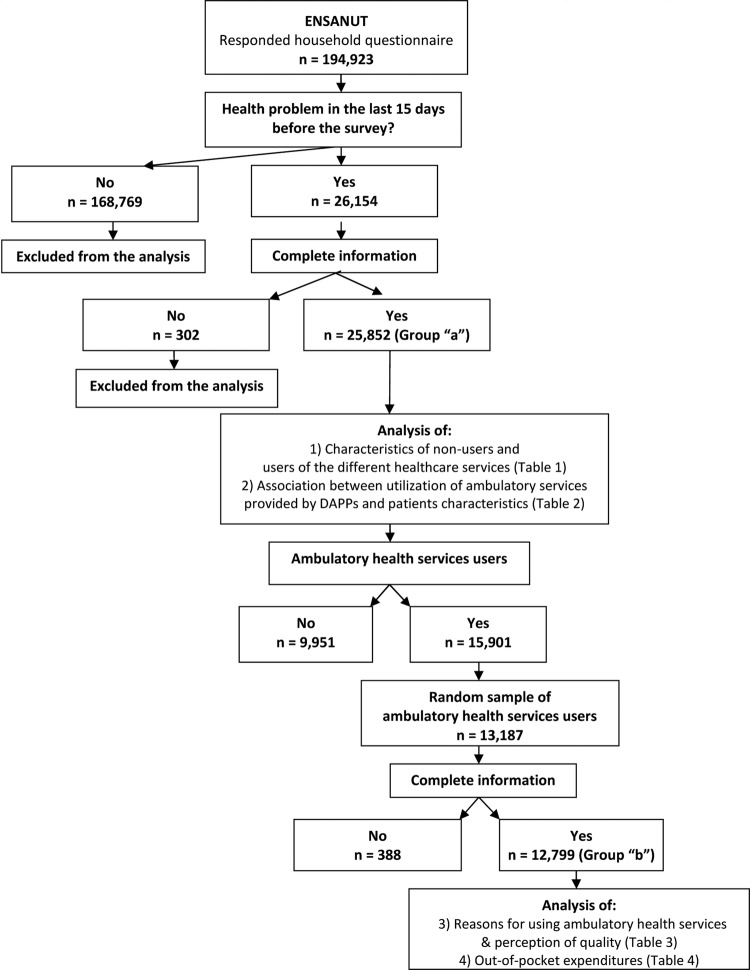
Participants: The study population comprised 25 852 individuals identified as having had a health problem 15 days before the survey, and a random sample of 12 799 ambulatory health service users.
Outcome measures: Sociodemographic characteristics, reasons for attending healthcare services, perception of quality and associated OOP expenditures.
Results: The distribution of users was as follows: DAPPs (9.2%), SS (16.1%), MoH (20.9%), private providers (15.4%) and non-users (38.5%); 65% of DAPP users were affiliated with a public institution (MoH 35%, SS 30%) and 35% reported not having health coverage. DAPP users considered the services inexpensive, convenient and with a short waiting time, yet they received ≥3 medications more often (67.2%, 95% CI 64.2% to 70.1%) than users of private doctors (55.7%, 95% CI 52.5% to 58.6%) and public institutions (SS 53.8%, 95% CI 51.6% to 55.9%; MoH 44.7%, 95% CI 42.5% to 47.0%). The probability of spending on consultations (88%, 95% CI 86% to 89%) and on medicines (97%, 95% CI 96% to 98%) was much higher for DAPP users when compared with SS (2%, 95% CI 2% to 3% and 12%, 95% CI 11% to 14%, respectively) and MoH users (11%, 95% CI 9% to 12% and 32%, 95% CI 30% to 34%, respectively).
Conclusions: DAPPs counteract current financial protection policies since a significant percentage of their users were affiliated with a public institution, reported higher OOP spending and higher number of medicines prescribed than users of other providers. The overprescription should prompt studies to learn about DAPPs' quality of care, which may arise from the conflict of interest implicit in the linkage of prescribing and dispensing processes.
Keywords: Primary Care.
Published by the BMJ Publishing Group Limited. For permission to use (where not already granted under a licence) please go to http://group.bmj.com/group/rights-licensing/permissions.
References
-
- Organisation for Economic Co-operation and Development. OECD Health Data 2013: how does Mexico compare. Organisation for Economic Co-operation and Development, 2013. http://www.oecd.org/mexico/Briefing-Note-MEXICO-2013.pdf
-
- Organisation for Economic Co-operation and Development. An overview of growing income inequalities in OECD countries: main findings. Organisation for Economic Co-operation and Development, 2011. http://www.oecd.org/els/soc/49499779.pdf
-
- Wirtz VJ, Reich MR, Leyva-Flores R, et al. Medicines in Mexico, 1990–2004: systematic review of research on access and use. Salud Publica Mex 2008;50:S470–9 - PubMed
-
- Knaul FM, González-Pier E, Gómez-Dantés O, et al. The quest for universal health coverage: achieving social protection for all in Mexico. Lancet 2012;380:1259–79 - PubMed
-
- Fundación Mexicana para la Salud: Trabajando por la salud de la población. Propuestas de política para el sector farmacéutico. Versión para el diálogo. FUNSALUD, A. C., 2011. http://www.funsalud.org.mx/eventos_2011/trabajando%20por%20la%20salud/Do...
MeSH terms
LinkOut - more resources
Full Text Sources
Other Literature Sources
Molecular Biology Databases
