. 2014 May 23:5:3930.
doi: 10.1038/ncomms4930.

The Brassica oleracea genome reveals the asymmetrical evolution of polyploid genomes

Shengyi Liu  1 Yumei Liu  2 Xinhua Yang  3 Chaobo Tong  1 David Edwards  4 Isobel A P Parkin  5 Meixia Zhao  6 Jianxin Ma  7 Jingyin Yu  8 Shunmou Huang  8 Xiyin Wang  9 Junyi Wang  10 Kun Lu  11 Zhiyuan Fang  12 Ian Bancroft  13 Tae-Jin Yang  14 Qiong Hu  8 Xinfa Wang  8 Zhen Yue  10 Haojie Li  15 Linfeng Yang  10 Jian Wu  12 Qing Zhou  10 Wanxin Wang  12 Graham J King  16 J Chris Pires  17 Changxin Lu  10 Zhangyan Wu  10 Perumal Sampath  14 Zhuo Wang  10 Hui Guo  18 Shengkai Pan  10 Limei Yang  12 Jiumeng Min  10 Dong Zhang  18 Dianchuan Jin  19 Wanshun Li  10 Harry Belcram  20 Jinxing Tu  21 Mei Guan  22 Cunkou Qi  23 Dezhi Du  24 Jiana Li  11 Liangcai Jiang  15 Jacqueline Batley  25 Andrew G Sharpe  26 Beom-Seok Park  27 Pradeep Ruperao  28 Feng Cheng  12 Nomar Espinosa Waminal  29 Yin Huang  10 Caihua Dong  8 Li Wang  19 Jingping Li  18 Zhiyong Hu  8 Mu Zhuang  12 Yi Huang  8 Junyan Huang  8 Jiaqin Shi  8 Desheng Mei  8 Jing Liu  8 Tae-Ho Lee  18 Jinpeng Wang  19 Huizhe Jin  18 Zaiyun Li  21 Xun Li  22 Jiefu Zhang  23 Lu Xiao  24 Yongming Zhou  21 Zhongsong Liu  22 Xuequn Liu  30 Rui Qin  30 Xu Tang  18 Wenbin Liu  10 Yupeng Wang  18 Yangyong Zhang  12 Jonghoon Lee  14 Hyun Hee Kim  31 France Denoeud  32 Xun Xu  10 Xinming Liang  10 Wei Hua  8 Xiaowu Wang  12 Jun Wang  33 Boulos Chalhoub  20 Andrew H Paterson  18
Affiliations
Free PMC article

The Brassica oleracea genome reveals the asymmetrical evolution of polyploid genomes

Shengyi Liu et al. Nat Commun. .
Free PMC article

Abstract

Polyploidization has provided much genetic variation for plant adaptive evolution, but the mechanisms by which the molecular evolution of polyploid genomes establishes genetic architecture underlying species differentiation are unclear. Brassica is an ideal model to increase knowledge of polyploid evolution. Here we describe a draft genome sequence of Brassica oleracea, comparing it with that of its sister species B. rapa to reveal numerous chromosome rearrangements and asymmetrical gene loss in duplicated genomic blocks, asymmetrical amplification of transposable elements, differential gene co-retention for specific pathways and variation in gene expression, including alternative splicing, among a large number of paralogous and orthologous genes. Genes related to the production of anticancer phytochemicals and morphological variations illustrate consequences of genome duplication and gene divergence, imparting biochemical and morphological variation to B. oleracea. This study provides insights into Brassica genome evolution and will underpin research into the many important crops in this genus.


Figures

Figure 1
Figure 1. Genomic structure and gene retention rates in syntenic regions of B. oleracea and B. rapa.
(a) Segmental colinearity of the genomes of B. oleracea, B. rapa and A. thaliana. Syntenic blocks are defined and labelled from A to X (coloured) previously reported in A. thaliana. (b) Time estimate of WGD and subsequent two Brassica species divergence. (c) Pattern of retention/loss of orthologous genes on each set of three subgenomic (LF, MF1 and MF2) blocks of B. oleracea and B. rapa corresponding to A. thaliana A to X blocks. The x axis denotes the physical position of each A. thaliana gene locus. The y axis denotes the proportion of orthologous genes retained in the B. oleracea and B. rapa subgenomic blocks around each A. thaliana gene, where 500 genes flanking each side of a certain gene locus were analysed, giving a total window size of 1,001 genes.
Figure 2
Figure 2. TE comparison analyses in B. oleracea and B. rapa.
(a) TE copy number and total length in each assembly and B. oleracea–B. rapa syntenic blocks. (b) The number of intact LTR (Copia-like and Gypsy-like) birthed at different times (million years ago, MYA) in the syntenic regions of B. oleracea and B. rapa. (c) The comparison of TE distribution and composition in B. oleracea–B. rapa syntenic blocks along B. oleracea chromosomes. We divided B. oleracea–B. rapa syntenic region into non-overlapping sliding 200 kb windows to compare TE contents. For each window, the ratio log10(B. oleracea/B. rapa) was calculated for total syntenic block length (blue line), LTR length (purple line), gene length (yellow point), exons length (red point) and intron length (green point). If B. oleracea > B. rapa in absolute length of TE composition in a compared window, the dot or line is above the line y=0. The corresponding B. rapa chromosome segments along B. oleracea C08 were indicated by coloured bars. All other B. oleracea chromosomes are showed in Supplementary Fig. 31. (d) Phylogeny of the Copia-like elements as an example of LTR-RTs of the syntenic regions in B. rapa and B. oleracea. The neighbor-joining (NJ) trees were generated based on the conserved RT domain nucleotide sequences using the Kimura two-parameter method in MEGA4 (ref. 69).
Figure 3
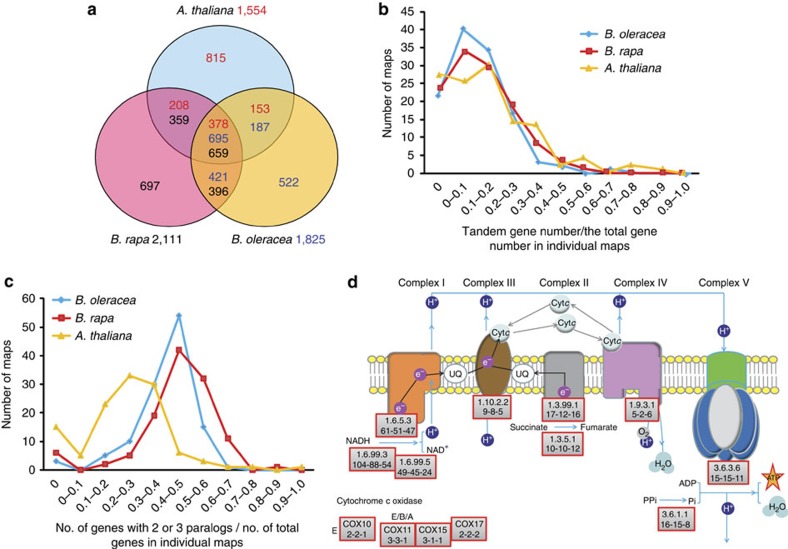
Figure 3. The duplicated genes derived from tandem duplication and whole-genome duplications in Brassica genomes.
(a) A Venn diagram showing shared and specific tandem duplication events in A. thaliana, B. rapa and B. oleracea. (b,c) Distribution of tandem genes and WGT/WGD-derived paralogues in the KEGG pathway maps in B. oleracea (bol), B. rapa (bra) and A. thaliana (ath). For each KEGG pathway map, the proportion of the number of duplicated genes or paralogues to the total genes was calculated (x axis) and the number of maps whose tandem gene proportion fell in a range was shown on the y axis. (d) Oxidative phosphorylation pathway enriched by WGT-derived paralogous genes in the Brassica genomes. The gene copy number for each KO enzyme in B. oleracea, B. rapa and A. thaliana were shown (dash-connected) under the KO enzyme number.
Figure 4
Figure 4. Divergence of Brassica paralogous and orthologous genes in B. oleracea and B. rapa.
(a) Genome-wide gene conversion in B. oleracea. The conversion in B. rapa is showed in Supplementary Fig. 64. (b) The ratio of differentially expressed duplicated gene pairs derived from different duplications: alpha whole-genome duplication (α-WGD), Brassiceae-lineage WGT, tandem duplication (TD). Bol, B. oleracea; Bra, B. rapa. C: callus; R: root; St: stem; L: leaf; F: flower; Si: silique. The differentially expressed duplicated gene pairs were defined as fold change >2 and false discovery rate (FDR) <0.05 or gene pair where expression was detected for only one gene within gene pairs (FDR <0.05). (c) Box and whisker plots for differentiated expression for three subgenomes (LF, MF1 and MF2) in flower tissue of B. oleracea and B. rapa. For the other tissues, see Supplementary Fig. 67. (d) The duplicated gene pairs belonging to transcription factors (TFs) and its related GO terms contain a significantly lower ratio of differentially expressed duplicated gene pairs than the average at the genome-wide level in leaf (values given) and other tissues (values not presented) (Supplementary Table 45). (e) The GO terms (left) in which the duplicated gene pairs contain a significantly higher ratio of differentially expressed duplicated gene pairs than the average ratio at the genome-wide level in leaf and other tissues (Supplementary Table 46). Values from one tissue were presented and the other tissues were indicated with abbreviated letters to the right if expression in these tissues is significantly higher. (f) Expression variation caused by divergence (either different variants or differential expression of the same variants) of alternative splicing (AS) variants in WGT paralogous gene pairs with identical numbers of exons and in Bol–Bra orthologous gene pairs. IRES denotes types of intron retention and exon skipping.
Figure 5
Figure 5. Whole-genome-wide comparison of genes involved in glucosinolate metabolism pathways in B. oleracea and its relatives.
(a) Aliphatic and indolic GSL biosynthesis and catabolism pathways in A. thaliana, B. oleracea and B. rapa. The copy number of GSL biosynthetic genes in A. thaliana, B. rapa and B. oleracea are listed in square brackets, respectively. Potential anticancer substances/precursors are highlighted in blue bold. Two important amino acid chain elongation and side-chain modification loci MAMs and AOP2 are highlighted in red bold, within the number in the green bracket representing the number of non-functional genes. (b,c) The neighbour-joining (NJ) trees of MAM and AOP genes were generated based on the aligned coding sequences and 100 bootstrap repeats. The silenced genes are indicated by red hollow circle, expressed functional genes are represented by red solid disc and green rectangle. In A. thaliana ecotype Columbia there are just MAM1 and MAM3. (d) Three B. oleracea AOP2 loci among which are one functional AOP2 and two mutated AOP2. 1MOI3M: 1-methoxyindol-3-ylmethyl GSL; 1OHI3M: 1-hydroxyindol-3-ylmethyl GSL; 3MSOP: 3-methylsulfinylpropyl GSL; 3MTP: 3-methylthiopropyl GSL; 3PREY: 2-Propenyl GSL; 4BTEY: 3-butenyl GSL; 4MOI3M: 4-methoxyindol-3-ylmethyl GSL; 4OHB, 4-hydroxybutyl GSL; 4OHI3M: 4-hydroxyindol-3-ylmethyl GSL; 4MSOB: 4-methylsulfinylbutyl GSL; 4MTB, 4-methylthiobutyl GSL; AITC: allyl isothiocyanate; I3C: indole-3-carbinol; I3M: indolyl-3-methyl GSL; DIM: 3,3′-diindolymethane; MAM: methylthioalkylmalate; AOP: 2-oxoglutarate-dependent dioxygenase.

References

    1. U.S. Department of Agriculture, Agricultural Research Service. USDA National Nutrient Database for Standard Reference, Release 26-Vegetables and Vegetable Products. (2013).
    1. Kopsell D. A. & Kopsell D. E. Accumulation and bioavailability of dietary carotenoids in vegetable crops. Trends Plant Sci. 11, 499–507 (2006). - PubMed
    1. Halkier B. A. & Gershenzon J. Biology and biochemistry of glucosinolates. Annu. Rev. Plant Biol. 57, 303–333 (2006). - PubMed
    1. Khwaja F. S., Wynne S., Posey I. & Djakiew D. 3,3'-diindolylmethane induction of p75NTR-dependent cell death via the p38 mitogen-activated protein kinase pathway in prostate cancer cells. Cancer Prev. Res. (Phila) 2, 566–571 (2009). - PubMed
    1. Li Y. et al. Sulforaphane, a dietary component of broccoli/broccoli sprouts, inhibits breast cancer stem cells. Clin. Cancer Res. 16, 2580–2590 (2010). - PMC - PubMed

Publication types

Associated data