Review
doi: 10.1002/ana.24188.
Epub 2014 Jul 2.
A critique of the drug discovery and phase 3 clinical programs targeting the amyloid hypothesis for Alzheimer disease
Affiliations
- PMID: 24853080
- PMCID: PMC4204160
- DOI: 10.1002/ana.24188
Item in Clipboard
Review
A critique of the drug discovery and phase 3 clinical programs targeting the amyloid hypothesis for Alzheimer disease
Ann Neurol.
2014 Aug.
Free PMC article
No abstract available
Figures
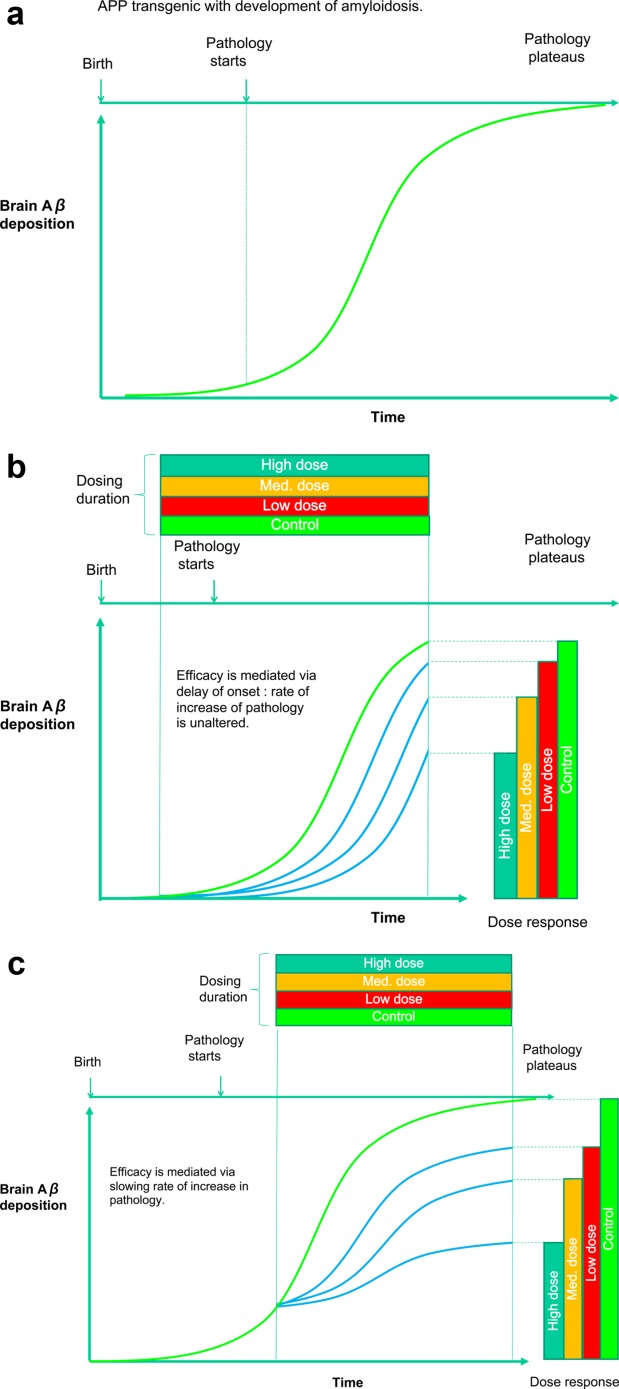
(A) The time course of the development of amyloid plaque in a typical APP transgenic mouse model. (B) Preventative paradigm. A potential amyloidocentric therapeutic agent is administered with dosing starting prior to the onset of amyloidosis. The therapeutic acts to delay the initial amyloid seeding events in a concentration-dependent manner but does not affect the rate of amyloid deposition. (C) Therapeutic paradigm. A potential amyloidocentric therapeutic agent is administered with dosing starting after the onset of amyloidosis. The therapeutic agent acts to slow the rate of amyloid deposition in a concentration-dependent manner. The dose responses of the therapeutic agent are very similar in B and C, but are potentially mediated via different mechanisms, and their construct validity in regard to the clinical situation has to be carefully considered.
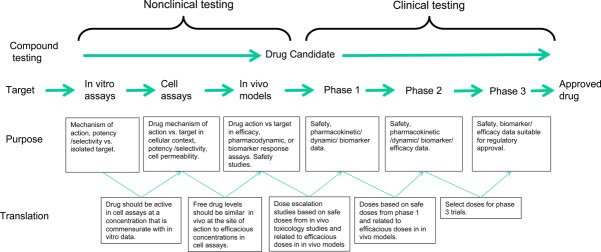
Many drug discovery programs progress through a logical sequence where the findings from one type of experiment inform the next step. Significant confidence is generated in programs where the data generated within each phase are concordant with subsequent phases. Programs that lack this translational quality are subject to increasing risk of failure. Drug Candidate is a therapeutic drug approach with sufficient safety and efficacy data to be administered to man.
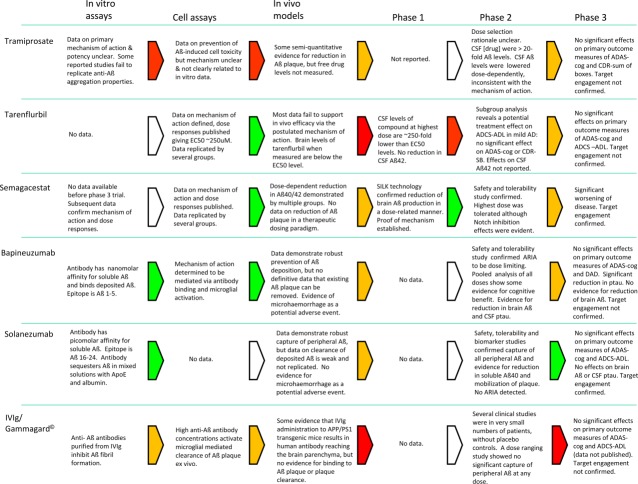
The key findings at each phase of the drug discovery process are summarized. These data must be seen in the context that all drug discovery programs, even those where each phase translates robustly into the following phase, are risky. Considerable judgement must be used during the program: for example, the interpretation of efficacy findings in transgenic mice and how well these may, or may not, translate to humans. Key: green = robust data support progression to next step; yellow = incomplete/inconsistent data indicate that progression involves significant risk; red = available data do not support progression; white = no data/not applicable. AD = Alzheimer disease; ADAS-cog = Alzheimer's Disease Assessment Scale–Cognitive Subscale; ADCS-ADL = Alzheimer's Disease Cooperative Study–Activities of Daily Living Inventory; APP = amyloid precursor protein; ARIA = amyloid-related imaging abnormality; CDR-SB = Clinical Dementia Rating–Sum of Boxes; CSF = cerebrospinal fluid; DAD = Disability Assessment for Dementia; EC50 = median effective concentration; IVIg = intravenous immunoglobulin G; SILK = stable isotope kinetic effect.
Comment in
-
Failure analysis of clinical trials to test the amyloid hypothesis.Ann Neurol. 2014 Aug;76(2):159-61. doi: 10.1002/ana.24227. Epub 2014 Jul 22. Ann Neurol. 2014. PMID: 25044380 No abstract available.
References
-
- Alzheimer A. About a peculiar disease of the cerebral cortex. Centralblatt für Nervenheilkunde Psychiatrie. 1907;30:177–179.
-
- Selkoe DJ. The molecular pathology of Alzheimer's disease. Neuron. 1991;6:487–498. - PubMed
-
- Hardy JA, Higgins GA. Alzheimer's disease: the amyloid cascade hypothesis. Science. 1992;256:184–185. - PubMed
-
- Glenner GG, Wong CW. Alzheimer's disease and Down's syndrome: sharing of a unique cerebrovascular amyloid fibril protein. Biochem Biophys Res Commun. 1984;122:1131–1135. - PubMed
Publication types
MeSH terms
Grants and funding
LinkOut - more resources
Full Text Sources
Other Literature Sources
Medical