. 2015 Mar 1;77(5):475-87.
doi: 10.1016/j.biopsych.2014.04.009. Epub 2014 Apr 25.

Chronic cannabinoid receptor 2 activation reverses paclitaxel neuropathy without tolerance or cannabinoid receptor 1-dependent withdrawal

Affiliations

Chronic cannabinoid receptor 2 activation reverses paclitaxel neuropathy without tolerance or cannabinoid receptor 1-dependent withdrawal

Liting Deng et al. Biol Psychiatry. .

Abstract

Background: Mixed cannabinoid receptor 1 and 2 (CB1 and CB2) agonists such as Δ(9)-tetrahydrocannabinol (Δ(9)-THC) can produce tolerance, physical withdrawal, and unwanted CB1-mediated central nervous system side effects. Whether repeated systemic administration of a CB2-preferring agonist engages CB1 receptors or produces CB1-mediated side effects is unknown.

Methods: We evaluated antiallodynic efficacy, possible tolerance, and cannabimimetic side effects of repeated dosing with a CB2-preferring agonist AM1710 in a model of chemotherapy-induced neuropathy produced by paclitaxel using CB1 knockout (CB1KO), CB2 knockout (CB2KO), and wild-type (WT) mice. Comparisons were made with the prototypic classic cannabinoid Δ(9)-THC. We also explored the site and possible mechanism of action of AM1710.

Results: Paclitaxel-induced mechanical and cold allodynia developed to an equivalent degree in CB1KO, CB2KO, and WT mice. Both AM1710 and Δ(9)-THC suppressed established paclitaxel-induced allodynia in WT mice. In contrast to Δ(9)-THC, chronic administration of AM1710 did not engage CB1 activity or produce antinociceptive tolerance, CB1-mediated cannabinoid withdrawal, hypothermia, or motor dysfunction. Antiallodynic efficacy of systemic administration of AM1710 was absent in CB2KO mice and WT mice receiving the CB2 antagonist AM630, administered either systemically or intrathecally. Intrathecal administration of AM1710 also attenuated paclitaxel-induced allodynia in WT mice, but not CB2KO mice, implicating a possible role for spinal CB2 receptors in AM1710 antiallodynic efficacy. Finally, both acute and chronic administration of AM1710 decreased messenger RNA levels of tumor necrosis factor-α and monocyte chemoattractant protein 1 in lumbar spinal cord of paclitaxel-treated WT mice.

Conclusions: Our results highlight the potential of prolonged use of CB2 agonists for managing chemotherapy-induced allodynia with a favorable therapeutic ratio marked by sustained efficacy and absence of tolerance, physical withdrawal, or CB1-mediated side effects.

Keywords: CB(2); Chemotherapy-induced neuropathic pain; Knockout mouse; Precipitated withdrawal; Side effect; Tolerance.


Conflict of interest statement

The authors report no biomedical financial interests or potential conflicts of interest.

Figures
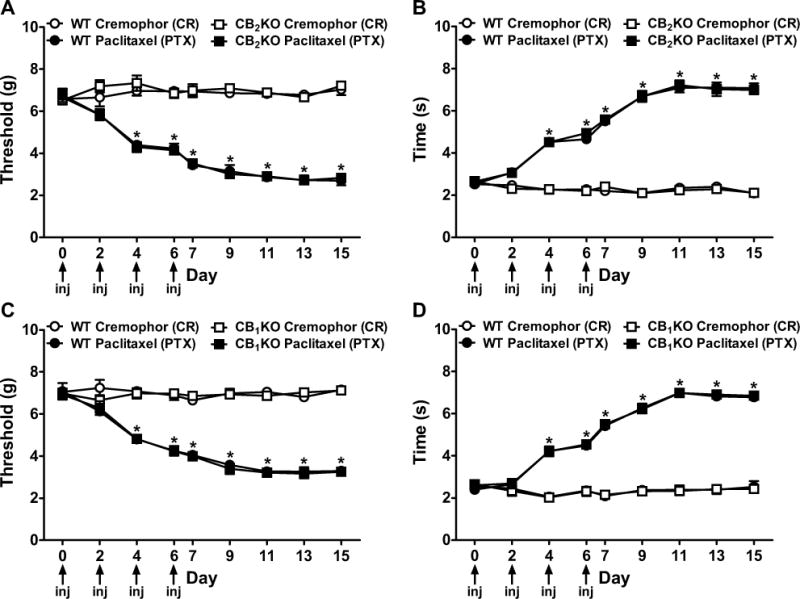
Figure 1
Figure 1. Paclitaxel produced hypersensitivities to mechanical and cold stimulation
(A, C) Mechanical and (B, D) cold allodynia developed equivalently in (A, B) CB2KO, (C, D) CB1KO, and corresponding WT littermates following paclitaxel treatment. Non-chemotherapy controls received cremophor-vehicle in lieu of paclitaxel. Arrows show timing of paclitaxel or cremophor injections (inj). Data are expressed as mean ± SEM (n=6 per group). *P<0.05 vs. control, repeated measures ANOVA and one-way ANOVA at each timepoint.
Figure 2
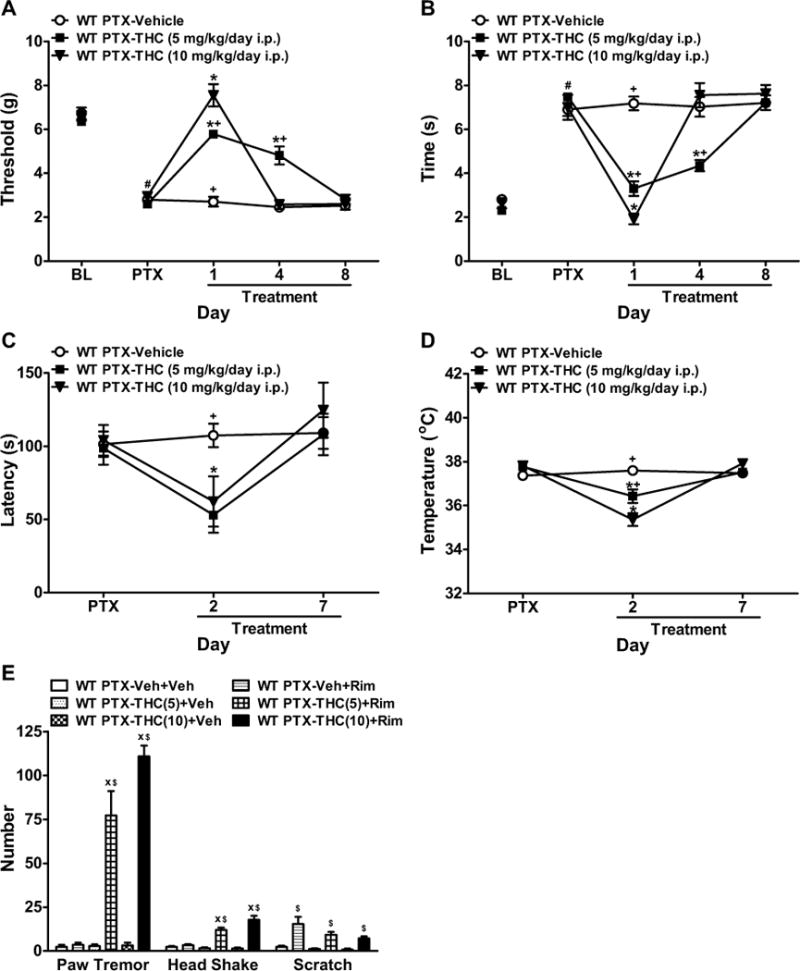
Figure 2. Effects of Δ9-THC in paclitaxel-treated WT mice
(A, B) Δ9-THC (5 or 10 mg/kg/day i.p.) attenuated paclitaxel-induced (A) mechanical and (B) cold allodynia in WT (C57BL/6J) mice in a dose- and time-dependent manner. (C, D) Δ9-THC (5 or 10 mg/kg/day i.p.) decreased (C) motor performance and (D) body temperature in paclitaxel-treated WT mice relative to vehicle on treatment day 2, but not day 7. (E) Δ9-THC (5 or 10 mg/kg/day i.p.) produced withdrawal symptoms when challenged with the CB1 antagonist rimonabant. BL, pre-paclitaxel baseline; PTX, post-paclitaxel baseline. Data are expressed as mean ± SEM (n=5–6 per group). *P<0.05 vs. vehicle, +P<0.05 vs. Δ9-THC (10 mg/kg/day i.p.), xP<0.05 vs. Veh+Rim (chronic vehicle and challenge by rimonabant), $P<0.05 vs. Veh+Veh (chronic vehicle and challenge by vehicle), one-way ANOVA followed by Bonferroni post hoc test or two-tailed t-test. #P<0.05 vs. BL, repeated measures ANOVA.
Figure 3
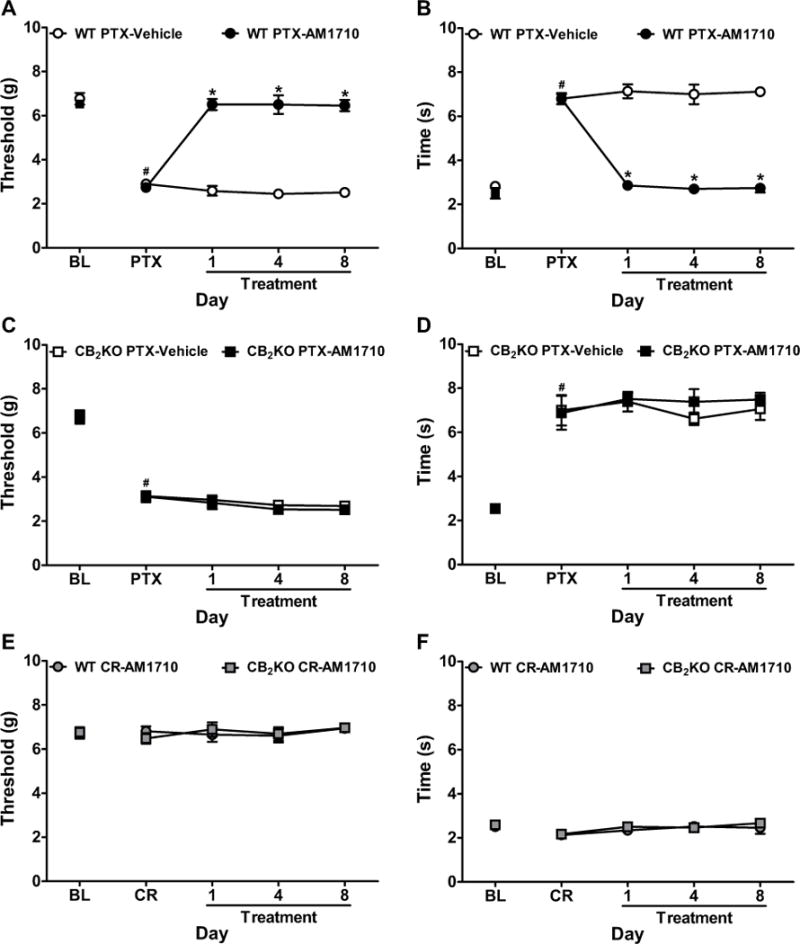
Figure 3. Chronic systemic administration of AM1710 suppressed paclitaxel-induced neuropathy in WT but not CB2KO mice
(A, B) AM1710 (5 mg/kg/day i.p. × 8 days) reversed paclitaxel-induced (A) mechanical and (B) cold allodynia in WT littermates. (C, D) AM1710 (5 mg/kg/day i.p. × 8 days) did not suppress paclitaxel-induced (C) mechanical or (D) cold allodynia in CB2KO mice. (E, F) AM1710 (5 mg/kg/day i.p. × 8 days) did not alter (E) mechanical or (F) cold responsiveness in cremophor-treated CB2KO or WT mice. BL, pre-paclitaxel baseline; PTX, post-paclitaxel baseline; CR, post-cremophor baseline. Data are expressed as mean ± SEM (n=4–8 per group). *P<0.05 vs. vehicle, one-way ANOVA followed by Bonferroni post hoc test. #P<0.05 vs. pre-paclitaxel baseline, repeated measures ANOVA.
Figure 4
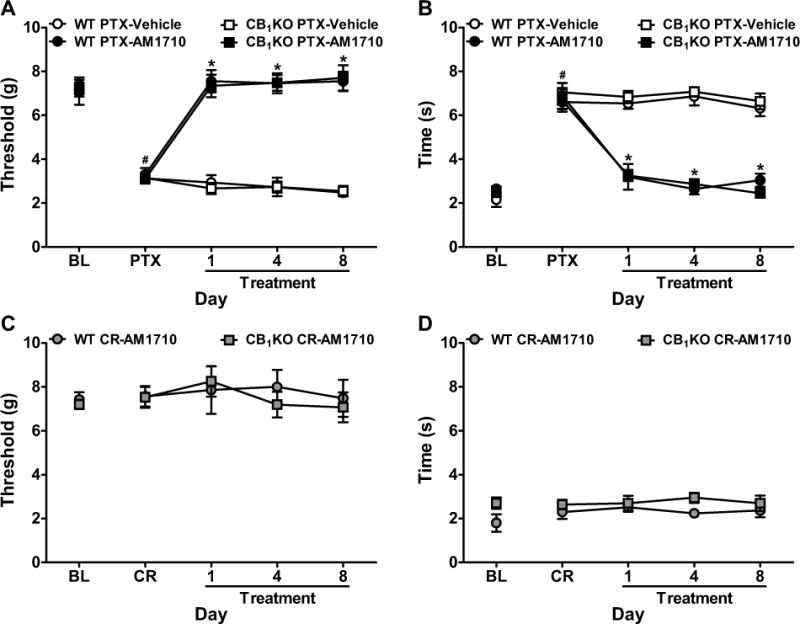
Figure 4. Chronic systemic administration of AM1710 reversed paclitaxel-induced neuropathic pain with similar efficacy in CB1KO and WT mice
(A, B) AM1710 (5 mg/kg/day i.p. × 8 days) reversed paclitaxel-induced (A) mechanical and (B) cold allodynia in both CB1KO and WT littermates. (C, D) AM1710 (5 mg/kg/day i.p. × 8 days) did not alter (C) mechanical or (D) cold responsiveness in cremophor-treated CB1KO or WT mice. BL, pre-paclitaxel baseline; PTX, post-paclitaxel baseline; CR, post-cremophor baseline. Data are expressed as mean ± SEM (n=4–8 per group). *P<0.05 vs. vehicle, one-way ANOVA followed by Bonferroni post hoc test. #P<0.05 vs. pre-paclitaxel baseline, repeated measures ANOVA.
Figure 5
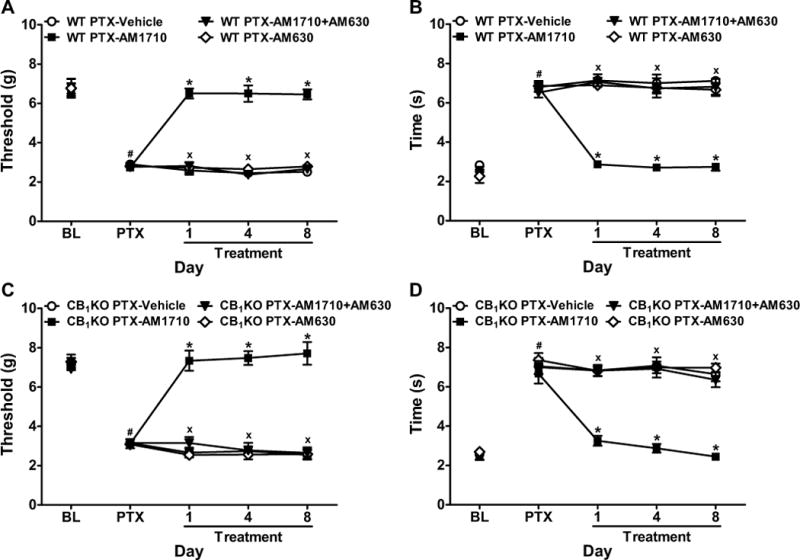
Figure 5. Anti-allodynic effects of chronic systemic AM1710 were mediated by CB2 receptors
AM1710 (5 mg/kg/day i.p. × 8 days)-induced suppressions of paclitaxel-evoked (A, C) mechanical and (B, D) cold allodynia were blocked by the CB2 antagonist AM630 (5 mg/kg/day i.p. × 8 days) in both (A, B) WT (C57BL/6J) and (C, D) CB1KO mice. BL, pre-paclitaxel baseline; PTX, post-paclitaxel baseline. Data are expressed as mean ± SEM (n=4–9 per group). *P<0.05 vs. vehicle, xP <0.05 vs. AM1710 (5 mg/kg i.p.), one-way ANOVA followed by Bonferroni post hoc test. #P<0.05 vs. pre-paclitaxel baseline, repeated measures ANOVA.
Figure 6
Figure 6. Chronic systemic AM1710 treatment did not produce cannabinoid CB1-dependent withdrawal signs
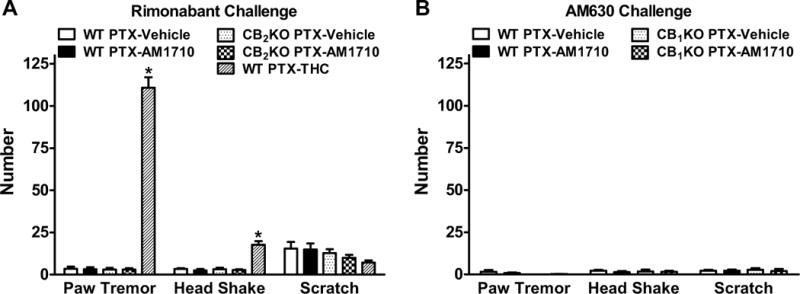
(A) AM1710 (5 mg/kg/day i.p. × 9 days) did not produce CB1-dependent withdrawal signs (i.e. paw tremors, headshakes) when precipitated with the CB1 antagonist rimonabant (10 mg/kg i.p.) in CB2KO or WT littermates. (B) Challenge with the CB2 antagonist AM630 (5 mg/kg i.p.) did not produce paw tremors, headshakes, or scratching behaviors in CB1KO or WT littermates treated chronically with AM1710 (5 mg/kg/day i.p. × 9 days). Data are expressed as mean ± SEM (n=4–5 per group). *P<0.05 vs. vehicle, one-way ANOVA followed by Bonferroni post hoc test.
Figure 7
Figure 7. Antagonism of spinal CB2 receptors blocked anti-allodynic effects of systemic AM1710 in WT mice
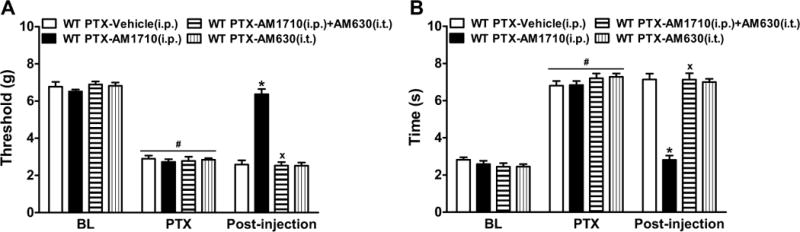
Intrathecal administration of the CB2 antagonist AM630 (5 μg i.t.) blocked AM1710 (5 mg/kg i.p.)-induced suppressions of (A) mechanical and (B) cold allodynia in paclitaxel-treated WT (C57BL/6J) mice. BL, pre-paclitaxel baseline; PTX, post-paclitaxel baseline. Data are expressed as mean ± SEM (n=6 per group). *P<0.05 vs. vehicle, xP<0.05 vs. AM1710 (5 mg/kg i.p.), one-way ANOVA followed by Bonferroni post hoc test. #P<0.05 vs. pre-paclitaxel baseline, repeated measures ANOVA.
Figure 8
Figure 8. Activation of spinal CB2 receptors suppressed paclitaxel-induced allodynia in WT but not CB2KO mice
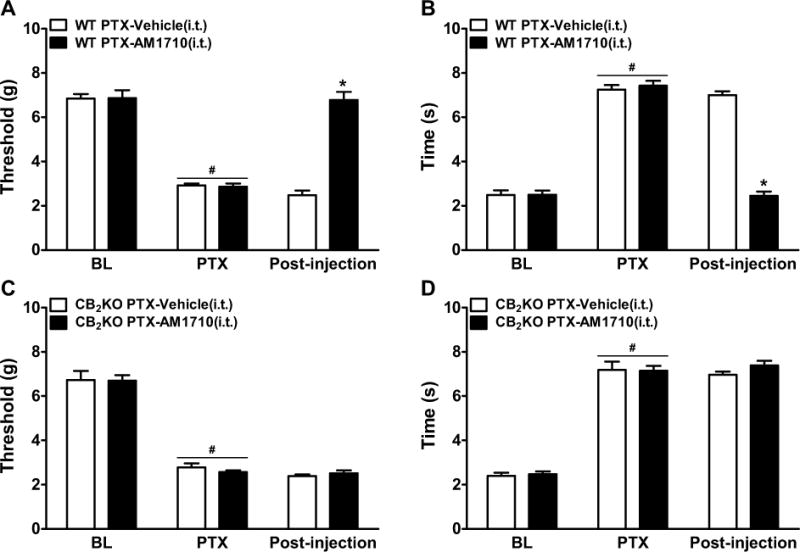
Intrathecal administration of AM1710 (5 μg i.t.) suppressed paclitaxel-induced (A, C) mechanical and (B, D) cold allodynia in (A, B) WT, but not (C, D) CB2KO mice. BL, pre-paclitaxel baseline; PTX, post-paclitaxel baseline. Data are expressed as mean ± SEM (n=6 per group). *P<0.05 vs. vehicle, one-way ANOVA followed by Bonferroni post hoc test. #P<0.05 vs. pre-paclitaxel baseline (BL), repeated measures ANOVA.
Figure 9
Figure 9. Impact of paclitaxel and AM1710 on cytokine and chemokine mRNA levels in lumbar spinal cord
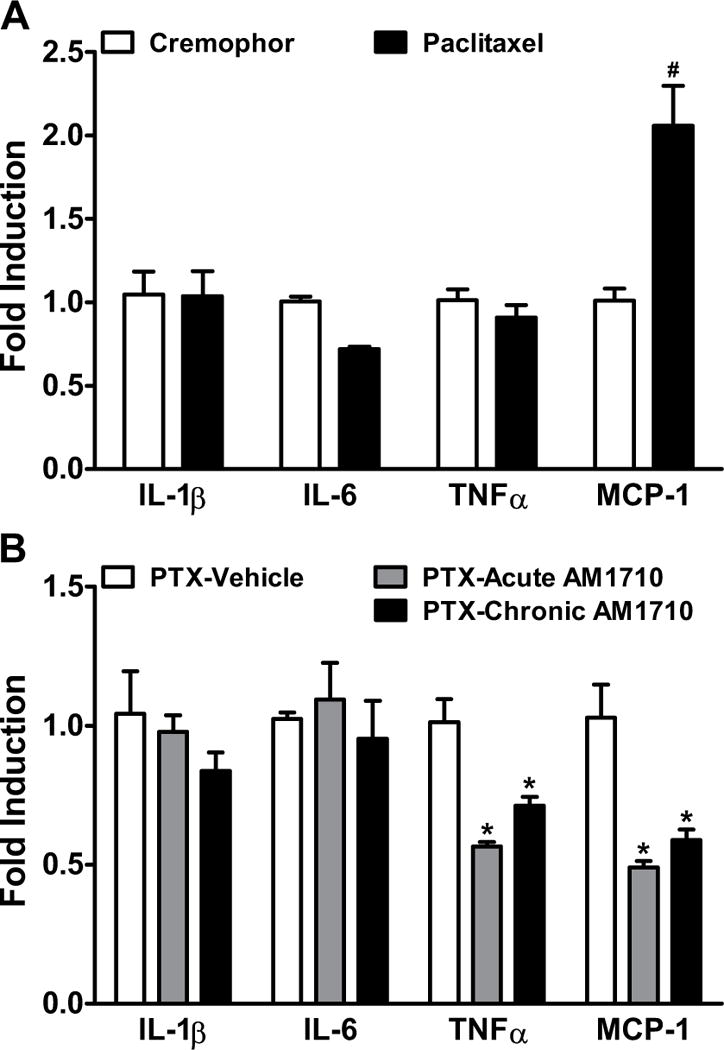
(A) Paclitaxel increased the spinal mRNA levels of MCP-1, but not IL-1β, IL-6, or TNFα relative to cremophor in WT mice (day 15 post initial paclitaxel dosing). (B) Both acute (once daily injections of vehicle × 7 days followed by a terminal injection of AM1710 (5 mg/kg i.p.) on the 8th day, grey bar) and chronic (5 mg/kg/day i.p. × 8 days, black bar) administrations of AM1710 decreased the spinal mRNA levels of TNFα and MCP-1, but not IL-1β or IL-6 relative to vehicle (once daily × 8 days, white bar) in paclitaxel-treated WT animals. IL-1β, interleukin-1 beta; IL-6, interleukin 6; TNFα, tumor necrosis factor alpha; MCP-1, monocyte chemoattractant protein-1. Data are expressed as mean ± SEM (n=4 per group). #P<0.05 vs. cremophor vehicle in lieu of paclitaxel, one-tailed t-test. *P<0.05 vs. vehicle in lieu of AM1710, one-way ANOVA followed by Bonferroni post hoc test.

References

    1. Pacher P, Kunos G. Modulating the endocannabinoid system in human health and disease–successes and failures. The FEBS journal. 2013;280:1918–1943. - PMC - PubMed
    1. Pertwee RG. Targeting the endocannabinoid system with cannabinoid receptor agonists: pharmacological strategies and therapeutic possibilities. Philosophical transactions of the Royal Society of London Series B, Biological sciences. 2012;367:3353–3363. - PMC - PubMed
    1. Tanda G, Goldberg SR. Cannabinoids: reward, dependence, and underlying neurochemical mechanisms–a review of recent preclinical data. Psychopharmacology. 2003;169:115–134. - PubMed
    1. Ledent C, Valverde O, Cossu G, Petitet F, Aubert JF, Beslot F, et al. Unresponsiveness to cannabinoids and reduced addictive effects of opiates in CB1 receptor knockout mice. Science. 1999;283:401–404. - PubMed
    1. Atwood BK, Mackie K. CB2: a cannabinoid receptor with an identity crisis. Br J Pharmacol. 2010;160:467–479. - PMC - PubMed

Publication types

MeSH terms